Is the Yunus Regime Leading Bangladesh Towards Radical Islamist Control?

Synopsis
Bangladesh's interim government under Muhammad Yunus is reportedly steering the nation towards radical Islamist control, highlighted by recent violence following the death of leader Sharif Osman Hadi. This alarming trend raises concerns about regional stability and the government's anti-India rhetoric, suggesting a dangerous shift in the country's political landscape.
Key Takeaways
Muhammad Yunus ' government is perceived to be leaning towards radical Islamism.
Recent violence has raised alarms about national stability.
Sharif Osman Hadi's death has intensified anti-India sentiments.
The regime's foreign policy may align with Pakistan against India.
There is a growing threat of radical elements gaining influence.
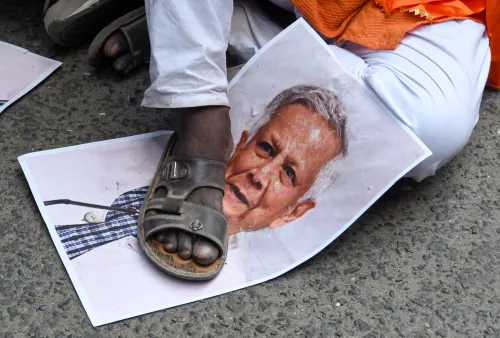
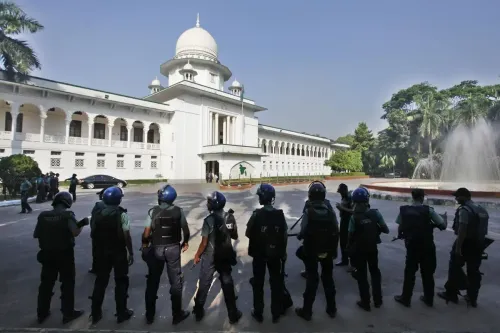
Dhaka/New Delhi, Dec 23 (NationPress) The interim government of Bangladesh, under the leadership of Muhammad Yunus, is allegedly directing the nation into the hands of radical Islamist factions. This alarming trend was underscored by recent acts of arson targeting media outlets and cultural institutions across the country, following the death of the radical Islamist leader Sharif Osman Hadi, as reported on Tuesday.
According to the report, the nefarious intentions of Yunus's administration and its allies pose a significant threat to the stability of the entire South Asian region.
“The violence escalated after the murder of youth leader Sharif Osman Hadi, who was assaulted by masked attackers on December 12. Hadi emerged as a prominent figure during the 2024 unrest against the Sheikh Hasina government, gaining notoriety for his radical and vehement political discourse, particularly his anti-India tirades. This extremist was an advocate for the ‘Greater Bangladesh’ notion, a political fantasy harbored by anti-India radical factions in Bangladesh longing for a ‘Bangladesh empire’ that would include neighboring territories of India,” detailed a report from India Narrative.
“Specifically, Hadi represented radical groups that played a crucial role in the 2024 unrest, contradicting claims that the protests were spontaneously organized by 'students, workers, professionals, and intellectuals.' Consequently, the nation is now dangerously drifting into the clutches of Islamist radicals,” it highlighted.
The report further indicated that anti-India Islamist radicalism has surged since the downfall of the Awami League government, led by former Prime Minister Sheikh Hasina, which has facilitated the emergence of new 'youth icons' like Hadi.
“The death of Hadi has quickly transformed into anti-India rhetoric, with the Indian High Commission being targeted. The consistent anti-India stance of the current interim government under Muhammad Yunus reinforces the notion that the constitution of this regime may have a conspiratorial aspect,” it stated.
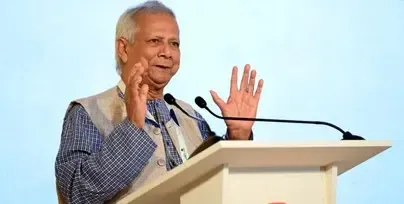
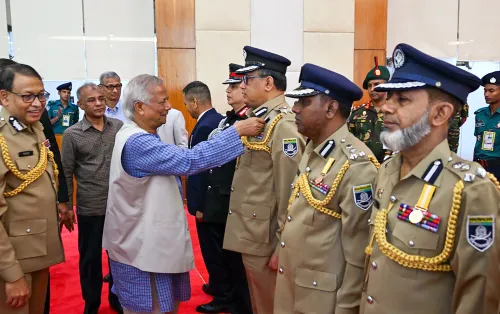
The report emphasized that the interim government in Dhaka aims to project its anti-Hasina legitimacy internationally, forming alliances with anti-India elements both domestically and externally, while its Chief Advisor, Yunus, promotes stronger relations with Pakistan.
“Indeed, while it is the sovereign right of any nation to establish its foreign policy, the Yunus regime appears to be employing pressure tactics against India, considering joining a Pakistan-proposed anti-India coalition in the region. What is more concerning is the interim government’s willingness to collaborate with Islamabad to potentially open another conflict front against India in Bangladesh,” it concluded.
Point of View
It is vital to emphasize the importance of monitoring the evolving political dynamics in Bangladesh. The Yunus regime's apparent alignment with radical Islamist factions poses a serious risk not only to national stability but also to regional peace. Our commitment is to uphold journalistic integrity while providing factual reporting on these crucial matters.
NationPress
26 Sept 2026
Frequently Asked Questions
What led to the rise of radical Islamism in Bangladesh?
The rise of radical Islamism in Bangladesh is attributed to a combination of political instability, the fall of the Awami League government, and the emergence of leaders like Sharif Osman Hadi who resonate with extremist ideologies.
How has the Yunus regime responded to anti-India sentiments?
The Yunus regime has adopted an anti-India stance, which is seen as a way to solidify its legitimacy and rally support from radical elements within the country.
What impact does this situation have on South Asian stability?
The alignment of Bangladesh's interim government with radical Islamist groups poses a significant threat to regional stability, potentially leading to increased tensions and conflicts in South Asia.
Who was Sharif Osman Hadi?
Sharif Osman Hadi was a youth leader known for his radical political rhetoric and opposition to the Sheikh Hasina government. His recent death has sparked violence and unrest in Bangladesh.
What are the implications of the Yunus regime's foreign policy?
The Yunus regime's inclination towards stronger ties with Pakistan and anti-India rhetoric could lead to geopolitical shifts and increased tensions in the region.