408 Eklavya school tribal students clear NEET 2026, 41 crack IIT-JEE Advanced

Synopsis
For the first time in a structured parliamentary disclosure, 408 Eklavya Model Residential School students have been confirmed as NEET qualifiers and 41 as IIT-JEE Advanced qualifiers — a signal that the Centre's coaching interventions for tribal students are producing measurable results, even as the absolute numbers remain a fraction of the 508-school network's full potential.
Key Takeaways
408 students from Eklavya Model Residential Schools (EMRSs) qualified for NEET 2026 for MBBS courses.
41 EMRS students cleared IIT-JEE (Advanced) 2026 for admission to IITs.
508 EMRSs are operational nationwide; pass rates stand at 93.62% (Class X) and 87.82% (Class XII) in 2025-26 .
173 schools achieved 100% pass rate in Class X; 92 schools in Class XII.
The ENABLE Programme , launched in 2025 , provides structured online coaching for IIT-JEE and NEET aspirants.
9,111 staff recruited via ESSE-2023; another 7,267 posts being filled through ESSE-2025.
408 students from Eklavya Model Residential Schools (EMRSs) have qualified for NEET for MBBS courses, while 41 students cleared the Joint Entrance Examination (Advanced) 2026 for admission to the Indian Institutes of Technology (IITs), the Lok Sabha was informed on Thursday, 6 August. The figures, shared by Minister of State for Tribal Affairs Durgadas Uikey in response to a parliamentary question, highlight a measurable uptick in competitive exam outcomes for Scheduled Tribe students from government-run residential schools.
Key Developments in Parliament
MoS Uikey told the House that eight Centres of Excellence are currently operational, providing focused mentoring and high-quality coaching to meritorious EMRS students preparing for IIT-JEE and NEET. He also highlighted the Engineering and NEET Admission Bridge Accelerated Learning Engagement (ENABLE) Programme, launched in 2025, which delivers structured online academic support and coaching to students aspiring to crack both competitive examinations.
Academic Performance Across 508 Schools
A total of 508 EMRSs are currently operational across the country. In the academic year 2025-26, the overall pass rate stood at 93.62% in Class X and 87.82% in Class XII. Notably, 173 schools achieved a 100% pass rate in Class X, and 92 schools recorded a 100% pass rate in Class XII — underscoring the improving academic baseline in tribal residential education.
Staff Recruitment and Infrastructure
On staffing, Uikey said 9,111 teaching and non-teaching staff have already been recruited through the ESSE-2023 examination. An additional recruitment drive through ESSE-2025 has been conducted to fill 7,267 more teaching and non-teaching posts across EMRSs nationwide.
Each new EMRS is built on a minimum of 15 acres with a student capacity of 480 from Classes VI to XII. The campuses are equipped with separate boys' and girls' hostels, integrated dining and kitchen facilities, staff quarters, classrooms with modern teaching aids, science and computer laboratories, libraries, playgrounds, and extracurricular facilities.
Why This Matters for Tribal Education
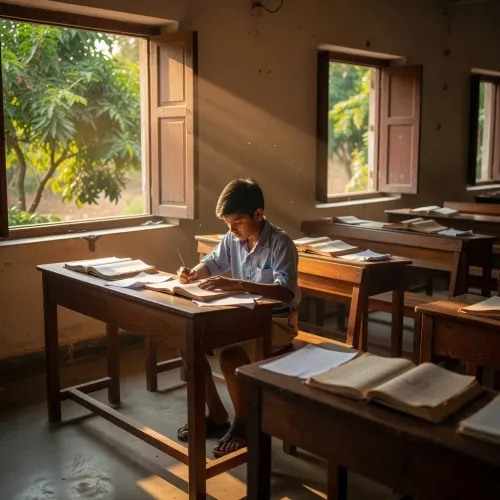
EMRSs were established to provide quality education to children from Scheduled Tribe communities in remote and forested areas, bridging the gap between tribal students and mainstream competitive opportunities. The NEET and IIT-JEE results, while still modest in absolute numbers relative to the total student population, signal that targeted coaching interventions are beginning to yield outcomes. This comes amid broader national efforts to expand access to professional education for historically underserved communities.
With the ENABLE Programme still in its early phase and new staff recruitment underway, the trajectory of EMRS competitive exam results will be closely watched in the coming academic cycles.
Point of View
But context is essential: 408 NEET qualifiers across 508 schools means fewer than one qualifier per school on average. The ENABLE Programme is barely a year old, and its online-first model raises questions about reach in areas with poor connectivity — precisely the regions EMRSs serve. The real measure of success will come when qualifier numbers scale proportionally with the student population, and when the government publishes disaggregated data on how many of these qualifiers ultimately secure seats. Until then, the figures mark a beginning, not a milestone.
NationPress
21 Sept 2026
Frequently Asked Questions
How many Eklavya Model Residential School students cleared NEET 2026?
A total of 408 students from Eklavya Model Residential Schools (EMRSs) qualified for NEET 2026 for MBBS courses, as disclosed by Minister of State for Tribal Affairs Durgadas Uikey in the Lok Sabha on 6 August.
How many EMRS students qualified for IIT-JEE Advanced 2026?
41 students from Eklavya Model Residential Schools qualified for the Joint Entrance Examination (Advanced) 2026, making them eligible for admission to the Indian Institutes of Technology.
What is the ENABLE Programme for tribal students?
The Engineering and NEET Admission Bridge Accelerated Learning Engagement (ENABLE) Programme, launched in 2025, provides structured online academic support and coaching to EMRS students preparing for IIT-JEE and NEET. It complements eight physical Centres of Excellence already operational for the same purpose.
How many Eklavya Model Residential Schools are operational in India?
508 EMRSs are currently operational across India. In 2025-26, they recorded pass rates of 93.62% in Class X and 87.82% in Class XII, with 173 and 92 schools respectively achieving 100% pass rates in those classes.
Who are Eklavya Model Residential Schools meant for?
EMRSs are government-run residential schools established to provide quality education to children from Scheduled Tribe (ST) communities, particularly in remote and forested regions. Each school is built on at least 15 acres and accommodates up to 480 students from Classes VI to XII.