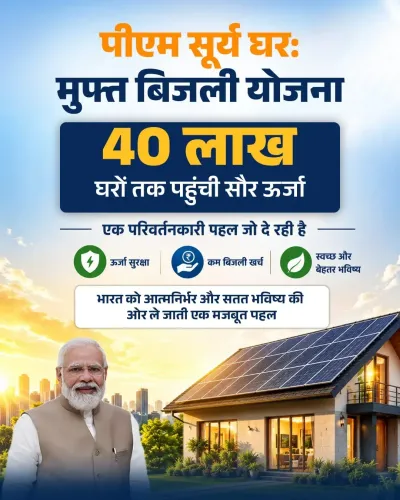
Giriraj Singh Flags 51 Lakh Homes Powered Under PM Surya Ghar
Synopsis
Government data shared by Union Textiles Minister Giriraj Singh shows PM Surya Ghar Muft Bijli Yojana has reached over 51 lakh households, while 28.4 lakh agricultural pumps have been solarised under PM-KUSUM, marking significant progress toward India's decentralised solar targets.
Key Takeaways
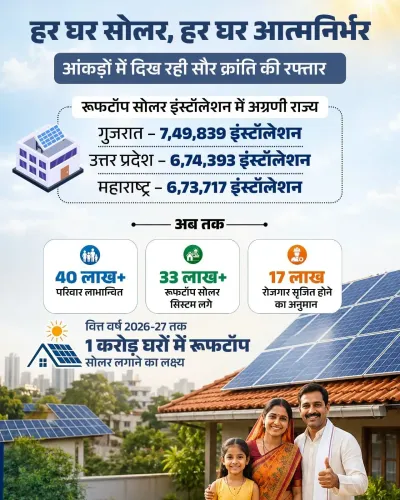
51 lakh+ households have benefited under the PM Surya Ghar Muft Bijli Yojana , roughly half the scheme's one-crore target.
The scheme offers up to 300 units of free electricity per month through subsidised rooftop solar installations.
28.4 lakh agricultural pumps have been solarised, primarily under the PM-KUSUM scheme launched in 2019 .
Union Textiles Minister Giriraj Singh shared the government data on 13 August 2026 via the NaMo App.
The two schemes represent a dual-track solar strategy — urban rooftops and rural farm loads — feeding India's broader renewable energy goals.
India's rooftop solar push is quietly rewriting the electricity story for millions of households — and the numbers are starting to show it. Union Textiles Minister Giriraj Singh on Thursday, 13 August 2026 shared government data showing that the PM Surya Ghar Muft Bijli Yojana has benefited more than 51 lakh households, while 28.4 lakh agricultural pumps have been solarised under related government programmes.
What PM Surya Ghar promises — and delivers
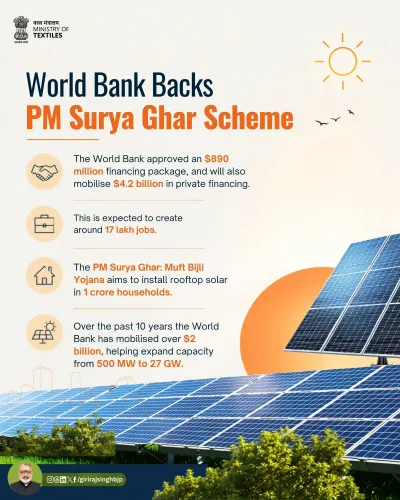
Announced in the 2024 Union Budget, the PM Surya Ghar Muft Bijli Yojana was designed with a single, headline-grabbing promise: up to 300 units of free electricity every month for households that install subsidised rooftop solar panels. The target was ambitious — one crore households across India. Crossing the 51 lakh mark means the scheme has covered roughly half that goal, a significant milestone in a programme that is still in active rollout.
The scheme sits within a larger architecture of India's decentralised solar strategy, layered atop earlier missions stretching back to the Jawaharlal Nehru National Solar Mission. The logic is consistent: push generation to the edge of the grid, reduce transmission losses, and put bill savings directly in the hands of consumers.
28.4 lakh farm pumps and the PM-KUSUM thread
The agricultural pump figure traces back to a separate but complementary programme. PM-KUSUM — launched in 2019 — was built specifically to wean farmers off diesel and grid power for irrigation, replacing pumps with solar-powered alternatives. Solarising 28.4 lakh pumps means that many farmers are now generating their own energy for irrigation, cutting input costs and reducing dependence on erratic rural electricity supply.
Together, the two data points sketch a two-track approach: urban and peri-urban rooftops under PM Surya Ghar, and rural agricultural loads under PM-KUSUM. Both feed India's broader renewable energy targets.
Singh's amplification and what the data signals
Giriraj Singh, who represents Begusarai, Bihar in the Lok Sabha, shared the update via the NaMo App — a platform used by BJP leaders to push government achievement messaging to party networks. The post is part of a pattern of routine progress communication from ministers on clean energy milestones, ahead of periodic Ministry of New and Renewable Energy target reviews.
The figures, if sustained, point to one of the faster-moving welfare-linked energy rollouts in recent years. The next question the data must answer: how quickly can the scheme close the gap to its one-crore target, and whether supplementary budget allocations in upcoming fiscal statements will accelerate the final stretch.
Half the country's rooftop solar target crossed. The clock is running on the other half.
Point of View
The gap to the one-crore target also signals that the harder, last-mile rollout — reaching rural and lower-income households — still lies ahead. Progress on PM-KUSUM's pump solarisation, running in parallel, suggests the government is advancing on both the household and agricultural fronts simultaneously, a pattern consistent with its broader rural welfare messaging.
NationPress
27 Sept 2026
Frequently Asked Questions
What is PM Surya Ghar Muft Bijli Yojana?
PM Surya Ghar Muft Bijli Yojana is a central government scheme that provides up to 300 units of free electricity per month to households through subsidised rooftop solar panel installations. It was announced in the 2024 Union Budget with a target of covering one crore households.
How many households have benefited from PM Surya Ghar so far?
According to government data shared in August 2026, more than 51 lakh households have benefited under the PM Surya Ghar Muft Bijli Yojana, representing roughly half the scheme's one-crore household target.
What is PM-KUSUM and how many pumps have been solarised?
PM-KUSUM is a scheme launched in 2019 to replace diesel and grid-powered agricultural pumps with solar-powered alternatives for farmers. Government data indicates that 28.4 lakh farm pumps have been solarised under the programme.
Why did Giriraj Singh share this solar scheme data?
Giriraj Singh, Union Textiles Minister and BJP MP from Begusarai, shared the government data via the NaMo App as part of routine government communication highlighting clean energy and welfare scheme achievements.
What is the overall target of PM Surya Ghar Muft Bijli Yojana?
The scheme targets installation of rooftop solar panels in one crore (10 million) households across India, providing free electricity and reducing household energy bills through solar generation.