AASU questions ₹2.08 crore VIP facility spend at Gauhati University

Synopsis
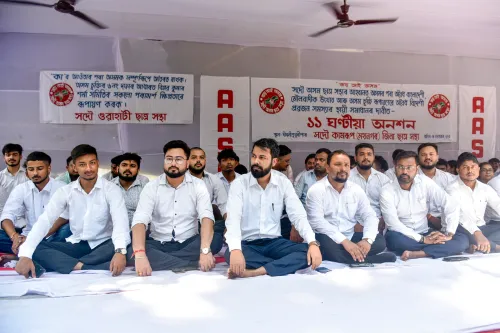
Assam's most prominent student body has gone public with a tender document showing Gauhati University has awarded a ₹2.08 crore contract for a VIP dining room and kitchen — even as the institution reportedly struggles with financial constraints. AASU has now escalated the matter to the state Education Department, turning a procurement decision into a governance flashpoint.
Key Takeaways
AASU on 8 July publicly questioned Gauhati University's decision to spend ₹2.08 crore on a VIP dining room, kitchen, and staff quarters.
AASU president Utpal Sarma made the tender document public; the contract has already been awarded.
Sarma said he would support even a ₹10 crore spend if the university had adequate funds and academic needs were met first.
The matter has been formally referred to the Assam government's Education Department for review.
AASU's objection centres on spending priorities, not infrastructure development per se.
The All Assam Students' Union (AASU) on Wednesday, 8 July publicly challenged Gauhati University's decision to allocate ₹2.08 crore for the construction of a VIP dining room, kitchen, and staff quarters, arguing the expenditure is difficult to justify at a time when the premier state institution is reportedly facing significant financial constraints.
What the Project Involves
According to the tender document made public by AASU president Utpal Sarma, the project covers a Guest House VIP Dining Room, Kitchen, and Staff Quarters at an estimated cost of ₹2.08 crore. Sarma confirmed that the contract has already been awarded, indicating the project is past the planning stage.
What AASU Said
Addressing reporters in Guwahati, Sarma was careful to distinguish between opposition to infrastructure development in general and concern over spending priorities. 'I also want Gauhati University to have modern infrastructure. There would be no objection even if ₹10 crore were spent to build world-class facilities, provided there is no shortage of funds for teaching, research and other academic activities,' he said.
He described it as 'unfortunate' that the university was channelling funds toward VIP hospitality infrastructure rather than addressing what he called pressing academic requirements — including strengthening teaching facilities and ensuring adequate support for students and faculty.
Complaint to Education Department
The AASU has formally brought the matter to the notice of the Assam government's Education Department, urging it to examine the rationale behind the expenditure and assess whether it constitutes an appropriate use of public funds given the university's current financial condition. This escalation signals that the student body intends to pursue the issue beyond a press statement.
Broader Context
Gauhati University, established in 1948, is Assam's oldest and most prominent public university. Concerns over resource allocation at state-funded universities have surfaced repeatedly across India, with student unions and faculty bodies arguing that administrative and hospitality spending often crowds out academic investment. This is not the first time AASU has raised governance concerns at the institution, reflecting a pattern of student-body scrutiny over university management decisions in the state.
Whether the Assam Education Department intervenes or the university defends the project on merit will determine the next phase of this dispute.
Point of View
But the optics at a cash-strapped public university are damaging — and AASU knows it. By releasing the tender document rather than simply issuing a statement, the student union has made this a transparency issue, not just a policy disagreement. The real question the Education Department must answer is whether Gauhati University has a credible financial plan that ring-fences academic spending before approving hospitality infrastructure. If it does not, this project will become a template for accountability demands at other state universities in Assam.
NationPress
7 Oct 2026
Frequently Asked Questions
What is the ₹2.08 crore project at Gauhati University?
It is a construction project for a Guest House VIP Dining Room, Kitchen, and Staff Quarters at Gauhati University, with an estimated cost of ₹2.08 crore. The contract has already been awarded, according to the tender document released by AASU.
Why is AASU objecting to the project?
AASU argues that spending on VIP hospitality infrastructure is difficult to justify when the university is reportedly facing financial constraints. The student union contends that academic priorities — teaching, research, and student support — should take precedence over non-essential facilities.
Who is Utpal Sarma and what did he say?
Utpal Sarma is the president of the All Assam Students' Union (AASU). He said he would have no objection to even a ₹10 crore spend if the university had adequate funds and academic needs were not compromised, but called the current allocation 'unfortunate' given the institution's financial situation.
What action has AASU taken beyond the press statement?
AASU has formally brought the matter to the attention of the Assam government's Education Department, urging it to examine whether the expenditure is an appropriate use of public funds given the university's current financial condition.
Is AASU opposed to infrastructure development at Gauhati University?
No. AASU has explicitly stated it supports infrastructure development at the university. Its objection is specifically to the prioritisation of VIP hospitality spending over academic and educational infrastructure when resources are limited.