Adani-Jabil 50:50 JV to manufacture AI, data centre gear in India
Synopsis
Adani Enterprises and Jabil have signed an MoU for a 50:50 joint venture to manufacture AI racks, servers and data centre equipment in India — a $3 trillion global market bet. For Adani, it is a deliberate move up the AI value chain: from powering hyperscale infrastructure to building the hardware inside it, anchored by a $100 billion green data centre commitment through 2035.
Key Takeaways
Adani Enterprises Limited and Jabil Inc. signed a non-binding MoU on 13 October 2026 for a proposed 50:50 joint venture .
The JV would manufacture and assemble AI racks, servers, storage and networking equipment for data centres in India.
The venture targets both domestic demand and export markets , serving global hyperscalers.
The companies estimate the global AI infrastructure market opportunity at more than $3 trillion over seven years .
The deal aligns with Adani Group's $100 billion commitment to build 5 GW of green-energy-powered AI-ready data centres by 2035 .
The proposed JV is subject to definitive agreements and regulatory approvals — it carries no legal force yet.
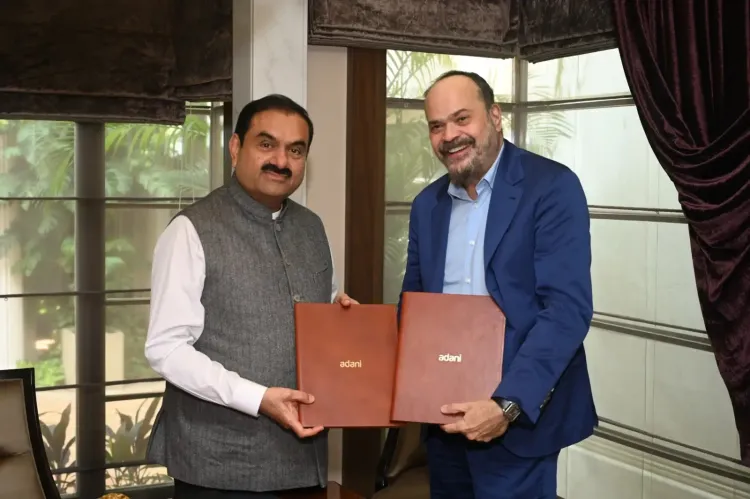
Adani Enterprises Limited (AEL) and global engineering and manufacturing company Jabil Inc. on Tuesday, 13 October 2026, announced the signing of a non-binding Memorandum of Understanding (MoU) for a proposed 50:50 joint venture to manufacture and assemble artificial intelligence (AI) and data centre equipment in India. The move marks a significant escalation in the Adani Group's ambitions across the AI infrastructure value chain, extending its presence from energy and hosting into hardware manufacturing.
Background and Strategic Context
The MoU builds on a June 2026 announcement in which Adani Group and Jabil had publicly signalled their intent to form a strategic alliance for an AI and data centre infrastructure manufacturing ecosystem in India. Tuesday's agreement formalises the next step in that roadmap. The proposed venture is structured as a parity partnership, with each company holding an equal stake.
Adani Group Chairman Gautam Adani described the rationale in broad terms. 'The AI revolution will demand far more than just breakthroughs in algorithms. It will require an entire new industrial architecture where energy, hyperscale infrastructure, advanced computing and precision manufacturing converge to power the intelligence economy,' he said.
What the Joint Venture Will Do
According to the companies, the proposed venture would manufacture and assemble AI racks, servers, storage and networking equipment used in data centres. The racks are intended to house high-performance computing systems for AI applications and other digital services. The venture would serve both domestic demand and export markets, positioning India as a manufacturing base for global hyperscalers.
Adani framed the deal as a progression up the value chain. 'Our vision is to expand up the AI value chain — evolving from powering and hosting AI infrastructure to engineering and manufacturing the critical systems that will define the next generation of computing,' he said. The proposed JV, he added, combines 'Jabil's world-class engineering and manufacturing capabilities with Adani's integrated strengths in energy, infrastructure and data centres to help build the physical backbone of the global AI economy.'
Jabil's Perspective and Market Estimate
Jabil Inc. Chief Executive Officer Mike Dastoor said the MoU represented a progression of the two companies' shared efforts. 'The signing of this MoU is the next step forward in our shared efforts to establish a scaled AI infrastructure manufacturing platform in India — a market we believe will become increasingly important for both domestic and global AI infrastructure demand,' Dastoor said.
Dastoor further noted that integrating Jabil's '60 years of engineering and manufacturing expertise' with Adani's infrastructure and energy capabilities would allow the venture to 'bring our rack-level data centre solutions to more hyperscalers in India and around the world.' The two companies estimate the global market opportunity at more than $3 trillion over the next seven years, driven by accelerating investment in AI computing infrastructure.
Adani's Broader AI Commitment
The proposed joint venture aligns with Adani Group's stated commitment to invest $100 billion to develop 5 GW of green-energy-powered, hyperscale AI-ready data centres by 2035. Hardware manufacturing, which the JV would add, would complement the Group's existing footprint across infrastructure, energy, logistics and data centre operations. Notably, this positions the conglomerate to capture more of the AI capital expenditure cycle rather than purely the hosting and energy components.
Conditions and Next Steps
The MoU is non-binding, and the proposed venture remains subject to the execution of definitive agreements, receipt of applicable regulatory approvals, and satisfaction of customary closing conditions. Until those steps are completed, the joint venture has no legal standing. Industry observers will watch whether the two companies can convert the intent into a functioning manufacturing operation amid India's evolving semiconductor and electronics policy landscape.
Point of View
Which plugs a credibility gap that most Indian conglomerates entering AI have struggled to address alone. The $3 trillion market estimate, however, is a macro projection, not a committed order book. The real measure will be how quickly the two sides convert the MoU into definitive agreements, secure approvals, and begin rack assembly — steps that historically take far longer in India's regulatory environment than announcement timelines suggest.
NationPress
13 Oct 2026
Frequently Asked Questions
What is the Adani-Jabil joint venture announced in October 2026?
It is a proposed 50:50 joint venture between Adani Enterprises Limited and Jabil Inc. to manufacture and assemble AI racks, servers, storage and networking equipment for data centres in India. The venture was announced via a non-binding MoU signed on 13 October 2026 and is still subject to definitive agreements and regulatory approvals.
What will the Adani-Jabil JV manufacture?
The joint venture plans to manufacture and assemble AI racks, servers, storage and networking equipment used in data centres. The racks are designed to house high-performance computing systems for AI applications and other digital services, catering to hyperscalers in India and globally.
How large is the market opportunity Adani and Jabil are targeting?
The two companies estimate the global market opportunity at more than $3 trillion over the next seven years, driven by accelerating investment in AI computing infrastructure. India is seen as increasingly important for both domestic and global AI infrastructure demand.
How does this JV fit into Adani Group's broader AI strategy?
The joint venture adds hardware manufacturing to Adani Group's existing presence in energy, infrastructure, logistics and data centres. It aligns with the Group's $100 billion commitment to develop 5 GW of green-energy-powered, hyperscale AI-ready data centres by 2035, essentially extending the Group's role from hosting AI to building its physical components.
Is the Adani-Jabil joint venture finalised?
No. The MoU signed on 13 October 2026 is non-binding. The proposed venture is subject to execution of definitive agreements, receipt of applicable regulatory approvals, and satisfaction of customary closing conditions before it takes legal effect.