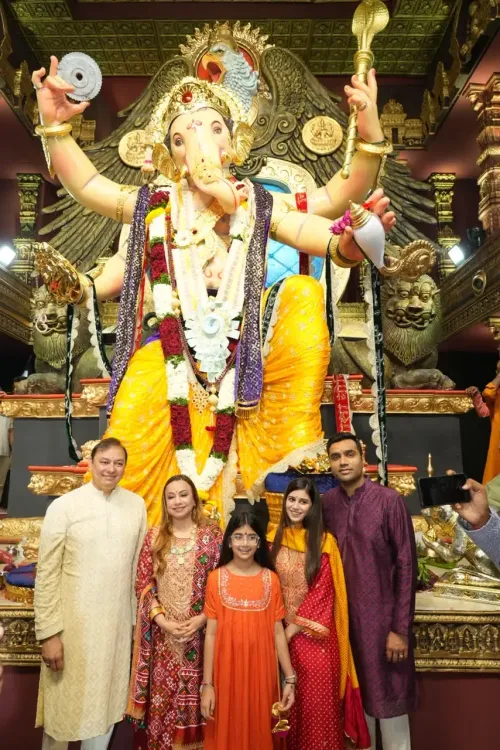
Pranav, Karan Adani offer prayers at Chinchpokli Cha Chintamani on Ganesh Chaturthi 2026
Synopsis
The Adani family's visit to Mumbai's 107-year-old Chinchpokli Cha Chintamani on Ganesh Chaturthi highlights growing corporate engagement with the city's iconic public festivals. This year's pandal, replicating South Indian temple architecture and themed around Lord Venkateshwara Balaji of Tirumala Tirupati, marks a striking aesthetic shift for a mandal with roots in Mumbai's working-class textile heartland.
Key Takeaways
Pranav Adani and Karan Adani offered prayers at Chinchpokli Cha Chintamani in Mumbai on Ganesh Chaturthi 2026 .
Chinchpokli Cha Chintamani is Mumbai's second-oldest public Ganapati, now in its 107th year .
This year's theme is inspired by Lord Venkateshwara Balaji of Tirumala Tirupati , with the pandal replicating the Sri Venkateswara Temple (Swarnagiri) in Hyderabad.
The mandal's roots go back to freedom fighter Lokmanya Bal Gangadhar Tilak , who popularised Ganesh Chaturthi as a public festival in the 1890s .
Celebrations have been held beside Chinchpokli railway station since 1939 , backed by nearly 5,000 contributors .
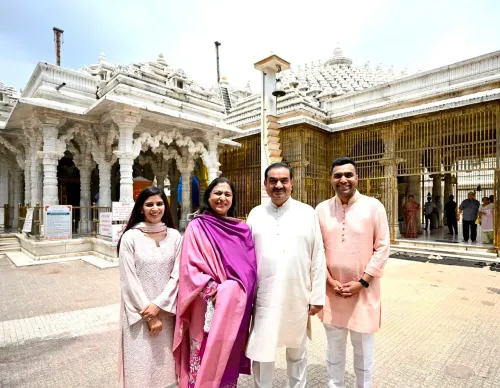
Pranav Adani, Managing Director (Agro, Oil & Gas) and Director of Adani Enterprises, and Karan Adani, Managing Director of Adani Ports and Special Economic Zone Ltd. (APSEZ), visited the historic Chinchpokli Cha Chintamani in Mumbai on the occasion of Ganesh Chaturthi, offering prayers alongside their family at one of the city's most revered public Ganapati mandals.
A 107-Year Legacy in Mumbai's Cultural Heart
Chinchpokli Cha Chintamani is Mumbai's second-oldest public Ganapati, now in its 107th year. The mandal traces its origins to the city's former textile heartland — the neighbourhoods of Parel, Girgaon, and Lalbaug — and carries forward the legacy of freedom fighter Lokmanya Bal Gangadhar Tilak, who transformed Ganesh Chaturthi from a household ritual into a mass public festival during the 1890s. Mill workers formed a vital part of the early celebrations, giving the festival its deep working-class roots in this part of the city.
Despite the upheaval of the landmark 1982 mill strike and the sweeping urban transformations that followed, Chinchpokli Cha Chintamani has endured as a cultural anchor for its community. Since 1939, the celebrations have been held beside the eastern side of Chinchpokli railway station, a tradition the Chinchpokli Sarvajanik Utsav Mandal has upheld without interruption.
This Year's Theme: South Indian Temple Grandeur
This year's celebrations offer an immersive experience inspired by the architectural magnificence of South Indian temple traditions. The idol is themed around Lord Venkateshwara Balaji of Tirumala Tirupati, featuring sacred motifs including the Garuda, Keertimukh, Shankha, Chakra, and a camphor Tilak.
The grand pandal replicates the splendour of the Sri Venkateswara Temple (Swarnagiri) in Hyderabad and Bhuvanagiri, complete with soaring gopurams, sacred deepastambhas, and sculpted yali/vyala guardian figures — a striking visual departure from the mandal's traditional aesthetic.
What the Adani Family Said
'We are truly honoured to have partnered with the Chinchpokli Sarvajanik Utsav Mandal. In its 107th year, the Chinchpokli Cha Chintamani's rich legacy has been synonymous with devotion, unity, and the cultural heartbeat of Mumbai,' said Pranav Adani on the occasion.
Community Impact Beyond the Festival
With nearly 5,000 contributors, the Chinchpokli Sarvajanik Utsav Mandal has extended its reach well beyond the annual Ganeshotsava. The organisation runs blood donation camps, healthcare initiatives, and programmes for children throughout the year, serving as a sustained community institution rather than a seasonal celebration. The Adani group's partnership with the mandal this year reflects the growing corporate engagement with Mumbai's iconic cultural festivals.
Point of View
Blurring the line between community festival and brand association. Chinchpokli Cha Chintamani's 107-year continuity, rooted in Tilak's vision of mass mobilisation, gives it a weight that goes beyond ritual. The mandal's South Indian temple theme this year is also notable — a pan-Indian cultural bridge at a time when regional identity is politically charged. Whether corporate partnerships strengthen or subtly reshape such community institutions is a question worth watching.
NationPress
14 Sept 2026
Frequently Asked Questions
What is Chinchpokli Cha Chintamani?
Chinchpokli Cha Chintamani is Mumbai's second-oldest public Ganapati, now in its 107th year. It is organised by the Chinchpokli Sarvajanik Utsav Mandal near Chinchpokli railway station and traces its origins to the city's textile-worker communities in Parel, Girgaon, and Lalbaug.
Why did the Adani family visit Chinchpokli Cha Chintamani?
Pranav Adani and Karan Adani, along with their family, visited to offer prayers on Ganesh Chaturthi and as part of the Adani group's partnership with the Chinchpokli Sarvajanik Utsav Mandal. Pranav Adani described the association as an honour, citing the mandal's 107-year legacy of devotion and cultural significance.
What is the theme of Chinchpokli Cha Chintamani in 2026?
This year's celebrations are inspired by South Indian temple architecture. The idol is themed around Lord Venkateshwara Balaji of Tirumala Tirupati, and the pandal replicates the Sri Venkateswara Temple (Swarnagiri) in Hyderabad, featuring gopurams, deepastambhas, and sculpted yali/vyala guardian figures.
What is the historical significance of Chinchpokli Cha Chintamani?
The mandal carries forward the legacy of freedom fighter Lokmanya Bal Gangadhar Tilak, who transformed Ganesh Chaturthi into a public festival in the 1890s as a means of community mobilisation. Despite the disruptions of the 1982 mill strike, the mandal has continued uninterrupted since 1939.
What community work does the Chinchpokli Sarvajanik Utsav Mandal do beyond Ganesh Chaturthi?
The mandal, backed by nearly 5,000 contributors, runs year-round community programmes including blood donation camps, healthcare initiatives, and educational activities for children. It has functioned as a sustained social institution well beyond the annual festival.