Ahmedabad mandates four-way waste segregation under new SWM Rules 2026
Synopsis
Ahmedabad has moved beyond advisory — four-way waste segregation is now a legal obligation backed by Supreme Court authority. With bulk generators facing contempt-of-court risk for non-compliance, the AMC's latest directive is one of the sharpest municipal waste enforcement moves in Gujarat's recent history.
Key Takeaways
Ahmedabad Municipal Corporation (AMC) has made four-way waste segregation mandatory for all households and commercial establishments.
The four categories are wet waste, dry waste, sanitary waste, and special care waste .
The directive is aligned with Solid Waste Management Rules-2026 and a Supreme Court order dated 19 February .
Establishments with a built-up area of 20,000 sq m or more , water consumption of 40,000 litres/day or more , or waste generation of 100 kg/day or more are classified as Bulk Waste Generators (BWGs) .
BWGs must process biodegradable waste on-site ; non-compliance may be treated as contempt of court .
Dumping, burning, or burying waste is now a legal offence across all zones and wards.
The Ahmedabad Municipal Corporation (AMC) on Tuesday announced stricter enforcement of waste management regulations across the city, making four-way waste segregation mandatory for all residential and commercial establishments and introducing compulsory on-site waste processing requirements for large generators. The directive aligns with the Solid Waste Management Rules-2026 issued by the Ministry of Environment, Forest and Climate Change and a Supreme Court direction in a civil appeal dated 19 February.
The Four-Category Segregation Framework
Under the revised system, all households and commercial units in Ahmedabad must segregate waste into four distinct categories before disposal. Wet waste covers kitchen and food-related refuse such as vegetable and fruit scraps. Dry waste encompasses recyclable materials including paper, plastic, glass, and metal. Sanitary waste — used diapers and sanitary pads — must be securely wrapped before being handed over for collection. Special care waste refers to hazardous domestic waste, which must be stored separately for designated collection.
The AMC has stated that dumping waste on roads, in open areas, drains, or water bodies, as well as burning or burying waste, will be treated as a legal offence. Non-compliance with segregation norms will be considered a violation of the Supreme Court's directions, with enforcement action possible under the Solid Waste Management Rules-2026 and applicable environmental laws.
Norms for Bulk Waste Generators
In a parallel directive, AMC has tightened norms for Bulk Waste Generators (BWGs) — a category that includes large residential societies, hotels, restaurants, educational institutions, religious establishments, government and semi-government offices, universities, and shopping complexes. An establishment qualifies as a BWG if it has a built-up area of 20,000 square metres or more, consumes 40,000 litres or more of water per day, or generates 100 kilograms or more of solid waste daily.
Such units are now required to process biodegradable waste on-site within their premises and ensure that dry waste is handed over exclusively to authorised recyclers. The civic body warned that non-compliance with on-site processing requirements will be treated as contempt of court in view of the Supreme Court's directions, and may attract punitive action under environmental laws.
Why AMC Is Acting Now
The measures apply uniformly across all zones and wards of Ahmedabad. The corporation said the primary objective is to reduce dependence on landfill sites and promote scientific waste management practices. This comes amid mounting pressure on Indian cities to comply with updated federal environmental standards, with the Supreme Court's February directive adding a judicial imperative to what had previously been an administrative challenge.
Notably, Ahmedabad is among the first major Gujarat cities to operationalise the SWM Rules-2026 framework at the ward level, setting a potential benchmark for other urban local bodies in the state.
Awareness and Enforcement Drives Ahead
AMC has appealed to citizens and institutions to adhere to the new framework, stating:
Point of View
Raising the stakes considerably. The real test will be whether AMC has the ward-level capacity to monitor bulk generators consistently, or whether this follows the familiar pattern of strong announcements and weak follow-through. With landfill pressure mounting in Ahmedabad and other Tier-1 cities, the SWM Rules-2026 rollout deserves scrutiny not just for intent, but for measurable diversion outcomes.
NationPress
27 Oct 2026
Frequently Asked Questions
What is the four-way waste segregation system mandated by AMC?
The Ahmedabad Municipal Corporation now requires all households and commercial units to separate waste into four categories: wet waste (food and kitchen scraps), dry waste (recyclables like paper, plastic, glass, and metal), sanitary waste (diapers and sanitary pads, securely wrapped), and special care waste (hazardous domestic items). The system is mandatory under the Solid Waste Management Rules-2026 and a Supreme Court directive.
Who qualifies as a Bulk Waste Generator under AMC's new rules?
An establishment is classified as a Bulk Waste Generator (BWG) if it has a built-up area of 20,000 square metres or more, consumes 40,000 litres or more of water per day, or generates 100 kilograms or more of solid waste daily. This includes large housing societies, hotels, restaurants, schools, universities, shopping complexes, and government offices.
What happens if residents or businesses do not comply?
Non-compliance with segregation norms will be treated as a violation of the Supreme Court's directions. For bulk generators, failure to process biodegradable waste on-site may be treated as contempt of court. Dumping, burning, or burying waste is classified as a legal offence under the Solid Waste Management Rules-2026 and applicable environmental laws.
Why has AMC introduced these rules now?
The measures are aligned with the Solid Waste Management Rules-2026 issued by the Ministry of Environment, Forest and Climate Change and a Supreme Court civil appeal order dated 19 February. The civic body says the goal is to reduce dependence on landfill sites and promote scientific waste management across all zones and wards of Ahmedabad.
What awareness steps is AMC taking to help residents comply?
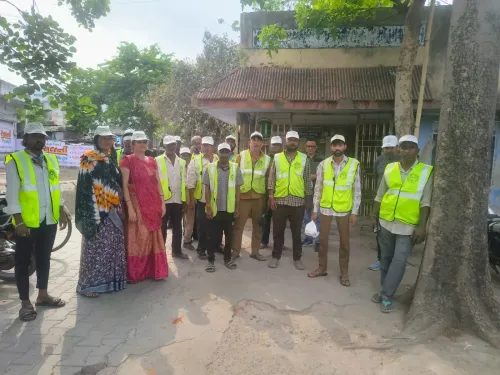
AMC has said it will conduct city-wide awareness and enforcement drives to help residents and institutions transition to the new framework. The corporation has urged citizens to treat cleanliness as both a duty and a right, signalling that education will accompany enforcement.