India-UK CETA: Ahmedabad's first shipment flagged off from Sanand ICD
Synopsis
On the very day the India-UK CETA entered into force, Ahmedabad sent its first preferential-tariff shipment to the UK — ₹3.07 crore worth of goods from seven exporters spanning pharma, automobiles, and polymers. Gujarat, with its pharma, chemical, and engineering clusters, is positioned to be one of the biggest winners of a deal that gives 99% of India's exports duty-free access to the UK market.
Key Takeaways
The first India-UK CETA export consignment was flagged off from Sanand ICD, Ahmedabad on 15 July 2025 — the same day the agreement entered into force.
The shipment was valued at ₹3,07,76,171.36 and comprised cargo from seven exporters including JCB Industries , Otsuka Pharmaceutical , and Maruti Suzuki .
Under CETA, 99% of India's exports to the UK receive duty-free market access ; India opened 89.5% of its tariff lines to the UK.
The accompanying Double Contribution Convention is set to benefit over 75,000 Indian professionals and 900+ companies , saving an estimated ₹4,000 crore annually.
Gujarat is expected to gain significantly, with pharma (Ahmedabad), chemicals (Surat, Bharuch), engineering goods (Rajkot), and marine products (Veraval) all in line for expanded UK market access.
India and the UK aim to double bilateral trade to USD 112 billion by 2030 under the new framework.
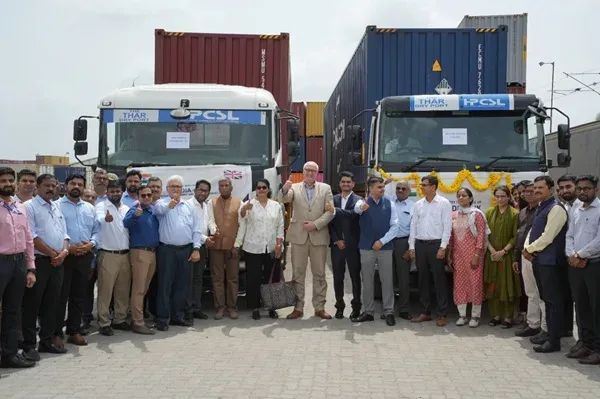
Ahmedabad marked a historic milestone on 15 July 2025 as the first export consignment under the India-United Kingdom Comprehensive Economic and Trade Agreement (CETA) was flagged off from the Inland Container Depot (ICD) at Sanand, signalling the operational start of preferential tariff-free trade between India and the UK. The shipment, valued at over ₹3.07 crore, comprised cargo from seven exporters in the Ahmedabad region — the same day the landmark agreement entered into force.
The Inaugural Shipment
The consignment, valued precisely at ₹3,07,76,171.36 according to the Ministry of Commerce and Industry, was organised by the Office of the Additional Director General of Foreign Trade (DGFT), Ahmedabad, in coordination with the Customs Department. It covered a diverse range of sectors — industrial equipment, pharmaceuticals, automobiles, polymers, and textiles — reflecting the breadth of Ahmedabad's manufacturing base.
The seven participating exporters were JCB Industries Pvt. Ltd, Otsuka Pharmaceutical India Pvt. Ltd, Maruti Suzuki India Limited, Canpac Trends Pvt. Ltd, Secure Meters Ltd, Shri Ambica Polymer Pvt. Ltd, and Vishakha Polyfab Pvt. Ltd.
Who Attended the Flag-Off
The ceremony was attended by British Deputy High Commissioner in Ahmedabad Stephen Hickling, Additional Commissioner of Customs Ram Vishnoi, and Joint Director General of Foreign Trade Rahul Singh. Assistant DGFTs Deepshikha Singh and Divya Patel, along with representatives of the exporting companies and the Export Promotion Council, were also present.
What the India-UK CETA Covers
The India-UK CETA was signed in London on 24 July 2024 by Union Commerce and Industry Minister Piyush Goyal and UK Secretary of State for Business and Trade Jonathan Reynolds, in the presence of Prime Minister Narendra Modi and British Prime Minister Keir Starmer. It entered into force on 15 July 2025, alongside the Double Contribution Convention (DCC) on social security.
Under CETA, 99% of India's exports to the UK — covering nearly the entire value of bilateral merchandise trade — receive duty-free market access. The agreement spans labour-intensive sectors such as textiles, leather, marine products, gems and jewellery, and toys, as well as engineering goods, chemicals, and automobile components. India has, in turn, opened 89.5% of its tariff lines, covering 91% of UK exports, while retaining protections for sensitive sectors including dairy, cereals, pulses, and certain essential oils.
Gujarat's Expected Gains
Officials said Gujarat is expected to be among the primary beneficiaries of the agreement. The state stands to gain from expanded export opportunities in pharmaceuticals concentrated in Ahmedabad, chemicals from Surat and Bharuch, engineering goods from Rajkot, and marine products from Veraval. The agreement is also projected to ease UK market access for micro, small and medium enterprises by lowering trade barriers.
The DCC and Professionals' Benefit
The accompanying Double Contribution Convention exempts Indian professionals on temporary assignments in the UK from making dual social security contributions for up to five years. This provision is expected to benefit more than 75,000 professionals and over 900 Indian companies, with estimated annual savings exceeding ₹4,000 crore.
India and the UK currently conduct bilateral trade worth approximately USD 56 billion — comprising merchandise trade of around USD 23 billion and services trade of approximately USD 33 billion. Both governments have set a target of doubling bilateral trade by 2030 under the new framework.
Point of View
But the numbers behind it are substantial. A deal giving 99% of Indian exports duty-free UK access — covering textiles, pharma, and auto components — is structurally significant for Gujarat's export clusters. The real test, however, is whether MSMEs can navigate compliance requirements to actually claim preferential tariffs, or whether the gains accrue mainly to large exporters like those in the inaugural shipment. The DCC provision, saving an estimated ₹4,000 crore annually for Indian professionals in the UK, is arguably the agreement's most immediately tangible benefit — yet it has received far less attention than the merchandise trade headline. With both governments targeting a doubling of bilateral trade by 2030, execution capacity on both sides will matter as much as the text of the agreement.
NationPress
14 Oct 2026
Frequently Asked Questions
What is the India-UK CETA and when did it come into force?
The India-UK Comprehensive Economic and Trade Agreement (CETA) is a bilateral free trade deal signed in London on 24 July 2024 by Commerce Minister Piyush Goyal and UK Secretary of State Jonathan Reynolds. It entered into force on 15 July 2025, granting 99% of India's exports to the UK duty-free market access.
What was in Ahmedabad's first CETA export shipment?
The consignment, valued at ₹3,07,76,171.36, included goods from seven Ahmedabad-region exporters: JCB Industries, Otsuka Pharmaceutical India, Maruti Suzuki India, Canpac Trends, Secure Meters, Shri Ambica Polymer, and Vishakha Polyfab. It covered industrial equipment, pharmaceuticals, automobiles, polymers, and textiles.
How will Gujarat benefit from the India-UK CETA?
Gujarat is expected to be among the largest beneficiaries, with expanded UK market access for pharmaceuticals from Ahmedabad, chemicals from Surat and Bharuch, engineering goods from Rajkot, and marine products from Veraval. The agreement also aims to lower trade barriers for MSMEs across the state.
What is the Double Contribution Convention signed alongside CETA?
The Double Contribution Convention (DCC) exempts Indian professionals on temporary assignments in the UK from paying dual social security contributions for up to five years. It is expected to benefit more than 75,000 professionals and over 900 Indian companies, with estimated annual savings exceeding ₹4,000 crore.
What is the target for India-UK bilateral trade under CETA?
Both governments have set a target of doubling bilateral trade by 2030. Currently, India-UK bilateral trade stands at approximately USD 56 billion, comprising USD 23 billion in merchandise trade and USD 33 billion in services trade.