CM Dhami: Uttarakhand's Aipan Art Gets GI Tag
Synopsis
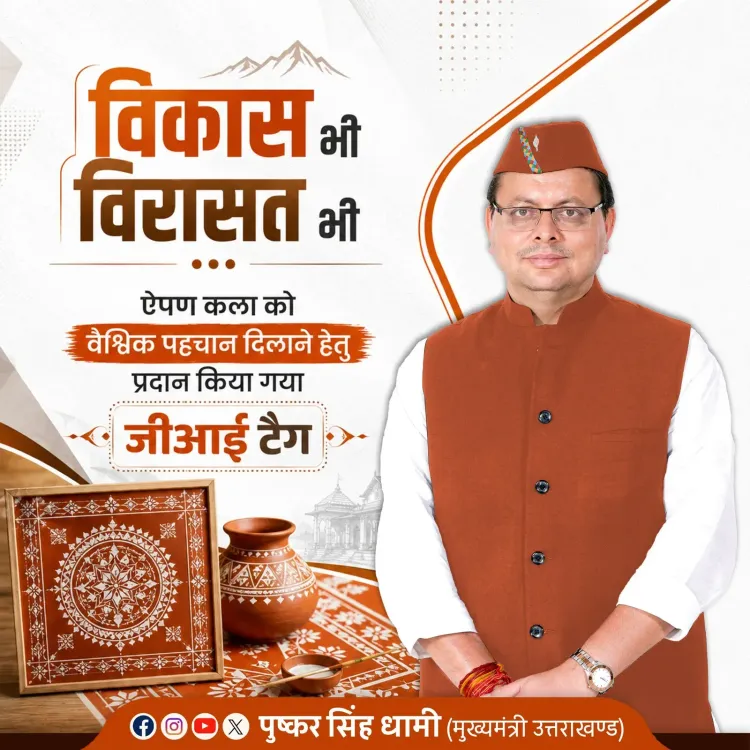
Uttarakhand Chief Minister Pushkar Singh Dhami announced that the state's traditional Aipan folk art has been granted a GI tag, linking the move to PM Modi's 'Vikas bhi, Virasat bhi' vision and promising global recognition and new economic opportunities for local artisans.
Key Takeaways
Uttarakhand's traditional Aipan folk art has been granted a Geographical Indication (GI) tag , announced by CM Pushkar Singh Dhami on 25 July 2026 .
The GI tag is framed as an expression of PM Narendra Modi 's 'Vikas bhi, Virasat bhi' philosophy linking development with cultural heritage.
Aipan is a centuries-old ritual art form from the Kumaon region , traditionally practised by women using red ochre and white rice paste.
The recognition is expected to open new markets and income opportunities for Uttarakhand's artisan and handicraft communities .
GI tags for comparable folk arts such as Madhubani paintings have historically boosted artisan incomes and export interest.
The move may accelerate GI applications for other Uttarakhand traditions, including Garhwali paintings and Ringal craft .
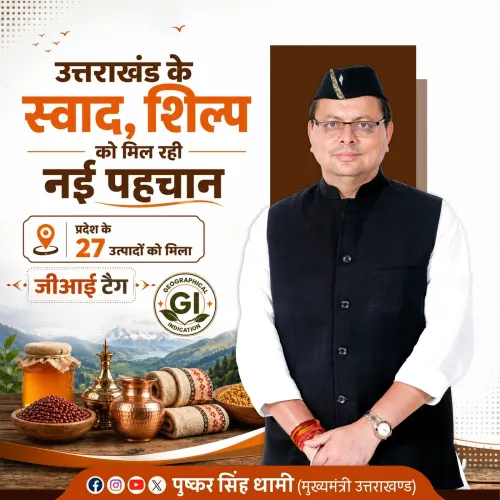
Uttarakhand Chief Minister Pushkar Singh Dhami announced on Friday, 25 July 2026 that the state's traditional Aipan folk art has been granted a Geographical Indication (GI) tag, calling it a significant milestone in placing the state's cultural heritage on the global map.
Posting in Hindi on X, CM Dhami said the move fulfils Prime Minister Narendra Modi's vision of 'Vikas bhi, Virasat bhi' ('Development as well as Heritage') — a governing philosophy that seeks to advance economic growth without sacrificing cultural roots. He stated that the GI tag will give Aipan 'global recognition' while creating 'new opportunities for local artists and those associated with handicrafts.'
Context
Aipan is a centuries-old ritual art form practised predominantly in the Kumaon region of Uttarakhand. Traditionally drawn by women on floors and walls during festivals, weddings, and religious ceremonies, it uses a distinctive red-and-white palette derived from natural pigments — red ochre (geru) as the base and white rice paste (biswar) for motifs. The art carries deep spiritual and social significance within Kumaoni communities.
Policy Backdrop
The Geographical Indications of Goods (Registration and Protection) Act, 1999, administered by the Geographical Indications Registry under the Department for Promotion of Industry and Internal Trade (DPIIT), provides the legal framework for such recognition. A GI tag certifies that a product or art form originates from a specific geographic region and possesses qualities or a reputation attributable to that origin, offering both legal protection and branding leverage.
Since 2014, the central government has significantly accelerated GI registrations for handicrafts and folk arts as part of a broader cultural-economy push. Comparable recognitions include Madhubani paintings from Bihar and Warli art from Maharashtra, each of which saw increased artisan incomes and export interest following their GI status.
Stakeholders and Impact
The most immediate beneficiaries are Uttarakhand's Aipan artisans — a community composed largely of women in Kumaon districts such as Almora, Pithoragarh, and Nainital. A GI tag enables artisans to market their work under a protected label, potentially commanding premium prices in domestic and international craft markets. It also opens pathways to government-backed artisan development programmes and export promotion schemes.
The tourism sector in Uttarakhand stands to benefit as well: Aipan motifs have already found commercial traction in textiles, stationery, and home decor, and the GI status is expected to strengthen branding efforts for the state's handicraft exports.
What's Next
Observers will watch for state-level follow-through — including artisan training programmes, market-linkage initiatives, and e-commerce integration — that would translate the GI tag into tangible income gains. Uttarakhand has several other distinct folk traditions, including Garhwali paintings and Ringal craft, and the Aipan recognition may accelerate GI applications for those art forms as well. The broader pattern suggests that cultural-heritage protection is becoming a sustained policy priority for the state ahead of upcoming electoral cycles.
Point of View
Virasat bhi' framing, CM Dhami aligns state cultural policy squarely with the BJP's national narrative of heritage-led development. This follows a well-established pattern in which GI recognitions serve dual purposes — genuine economic uplift for artisan communities and visible identity politics that resonate with regional pride. The real test will be whether the tag is followed by substantive artisan-support infrastructure, or remains primarily a branding exercise. With Uttarakhand having gone through political turbulence in recent years, such cultural wins also serve as soft consolidation of the ruling dispensation's connect with the state's distinct hill identity.
NationPress
22 Oct 2026
Frequently Asked Questions
What is Aipan art and why is it significant?
Aipan is a traditional ritual folk art from the Kumaon region of Uttarakhand, practised predominantly by women during festivals and religious ceremonies using red ochre as a base and white rice paste for intricate motifs. It holds deep cultural and spiritual significance in Kumaoni communities and is now recognised with a GI tag for its unique regional identity.
What does a GI tag mean for Aipan artists?
A GI tag legally protects the Aipan art form as a product of Uttarakhand's Kumaon region, allowing artisans to market their work under a protected label. This can help them command premium prices, access government support schemes, and expand into domestic and international craft markets.
Who announced the Aipan GI tag?
Uttarakhand Chief Minister Pushkar Singh Dhami announced the GI tag for Aipan art on 25 July 2026 via a post on X, linking the achievement to PM Narendra Modi's 'Vikas bhi, Virasat bhi' cultural-development vision.
Which government body grants GI tags in India?
GI tags in India are granted by the Geographical Indications Registry, which operates under the Department for Promotion of Industry and Internal Trade (DPIIT), pursuant to the Geographical Indications of Goods (Registration and Protection) Act, 1999.
What is Modi's 'Vikas bhi Virasat bhi' policy?
'Vikas bhi, Virasat bhi' — meaning 'Development as well as Heritage' — is a governing philosophy articulated by Prime Minister Narendra Modi that seeks to pursue economic growth while simultaneously preserving and promoting India's cultural and traditional heritage. It has been used to frame a range of policies from heritage site restoration to GI tag drives for folk arts.