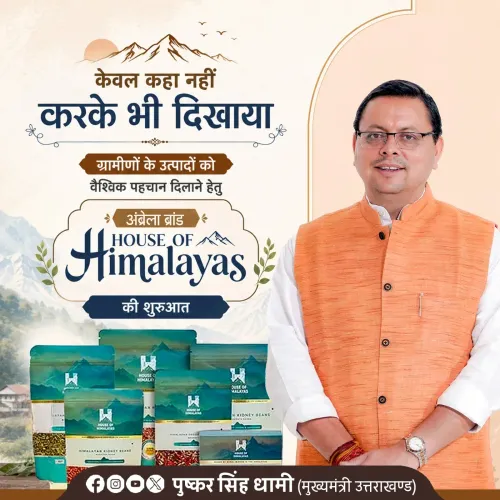
CM Dhami: 27 Uttarakhand Products Get GI Tag

Synopsis
Uttarakhand CM Pushkar Singh Dhami announced that 27 state products have secured Geographical Indication tags, aiming to give the state's handicrafts and local produce national and global recognition while boosting incomes for farmers, artisans, and rural producers.
Key Takeaways
27 Uttarakhand products have received Geographical Indication (GI) tags, according to CM Pushkar Singh Dhami .
The GI tags are intended to establish a unique legal identity for these products and protect them from imitation.
Beneficiaries include local producers, farmers, artisans, and handicraft workers across the state.
GI certification is expected to open new markets and help producers command better prices domestically and internationally.
The initiative aligns with India's National IPR Policy and TRIPS commitments, mirroring similar drives in other Indian states.
Implementation outcomes — including actual export growth and price premiums — remain the key metric to watch going forward.
Uttarakhand Chief Minister Pushkar Singh Dhami announced on Monday, 27 July 2026 that 27 products from the state have received Geographical Indication (GI) tags, crediting his government's push to give the state's cultural heritage, traditional handicrafts, and local produce national and global recognition.
Context
Posting on X, CM Dhami stated — 'हमारी सरकार ने उत्तराखंड की समृद्ध सांस्कृतिक विरासत, पारंपरिक हस्तशिल्प और स्थानीय उत्पादों को राष्ट्रीय एवं वैश्विक पहचान दिलाने का कार्य किया है' ('Our government has worked to give Uttarakhand's rich cultural heritage, traditional handicrafts, and local products national and global recognition'). He added that the GI tags are opening new markets, better prices, and greater employment opportunities for local producers, farmers, artisans, and those engaged in handicrafts.
Uttarakhand is a Himalayan state celebrated for its distinctive craft traditions, agricultural produce, and cultural practices — making it a natural candidate for GI-based protection of regional identity.
Policy Backdrop
India's Geographical Indications of Goods (Registration and Protection) Act, 1999 provides the legal framework for certifying products tied to a specific geographic origin and tradition. The legislation also aligns with India's commitments under the TRIPS Agreement (Trade-Related Aspects of Intellectual Property Rights) at the World Trade Organisation.
Across India, states have increasingly pursued GI registrations as a tool to safeguard traditional knowledge and link heritage to economic outcomes — particularly for rural and artisan communities. Uttarakhand's drive to secure tags for 27 products places it among the more active states in this national push under India's broader National Intellectual Property Rights Policy.
Stakeholders and Impact
The primary beneficiaries of GI certification are local producers, farmers, artisans, and handicraft workers across Uttarakhand. A GI tag establishes a product's unique identity and legally prevents misrepresentation or imitation, which typically helps authentic producers command better prices in both domestic and export markets.
For a state where a significant portion of the rural economy depends on agriculture and traditional crafts, improved market access and price premiums can have a meaningful impact on household incomes. The move also strengthens the state's cultural tourism narrative by formally documenting and protecting its heritage goods.
What's Next
The tangible outcomes — including export growth, price premiums realised by producers, and any further GI applications filed by the state — will be the true measure of the initiative's success. Observers will watch whether the Dhami government follows through with market-linkage programmes, branding support, and export facilitation to translate the legal protections into on-ground economic gains for Uttarakhand's artisan and farming communities.
Point of View
A state heavily dependent on rural and craft economies, GI tags offer a low-cost policy win that resonates with both local voters and a national audience interested in 'vocal for local' narratives. The real test lies beyond the certification: whether market-linkage and branding support follow. Without those, GI tags risk remaining symbolic rather than transformative for the artisans and farmers they are meant to serve.
NationPress
25 Oct 2026
Frequently Asked Questions
What is a GI tag and why does it matter for Uttarakhand products?
A Geographical Indication (GI) tag is a legal certification under India's GI Act, 1999, that identifies a product as originating from a specific region with qualities or reputation tied to that origin. For Uttarakhand, it means local handicrafts and produce gain protected status, helping artisans and farmers access better markets and prices.
How many products from Uttarakhand have received GI tags?
According to CM Pushkar Singh Dhami's post on 27 July 2026, 27 products from Uttarakhand have received GI tags.
Who benefits from Uttarakhand's GI tag products?
The primary beneficiaries are local producers, farmers, artisans, and those engaged in traditional handicrafts across Uttarakhand, who gain access to new markets, better pricing, and more employment opportunities.
Which law governs GI tags in India?
GI tags in India are governed by the Geographical Indications of Goods (Registration and Protection) Act, 1999 , which provides legal protection for regionally specific products and aligns with India's TRIPS commitments under the WTO.
What is the significance of CM Dhami promoting GI tags for Uttarakhand?
The push reflects the state government's broader effort to give Uttarakhand's cultural heritage and traditional products national and global visibility, while supporting rural livelihoods — a goal that also aligns with India's national IPR policy framework.