Air India breaks ground on new MRO hangar at Delhi's IGI Airport
Synopsis
Air India has broken ground on a 9-acre MRO hangar at Delhi's IGI Airport — its first major maintenance infrastructure push since the Tata Group takeover. With a 25-metre clear-height design, on-site spare parts storage, and IGBC green-building compliance, the facility is a concrete step away from India's costly dependence on overseas aircraft maintenance.
Key Takeaways
Air India broke ground on a new MRO hangar at Indira Gandhi International Airport, New Delhi on 22 October 2026 .
The facility spans nine acres and can service one widebody and one narrowbody aircraft simultaneously.
Features include a 25-metre clear height , integrated engineering offices, an on-site spare-parts warehouse, and a dedicated cabin shop.
The hangar meets IGBC Green Building norms for energy and water conservation.
CEO Tewolde Gebremariam and DIAL Deputy CEO Manomay Rai attended the groundbreaking ceremony.
The project aims to reduce India's reliance on overseas MRO facilities and cut aircraft ground time.
Air India on 22 October 2026 broke ground on a new multi-facility Maintenance, Repair and Overhaul (MRO) hangar at Indira Gandhi International Airport (IGIA) in New Delhi, marking a significant step toward building greater in-house engineering capabilities at the airline's largest hub. The facility, spread across nine acres, is designed to accommodate one widebody and one narrowbody aircraft simultaneously.
What the Facility Will House
The state-of-the-art hangar will centralise key engineering and maintenance functions under direct operational oversight, eliminating the fragmented workflows that currently drive up logistics costs. An integrated engineering office and an on-site spare-parts warehouse will sit alongside a dedicated cabin shop, enabling faster repair of aircraft interiors and reducing dependence on third-party vendors.
By bringing inspections, cabin upkeep, and defect rectification under one roof, the facility is expected to significantly cut aircraft ground time. Direct access to technical teams and spares will also enable quicker resolution of aircraft grounded for technical reasons, minimising passenger disruptions, according to the Air India statement.
Key Specifications and Design
Designed for long-term scalability, the hangar features a 25-metre clear height and large column-free spans capable of accommodating next-generation wide-body jets. The structure adheres to advanced fire-protection standards and aligns with Air India's environmental, social, and governance (ESG) commitments by conforming to Indian Green Building Council (IGBC) Green Building norms for energy and water conservation.
Who Attended the Groundbreaking
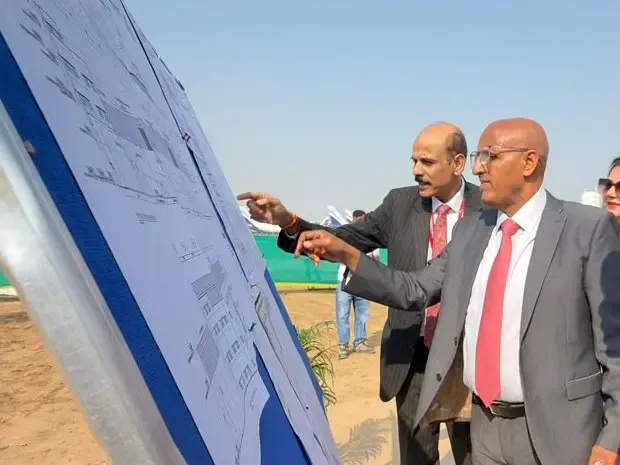
The ceremony was attended by Air India's newly appointed Chief Executive Officer and Managing Director, Tewolde Gebremariam, alongside senior leadership from both the airline and Delhi International Airport Ltd (DIAL). Also present were P Balaji, Air India's Group Head for Governance, Regulatory, Compliance and Corporate Affairs, and Manomay Rai, Deputy CEO of DIAL.
Broader Significance for Indian Aviation
India has long been dependent on overseas MRO facilities, with a significant share of aircraft maintenance work historically routed to Singapore, Sri Lanka, and the UAE — a drain on foreign exchange and a structural bottleneck for domestic carriers. Air India's investment signals a broader industry push toward building a competitive MRO ecosystem domestically, in line with the government's aviation self-reliance goals. Notably, this is among the first major MRO infrastructure announcements since Air India returned to the Tata Group fold. The facility is expected to improve fleet reliability and deliver a more consistent travel experience for passengers across the airline's network.
Point of View
And outsourcing maintenance abroad is an expensive, operationally risky default for a growing carrier. What the announcement does not yet answer is the construction timeline and when the hangar will be operationally ready — critical details given that fleet induction is already underway. India's MRO sector has been a policy talking point for years, but capital commitment at this scale from a major carrier is rare. If Air India executes on schedule, it could anchor a wider MRO cluster at IGIA and shift the economics for other Indian carriers still routing heavy maintenance overseas.
NationPress
22 Oct 2026
Frequently Asked Questions
What is the new Air India MRO hangar at Delhi airport?
It is a multi-facility Maintenance, Repair and Overhaul hangar being built by Air India on a nine-acre plot at Indira Gandhi International Airport in New Delhi, designed to service one widebody and one narrowbody aircraft simultaneously. The facility will centralise inspections, cabin upkeep, defect rectification, and spare-parts storage under one roof.
Why is Air India building its own MRO facility?
Air India is building the facility to reduce dependence on third-party and overseas MRO vendors, cut aircraft ground time, and lower logistics costs. Greater in-house maintenance capability is expected to improve fleet reliability and passenger experience.
Who attended the Air India MRO groundbreaking ceremony?
The ceremony was attended by Air India CEO and MD Tewolde Gebremariam, Group Head P Balaji, and DIAL Deputy CEO Manomay Rai, along with other senior executives from Air India and Delhi International Airport Ltd.
What are the key design features of the new hangar?
The hangar has a 25-metre clear height and large column-free spans to accommodate next-generation aircraft. It includes advanced fire-protection systems and complies with IGBC Green Building norms for energy and water efficiency.
How does this fit into India's broader aviation MRO ambitions?
India has historically sent a large share of aircraft maintenance work to overseas facilities in Singapore, Sri Lanka, and the UAE. Air India's investment is part of a broader push to develop a domestic MRO ecosystem, aligned with the government's aviation self-reliance goals under the Tata-era turnaround of the airline.