Akhilesh Yadav coins 'BJP 3C Inflation' tag, hits fuel prices
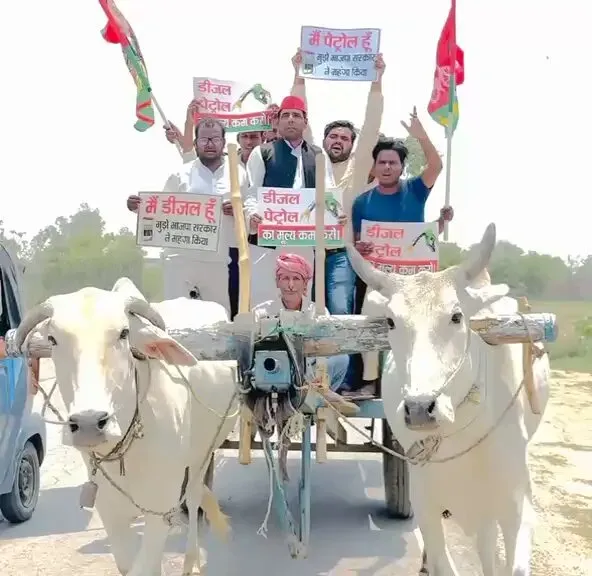
Synopsis
Samajwadi Party president Akhilesh Yadav on 23 May 2026 coined the term 'BJP 3C Inflation' — commission, corruption, Covid — accusing the BJP of inflicting a 'third dose' of price rise on ordinary citizens, and sarcastically suggesting the party sell expensive fuel and goods only to its own card-carrying members.
Key Takeaways
Akhilesh Yadav posted on 23 May 2026 coining the phrase 'BJP 3C INFLATION' , defining it as commission, corruption, and Covid-linked price rise.
He called the latest price increase the 'third dose of inflation' , using pandemic vaccination language as a rhetorical device.
He sarcastically suggested the BJP sell expensive petrol, diesel, cooking oil, and transport-linked goods exclusively to its own card-carrying supporters.
The post targeted BJP supporters who, he claimed, would vote for the party regardless of inflation levels.
The campaign hashtag #BJP_3C_INFLATION signals an organised opposition messaging push on fuel and commodity prices.
Fuel prices in India remain outside the GST framework, keeping them a live political issue driven by central excise and state VAT decisions.
Samajwadi Party president Akhilesh Yadav on Saturday, 23 May 2026, launched a sharp political broadside against the Bharatiya Janata Party, coining the term 'BJP 3C INFLATION' — which he defined as standing for 'commission, corruption, and Covid-era price rise' — and accusing the ruling party of delivering what he called the 'third dose of inflation' to ordinary citizens.
Context
In his post on X, Akhilesh Yadav directly addressed BJP supporters who, he suggested, would vote for the party regardless of how high prices climbed. Translating his pointed Hindi, he wrote: 'Unhe yeh mahangai mubarak!' — 'Congratulations to them on this inflation!' He sarcastically proposed that the BJP should check its supporters' membership cards and sell expensive petrol, diesel, cooking oil, and all goods inflated by higher transport costs exclusively to them, sparing the general public and the poor.
The post was accompanied by a video and carried the hashtag #BJP_3C_INFLATION, signalling a coordinated messaging campaign rather than a one-off remark. The framing of inflation as a 'dose' — echoing the pandemic-era vaccination language — is a deliberate rhetorical device to link post-Covid price pressures with BJP governance.
Policy Backdrop
Fuel prices have been a recurring flashpoint in Indian politics since the early years of BJP rule at the centre from 2014 onwards. The central government had cut excise duty on petrol by Rs 8 per litre and on diesel by Rs 6 per litre in May 2022, a move aimed at cooling inflation, but opposition parties have continued to argue that the overall tax burden on fuels remains high. The GST rollout of July 2017 restructured indirect taxation across commodity chains, and its cascading effect on transport and logistics costs has been a persistent theme in political debate.
Petrol and diesel remain outside the GST framework, meaning state and central levies continue to determine pump prices independently — a structural feature that both ruling and opposition parties have weaponised in different ways across election cycles. Uttar Pradesh, India's most populous state and Akhilesh Yadav's political base, is particularly sensitive to fuel-driven inflation given its large rural population and dependence on road transport for agricultural supply chains.
Stakeholders and Impact
The groups most directly affected by fuel-linked inflation are common consumers, poor households, and fuel-dependent sectors such as agriculture, logistics, and small trade. Rising petrol and diesel prices feed into the cost of vegetables, grains, and daily essentials through higher freight charges — a transmission mechanism that the Samajwadi Party has consistently highlighted in its outreach to rural and semi-urban voters in Uttar Pradesh.
For the BJP, the political risk lies in the perception gap between macro-economic indicators and household-level price experience. Opposition messaging that personalises inflation — as Akhilesh Yadav does here by invoking membership cards and selective pricing — is designed to make abstract fiscal policy feel immediate and discriminatory to swing voters.
What's Next
Political observers will watch whether the #BJP_3C_INFLATION hashtag gains traction as an organised campaign theme ahead of any upcoming state or national electoral cycle. Any revision to central excise duties or state VAT on fuels in the next Union Budget, or fresh inflation data releases, are likely to reignite this debate. Parliamentary discussions on retail price indices and fuel taxation will provide the opposition further platforms to press the same argument, with Akhilesh Yadav well-positioned to lead that charge from his Lok Sabha seat.
Point of View
Hashtag-ready slogan. The 'third dose' metaphor is strategically chosen: it ties post-pandemic inflation to BJP governance in a single phrase that resonates with voters who lived through Covid-era hardship. By suggesting that BJP supporters alone should bear inflated prices, Yadav is not merely mocking loyalists — he is attempting to peel away soft supporters who prioritise household economics over partisan identity. This style of personalised, satirical inflation messaging has been a recurring tool for the Samajwadi Party in Uttar Pradesh, and its reappearance in mid-2026 suggests the party is laying rhetorical groundwork for the next electoral contest.
NationPress
7 Oct 2026
Frequently Asked Questions
What is 'BJP 3C Inflation' that Akhilesh Yadav is talking about?
'BJP 3C Inflation' is a term coined by Samajwadi Party president Akhilesh Yadav on 23 May 2026. He defined the three Cs as commission, corruption, and Covid, arguing these factors under BJP rule have driven up prices of petrol, diesel, cooking oil, and other daily essentials.
Why did Akhilesh Yadav call the latest price rise the 'third dose of inflation'?
Yadav used the phrase 'third dose' as a deliberate reference to Covid-era vaccination language, implying that just as people received multiple vaccine doses, ordinary citizens are now receiving repeated rounds of inflation under BJP governance.
What is Akhilesh Yadav's demand regarding fuel prices?
Yadav did not make a formal policy demand in this post. Instead, he sarcastically suggested that the BJP should sell expensive petrol, diesel, and other goods only to its card-carrying members and spare the general public and the poor from high prices.
Are petrol and diesel prices covered under GST in India?
No. Petrol and diesel remain outside the GST framework in India. Their retail prices are determined by a combination of central excise duty and state VAT, which is why they are frequently at the centre of political disputes over inflation.
What is the Samajwadi Party's broader position on inflation?
The Samajwadi Party has consistently argued that BJP policies on excise duty, GST, and supply chains are responsible for economic distress among common citizens, particularly in Uttar Pradesh. Akhilesh Yadav regularly raises fuel prices and commodity inflation as campaign issues.