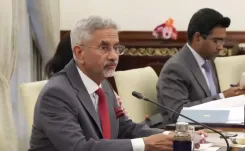
Akhilesh Yadav taunts BJP after poll drubbing, demands resignation
Synopsis
Samajwadi Party president Akhilesh Yadav on 3 August 2026 unleashed a twelve-point attack on the BJP following an electoral defeat, invoking divine justice, demanding leadership resignations, and declaring the result a vindication of his PDA caste-social coalition in Uttar Pradesh.
Key Takeaways
Akhilesh Yadav posted a twelve-point charge sheet against the BJP on 3 August 2026 , citing vote theft, paper leaks, job theft, reservation theft, corruption, and inflation.
He described the result as 'the combined outcome of youth unity and parental outrage' — a direct claim of credit for his PDA coalition strategy.
Akhilesh mocked an internal BJP fault line, suggesting a PDA-community leader denied a national post is now privately celebrating with the '5 vs 7' numerical jibe.
He declared this a 'double defeat of the double engine,' noting the BJP's national president lost his own assembly seat.
He predicted BJP ticket-seekers will soon be impossible to find 'even with a drone and binoculars' as the party's fortress seats crumble.
He closed with a sardonic aside that sweets are being distributed inside the BJP — implying internal relief at a dominant leader's fall.
A stinging electoral verdict has handed Samajwadi Party president Akhilesh Yadav the sharpest political ammunition he has wielded in years — and on 3 August 2026, he used it without restraint, posting a sweeping indictment of the Bharatiya Janata Party that ricocheted across social media within hours.
The divine metaphor and the twelve-count charge sheet
Akhilesh opened with a theological flourish that landed like a political punch. 'Bhagwan ko nachane ka ahankaar rakhnewalon ko Bhagwan ne hi nacha diya' — 'Those who had the arrogance to make God dance have been made to dance by God himself,' he wrote. The imagery was deliberate: the BJP, long projecting an aura of divine mandate and invincibility, had been humbled by the ballot box itself.
He then unfurled a twelve-point charge sheet against the ruling party — 'vote theft', 'paper theft' (a reference to examination paper leaks), 'offering-donation-charity theft', 'job theft', 'reservation theft', 'commission-seeking', 'atrocities on PDA communities', 'rampant corruption', 'the blow of inflation', 'adulteration made official policy', 'insult to mothers and daughters', and 'an all-out assault on the country's Gen Z.' The list was not rhetorical padding; each bullet point maps to a live grievance that has animated street protests and student agitations across Uttar Pradesh over the past two years.
The '5 vs 7' jibe and the internal BJP fault line
Akhilesh's sharpest barb was reserved for an internal BJP tension he chose to illuminate publicly. He pointed to a figure within Uttar Pradesh — described as belonging to the PDA (Pichhda-Dalit-Alpsankhyak) social coalition — who was, in his telling, deliberately given only a state-level post rather than a national one because of his caste identity. That person, Akhilesh wrote, is now smiling and asking: '5 bada ya 7' — '5 is bigger, or 7?' — a pointed numerical riddle widely read as a reference to rival leadership tallies or vote margins that exposed the BJP's internal hierarchy.
The subtext is unmistakable: the BJP's caste arithmetic, which once looked like its greatest strength in UP, is now a source of internal fracture. Akhilesh pressed the wound further, noting that if the national president could not win his own assembly constituency, the state president would not even be able to field candidates — 'This is the double defeat of the double engine.'
The PDA coalition's vindication — and what it means for UP politics
The Samajwadi Party has built its PDA strategy — a social alliance of backward classes, Dalits, and minorities — since at least the 2022 Uttar Pradesh assembly elections, betting that a consolidated non-BJP vote could crack the party's fortress seats. Akhilesh framed this result as that bet paying off: 'This is the combined result of the unity of youth and the outrage of their parents.'
He went further, predicting a cascade effect: that BJP's safest, most traditional seats would no longer provide cover, and that candidates willing to carry the BJP ticket would soon be impossible to find 'even with a drone and binoculars.' The closing parenthetical — 'Laddoo toh BJP ke andar bhi bant rahe hain', 'Sweets are being distributed inside the BJP too' — was a sardonic suggestion that the ruling party's own members are privately celebrating the exit of a leader whose dominance had become suffocating.
He closed with congratulations to all winning candidates and a call to remain 'alert, conscious, and committed to the Constitution' — a line that doubles as a warning and a benchmark against which he will measure them.
The BJP's response to mounting resignation demands, and its candidate strategy for the next electoral cycle in Uttar Pradesh, will now define whether this defeat is a correction or a turning point.
Point of View
Unemployment, reservation erosion — that have defined youth politics in the state. The '5 vs 7' jibe is a calculated attempt to deepen an internal BJP caste fault line, suggesting the SP sees more mileage in fracturing the ruling coalition from within than in frontal ideological combat. If the BJP's organisational response is delayed or incoherent, Akhilesh's framing — that this defeat is the beginning of a structural collapse, not a cyclical setback — could set the dominant narrative heading into the next Uttar Pradesh assembly election cycle.
NationPress
3 Aug 2026
Frequently Asked Questions
What did Akhilesh Yadav say about BJP's election defeat?
Akhilesh Yadav posted a twelve-point charge sheet on 3 August 2026, accusing the BJP of vote theft, paper leaks, job theft, reservation theft, corruption, inflation, and attacks on Gen Z and women, calling the result 'the double defeat of the double engine.'
What is the PDA coalition Akhilesh Yadav keeps mentioning?
PDA stands for Pichhda-Dalit-Alpsankhyak — a social alliance of backward classes, Dalits, and minorities that the Samajwadi Party has built as its core electoral coalition in Uttar Pradesh, deployed prominently since the 2022 state assembly elections.
What does '5 bada ya 7' mean in Akhilesh's post?
The '5 vs 7' phrase is a political riddle — widely read as a reference to competing leadership figures or vote margins — that Akhilesh used to highlight an internal BJP caste tension, suggesting a PDA-community leader within the party is privately celebrating after being sidelined.
Why is Akhilesh demanding BJP resignations?
Akhilesh argued that if the BJP's national president could not win his own assembly constituency, neither the national nor the state leadership has a credible mandate to lead the party, making resignation demands both politically logical and publicly embarrassing for the BJP.
What is the 'double engine' government Akhilesh refers to?
The BJP has promoted the idea of a 'double engine' government — meaning the same party ruling both at the centre and in the state — as a guarantee of faster development. Akhilesh used the phrase sarcastically to say this electoral defeat is a 'double failure' of that very claim.