Should India Remember Ambedkar More Than the Babri Mosque on December 6?
Synopsis
On December 6, a day meant to honor Dr. B.R. Ambedkar, a controversial event led by Humayun Kabir in West Bengal reignited the Babri Mosque debate. This article explores the implications of prioritizing divisive symbols over unity and constitutional values.
Key Takeaways
Ambedkar's legacy should be prioritized over divisive symbols.
The Babri Mosque incident has significant historical implications.
Political actions can provoke communal tensions.
December 6 is a day for reflection on unity and constitutional values.
India must choose stability and foresight over division.
New Delhi, Dec 7 (NationPress) On the day of Mahaparinirvan Diwas -- a moment for the nation to pay tribute to Bharat Ratna Babasaheb Dr B.R. Ambedkar, the chief architect of India's Constitution -- a contrasting event took place in Murshidabad, West Bengal. Suspended Trinamool Congress member Humayun Kabir selected this serious day of December 6 to initiate the foundation laying for the 'Babri Mosque'.
Kabir asserted that he was exercising his 'constitutional right' and that the occasion was fully compliant with the law. He suggested that the government was in support of his actions.
He mentioned that anyone is free to construct a temple, church, or mosque anywhere across the country. While he holds the right to do so, intention, context, and timing are crucial factors.
Kabir referred to the Supreme Court's 2019 Ayodhya ruling, asserting that it 'acknowledged the demolition of the Babri Masjid' and did not prohibit the establishment of a mosque elsewhere. However, this was not a spiritual reconstruction but rather a politically charged act.
The 2019 Supreme Court ruling -- which settled the long-standing dispute over the 2.77-acre Ayodhya site -- was accepted widely due to its thorough judicial examination.
The Court recognized a historic injustice and provided a path toward closure. The Ram Temple has since been completed.
For many Indians, the matter had transitioned from agitation to acceptance. Over the past six years, despite various political attempts, December 6 had begun to lose its impact, no longer making headlines.
The country had, in its way, allowed a painful memory to recede into history. Until now. With Assembly elections looming in West Bengal, Kabir has suddenly revived the Babri issue.
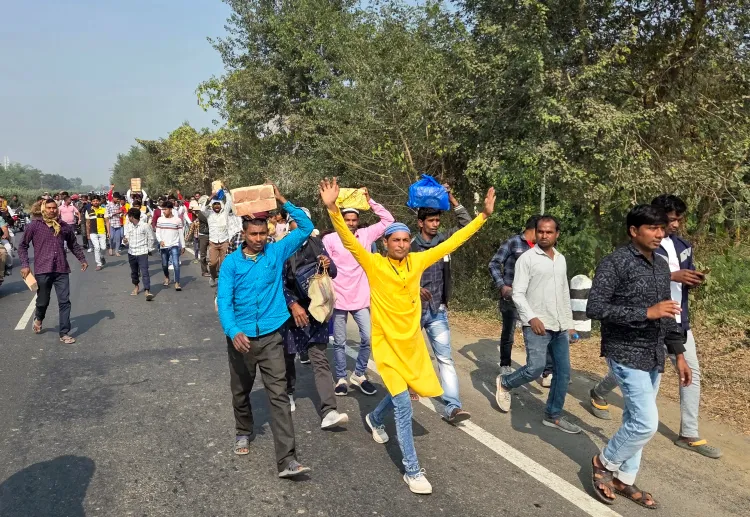
Subtly supported by his party and state machinery, he rallied crowds and orchestrated a calculated political display. His foundation stone ceremony drew thousands of Muslims bearing red bricks on their heads, resembling a choreographed act of defiance, thus thrusting December 6 back into the center of polarization.
Each year, December 6 compels India to face two divergent histories. One signifies the demolition of the Babri Masjid in 1992, while the other commemorates the passing of Ambedkar in 1956 -- a figure whose legacy belongs to all Indians.
Conversely, the Babri incident stands as one of India's most polarizing events. When a political figure opts for Babri over Ambedkar on this day, the message is clear: division is prioritized over unity; provocation takes precedence over constitutional values. Is this politics masquerading as religious assertion? Kabir's motives are transparent.
Religion remains a potent tool to ignite emotions and rally voters toward specific political agendas. The upcoming Assembly elections in West Bengal are vital for Mamata Banerjee's Trinamool Congress and equally strategic for the BJP, which aims to broaden its influence in the state.
The troubling aspect is not merely that Kabir evoked Babri. It is that he chose December 6, a day that should serve as a reflection on Ambedkar’s vision -- emphasizing justice, equality, liberty, and fraternity.
Instead, he has reignited a symbol of communal discord. The current equation seems to be Ambedkar vs Babri, raising the question of what India should prioritize. The Babri conflict -- its repercussions were dealt with through commissions, courtrooms, and eventual reconciliation. Ambedkar's philosophy did not incite turmoil; he consistently cautioned against majoritarianism, communalism, and the abuse of identity politics. Kabir's actions suggest otherwise.
Kabir's political theatrics steer India toward its less admirable instincts, rather than its noble ones. They revive a symbol of division at the expense of a leader who tirelessly worked to unite the nation.
India is a youthful nation with a rich civilization. Its challenge lies in choosing stability over sentiment, foresight over chaos. If December 6 is reduced to a day of communal reflection, India misses a chance for self-examination. But if it becomes a day to revisit Ambedkar’s vision, India gains both direction and dignity. This is why Humayun Kabir's display should be recognized for what it is: a calculated effort to drag the state back into an engineered conflict. Who stands to gain from reopening a historical wound just before elections? The Trinamool Congress cannot absolve itself from this responsibility.
Kabir may be suspended in name, but the mobilization, machinery, and atmosphere surrounding the event tell a different story. If the party truly disapproved, how was such a large gathering allowed to form? Why was a day dedicated to Ambedkar allowed to be co-opted for a divisive spectacle? These are questions not only for Kabir but also for Mamata Banerjee and her administration. If they claim to uphold constitutional principles, then why support an act that undermines the very ideals Ambedkar advocated for?
(Deepika Bhan can be contacted at deepika.b@ians.in)
Point of View
I believe that the focus should remain on the values and ideals that unite us as a nation. On December 6, we must honor Dr. B.R. Ambedkar's contributions rather than allow divisive politics to overshadow his legacy. It is essential for India's growth and unity that we uphold the principles of justice, equality, and fraternity.
NationPress
15 Sept 2026
Frequently Asked Questions
What was the significance of December 6 in India?
December 6 marks the passing of Dr. B.R. Ambedkar, the principal architect of India's Constitution, and is a day to honor his legacy.
Who is Humayun Kabir?
Humayun Kabir is a suspended Trinamool Congress legislator who laid the foundation stone for the Babri Mosque on December 6, 2023.
What was the Supreme Court's ruling in 2019 regarding the Babri Masjid?
The Supreme Court's 2019 ruling resolved the Ayodhya dispute, recognizing a historic wrong and allowing the construction of a Ram Temple at the site.
Why is the Babri Mosque controversy significant?
The Babri Mosque controversy represents a deeply divisive moment in Indian history and raises questions about communal harmony and political agendas.
What ideals did Ambedkar advocate for?
Dr. B.R. Ambedkar advocated for justice, equality, liberty, and fraternity, principles that are foundational to India's Constitution.