Amit Shah: Cabinet Clears ₹25,445 Cr Varanasi Corridors
Synopsis
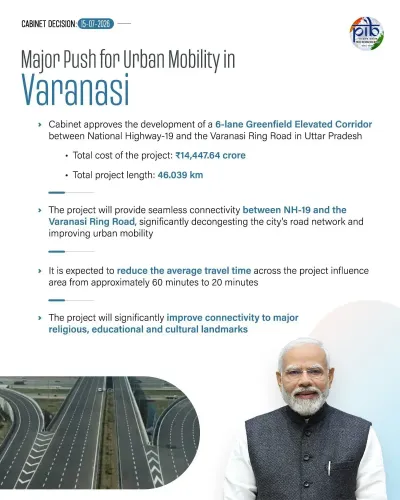
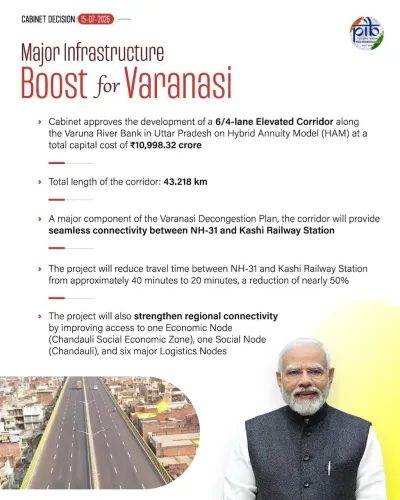
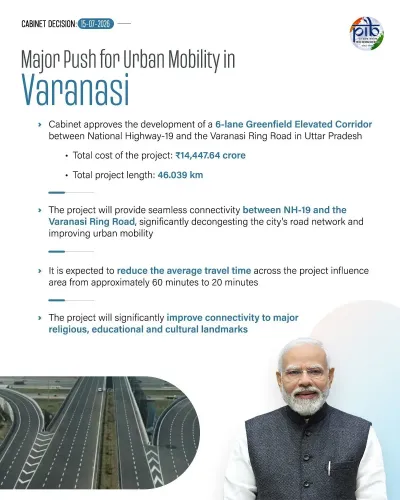
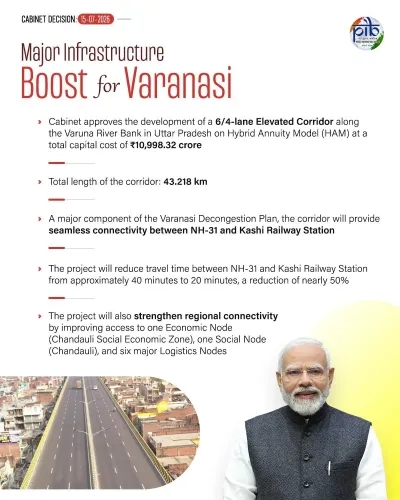
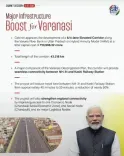
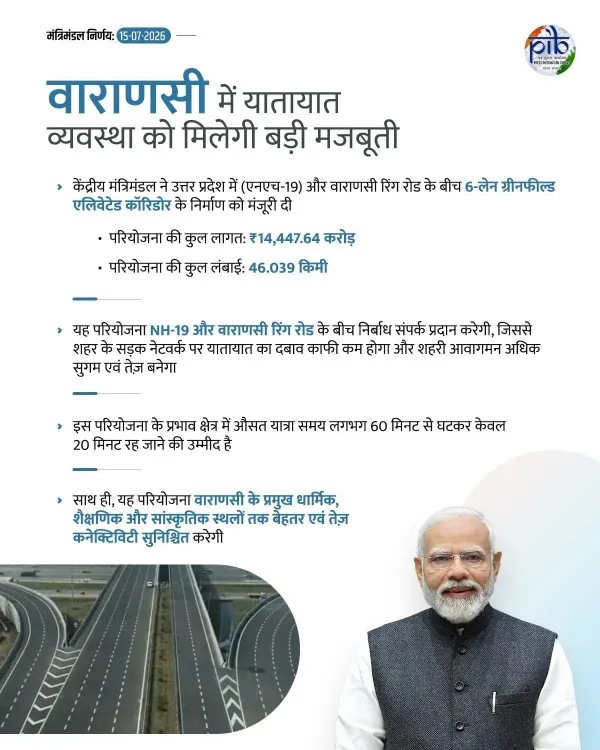
The Union Cabinet has cleared two elevated corridor projects worth ₹25,445 crore for Varanasi, promising seamless links between the railway station, ring road, and national highways. Union Home Minister Amit Shah said the move advances the Modi government's 'heritage also, development also' agenda and will boost economic activity across Purvanchal.
Key Takeaways
The Union Cabinet approved two elevated corridor projects worth ₹25,445 crore for Varanasi on 15 July 2026 .
The projects will create seamless connectivity between Varanasi railway station , the ring road , and national highways .
Union Home Minister Amit Shah linked the decision to the Modi government's 'virasat bhi, vikas bhi' ('heritage also, development also') policy framework.
The corridors are expected to reduce travel time, ease traffic congestion, and improve access to cultural and heritage sites in the city.
Economic activity across the broader Purvanchal region is expected to gain momentum from the improved infrastructure.
The approval continues a pattern of integrated transport-heritage investment in pilgrimage cities including Ayodhya , Mathura , and Ujjain .
Union Home Minister Amit Shah announced on Wednesday, 15 July 2026 that the Union Cabinet, under the leadership of Prime Minister Narendra Modi, has approved two elevated corridor projects worth ₹25,445 crore for Varanasi, describing the decision as a major gift to the ancient city.
Posting in Hindi, Shah wrote that the projects embody the Modi government's resolve of 'virasat bhi, vikas bhi' — 'heritage also, development also' — being translated into ground-level reality. He said the corridors will cut travel time, ease traffic pressure, and create seamless connectivity between the railway station, the ring road, and national highways.
Context
Varanasi, one of the world's oldest continuously inhabited cities and Prime Minister Modi's parliamentary constituency, has been the focus of sustained central infrastructure investment since 2014. The announcement builds on a series of urban and heritage-linked projects that have reshaped the city's connectivity over the past decade. Shah's post frames the two elevated corridors as the latest expression of the government's twin commitment to preserving cultural identity while accelerating modern development.
Policy Backdrop
The 'heritage also, development also' formulation was first given physical form through the Kashi Vishwanath Dham Corridor, inaugurated in 2021, which redeveloped the precinct around the city's most revered temple while improving pedestrian access. Between 2016 and 2022, multiple ring-road and national-highway widening schemes were also cleared to decongest Varanasi and improve links to the railway station and airport. The two newly approved elevated corridors sit within the broader Bharatmala and PM Gati Shakti frameworks, which prioritise multi-modal, high-speed connectivity across the country.
The pattern is not unique to Varanasi. Since 2019, integrated transport-heritage projects have been executed or approved in Ayodhya, Mathura, and Ujjain, signalling a deliberate policy of elevating pilgrimage cities as economic and tourism anchors.
Stakeholders and Impact
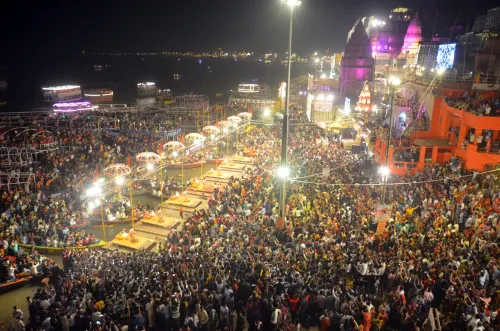
Shah noted that better access to cultural sites will give fresh momentum to economic activity across Purvanchal — the eastern Uttar Pradesh region that Varanasi anchors. Daily commuters stand to benefit from reduced congestion, while heritage tourists will gain faster, smoother routes to the city's ghats and temples. Businesses across the Purvanchal belt are expected to gain from improved freight and passenger movement once the corridors are operational.
The seamless link between the railway station, ring road, and national highways is particularly significant given Varanasi's role as a rail junction for eastern Uttar Pradesh. Improved last-mile connectivity could ease the chronic bottlenecks that affect both pilgrims and goods traffic moving through the city.
What's Next
Following cabinet clearance, the projects will move into the phases of detailed project reports, land acquisition, and competitive tendering. Observers will watch whether the corridors are fast-tracked under the PM Gati Shakti single-window framework to compress timelines. Additional announcements on Purvanchal expressway extensions or rail linkages could follow in upcoming budget cycles or cabinet meetings, given the government's stated focus on the region.
Point of View
445 crore for Varanasi is consistent with the BJP's long-running strategy of pairing heritage redevelopment with hard infrastructure in politically and culturally significant pilgrimage cities. By anchoring the announcement in the 'heritage also, development also' slogan, the government reinforces a brand identity it has cultivated since the Kashi Vishwanath Dham inauguration in 2021. The Purvanchal framing also signals an intent to broaden the political and economic dividend beyond Varanasi city limits ahead of future electoral cycles. Whether project timelines will match the ambition depends heavily on how swiftly land acquisition and tendering are resolved — historically the most friction-prone phases of such urban corridor projects.
NationPress
15 Jul 2026
Frequently Asked Questions
What are the two elevated corridor projects approved for Varanasi?
The Union Cabinet approved two elevated corridor projects for Varanasi worth a combined ₹25,445 crore. The projects aim to create seamless connectivity between the city's railway station, ring road, and national highways, reducing travel time and easing traffic congestion.
What is the 'virasat bhi, vikas bhi' policy the government refers to?
'Virasat bhi, vikas bhi' means 'heritage also, development also' in English. It is the Modi government's stated approach of simultaneously preserving India's cultural and religious heritage while investing in modern infrastructure, most visibly demonstrated through projects like the Kashi Vishwanath Dham Corridor in Varanasi.
How will the Varanasi elevated corridors benefit Purvanchal?
Better road connectivity linking Varanasi's railway station, ring road, and national highways is expected to reduce logistics costs and travel time for businesses and commuters across Purvanchal, the eastern Uttar Pradesh region. Improved access to cultural sites is also expected to boost heritage tourism and related economic activity.
What other pilgrimage cities have received similar infrastructure projects?
Since 2019, integrated transport-heritage projects have been approved or executed in Ayodhya, Mathura, and Ujjain, reflecting a broader central government policy of upgrading connectivity in major pilgrimage and cultural cities alongside heritage development.
What happens after the Union Cabinet approves an infrastructure project?
After cabinet approval, projects typically move into detailed project report preparation, land acquisition, and competitive tendering before construction begins. Under the PM Gati Shakti framework, a single-window clearance system is used to streamline these processes and reduce delays.