Amit Shah: Cabinet Clears Kanpur–Kabrai Greenfield Highway
Synopsis
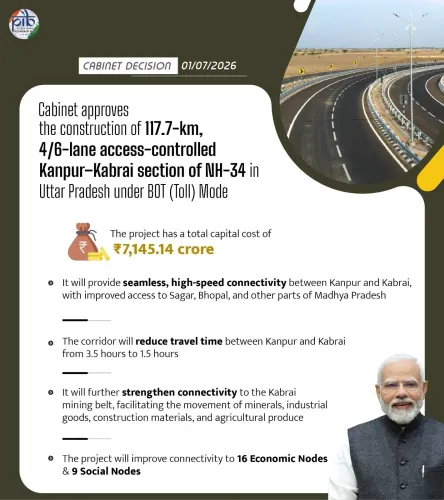
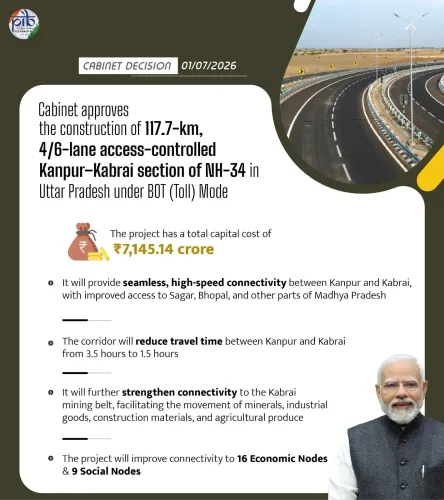
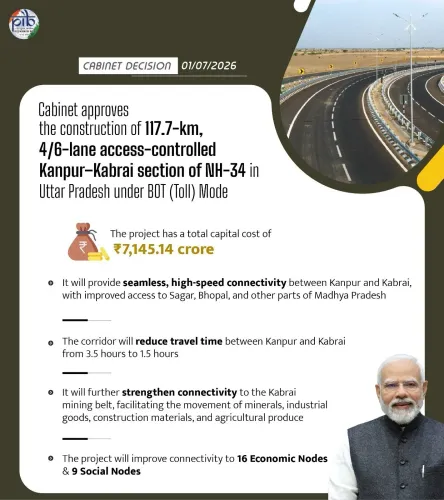
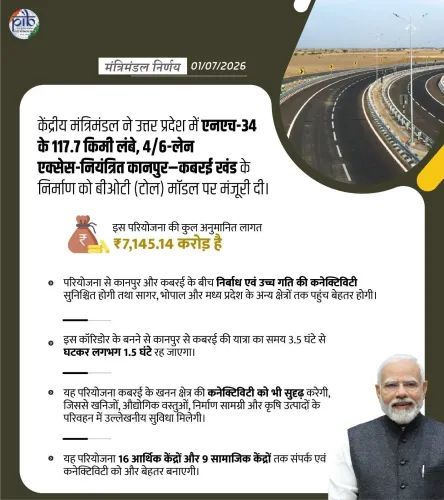
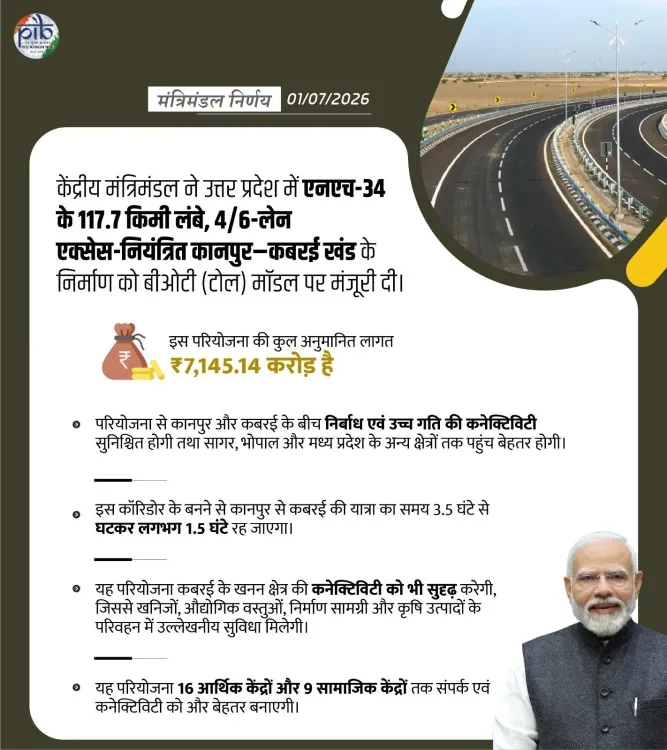
The Union Cabinet on 1 July 2026 approved the Kanpur–Kabrai 4-lane Greenfield Highway to provide high-speed road connectivity between Uttar Pradesh's Awadh and Bundelkhand regions. Home Minister Amit Shah called the project an engine of economic development that will save travel time and boost industry and trade.
Key Takeaways
The Union Cabinet approved the Kanpur–Kabrai 4-lane Greenfield Highway on 1 July 2026 .
The project will connect the Awadh and Bundelkhand regions of Uttar Pradesh via a new high-speed road alignment.
Union Home Minister Amit Shah described the highway as 'the engine of economic development' for Uttar Pradesh.
The corridor is expected to reduce travel time and provide new momentum to industry and trade in the region.
Bundelkhand is a historically underdeveloped region that has been a recurring focus of central infrastructure investment.
Next steps include formal notification by the Ministry of Road Transport and Highways , followed by tendering and land acquisition.
Union Home Minister Amit Shah announced on Wednesday, 1 July 2026 that the Union Cabinet has approved the Kanpur–Kabrai 4-lane Greenfield Highway, a high-speed road corridor designed to connect the Awadh and Bundelkhand regions of Uttar Pradesh. Shah described the project as a significant step toward providing fast road connectivity between the two historically distinct zones of India's most populous state.
Context
Posting on X, Shah wrote: 'उत्तर प्रदेश के अवध और बुंदेलखंड क्षेत्र के बीच हाई-स्पीड रोड कनेक्टिविटी उपलब्ध कराने की दिशा में केंद्रीय कैबिनेट ने आज महत्वपूर्ण कानपुर–कबरई 4-लेन ग्रीनफील्ड हाईवे को मंजूरी दी है।' ['In the direction of providing high-speed road connectivity between the Awadh and Bundelkhand regions of Uttar Pradesh, the Union Cabinet today approved the important Kanpur–Kabrai 4-lane Greenfield Highway.']. He further stated that the project 'will become the engine of economic development of Uttar Pradesh, will save travel time, and will give new momentum to industry and trade.'
The approval was granted at a Union Cabinet meeting held on 1 July 2026. The highway is a greenfield project, meaning it will be built on a new alignment rather than widening an existing road.
Policy Backdrop
The Kanpur–Kabrai corridor fits within a broader national push to extend access-controlled expressway infrastructure deep into states with large, geographically diverse territories. The central government's Bharatmala Pariyojana, approved in 2017, laid the framework for constructing greenfield expressways and highways across India, with several corridors earmarked for Uttar Pradesh.
Bundelkhand, a region spanning parts of Uttar Pradesh and Madhya Pradesh, has historically lagged in infrastructure and economic indicators. Successive cabinet approvals have targeted the region to reduce travel time and stimulate economic activity. The Awadh region, which includes major urban centres such as Lucknow and Kanpur, serves as the commercial and administrative anchor of the state, making the link between the two regions strategically significant.
Stakeholders and Impact
The highway is expected to benefit a wide set of stakeholders across Uttar Pradesh. The logistics and freight sector stands to gain from reduced transit times between the industrialised Kanpur belt and the agricultural and mineral-rich Bundelkhand hinterland. Industrial clusters along the corridor could see improved supply-chain access and investor interest.
Regional travellers, who currently navigate older, slower road alignments between the two zones, are also among the intended beneficiaries. Improved connectivity is widely associated with secondary effects such as growth in small and medium enterprises, better access to markets for farmers, and expanded employment opportunities in construction and logistics.
What's Next
Following cabinet approval, the project will move toward formal notification by the Ministry of Road Transport and Highways, after which tendering and land acquisition processes are expected to begin. The pace of land acquisition and environmental clearances will be key determinants of how quickly construction can commence.
Observers will watch for the project's inclusion in the official highway development pipeline and the timeline set by the ministry for awarding construction contracts. The corridor's progress will be a marker for the central government's continued commitment to closing the infrastructure gap in regions like Bundelkhand.
Point of View
A state of enormous electoral and economic weight. By explicitly framing the project as a link between the relatively prosperous Awadh belt and the lagging Bundelkhand region, the announcement signals an intent to use connectivity as a development lever in an area that has historically struggled to attract investment. The approval also reinforces the Bharatmala programme's role as the administrative vehicle for greenfield highway expansion, extending its reach into corridors that were not part of the original brownfield network. How quickly the project moves from approval to ground-breaking will be the real test of the government's execution capacity in a region where land acquisition has historically been a bottleneck.
NationPress
1 Jul 2026
Frequently Asked Questions
What is the Kanpur–Kabrai Greenfield Highway?
The Kanpur–Kabrai Greenfield Highway is a proposed 4-lane, access-controlled road corridor approved by the Union Cabinet on 1 July 2026 to connect Kanpur in the Awadh region with Kabrai in the Bundelkhand region of Uttar Pradesh on a new alignment.
Why was the Kanpur–Kabrai highway approved?
The highway was approved to provide high-speed road connectivity between the Awadh and Bundelkhand regions of Uttar Pradesh, reduce travel time, and stimulate industrial and trade activity in a historically underdeveloped part of the state.
What is Bundelkhand and why does it need better roads?
Bundelkhand is a region spanning parts of Uttar Pradesh and Madhya Pradesh that has historically lagged in infrastructure and economic development. Improved road connectivity is seen as a catalyst for attracting investment and improving market access for local farmers and businesses.
How does this highway relate to Bharatmala Pariyojana?
Bharatmala Pariyojana, approved in 2017, is the central government's umbrella programme for building greenfield expressways and highways across India. The Kanpur–Kabrai corridor aligns with that programme's objective of expanding the expressway network into under-served regions.
What are the next steps after cabinet approval of the Kanpur–Kabrai highway?
After cabinet approval, the Ministry of Road Transport and Highways is expected to formally notify the project, after which the tendering process and land acquisition will begin. Construction timelines will depend on the pace of these processes.