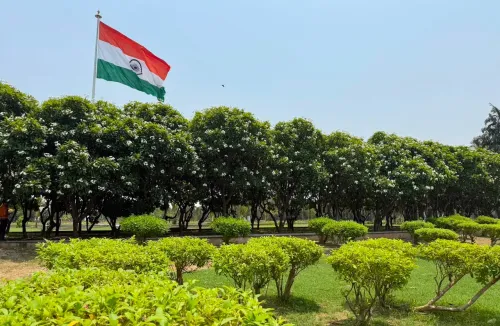
Amit Shah hails CAPFs as Environment Warriors on World Environment Day

Synopsis
On World Environment Day 2026, Union Home Minister Amit Shah credited the Central Armed Police Forces with planting over 7.5 crore saplings in six years, designating them 'Environment Warriors' and reaffirming the government's commitment to a greener, safer and healthier India.
Key Takeaways
Union Home Minister Amit Shah posted on World Environment Day, June 5, 2026 , honouring CAPFs for their conservation work.
The Central Armed Police Forces have planted over 7.5 crore saplings in six years , according to the post.
Shah designated the forces as 'Environment Warriors' , framing environment protection as a collective institutional responsibility.
The CAPFs — CRPF, BSF, CISF, ITBP and SSB — operate under the Ministry of Home Affairs and primarily handle internal security and border duties.
India's National Forest Policy, 1988 targets 33 per cent forest and tree cover, with central agencies including paramilitary forces encouraged to contribute.
The next Forest Survey of India report will be a key measure of whether CAPF plantations have improved recorded green cover.
Union Home Minister Amit Shah on Friday, June 5, 2026 — World Environment Day — lauded the Central Armed Police Forces for their role in nature conservation, saying they have planted over 7.5 crore saplings in six years and dedicated themselves as 'Environment Warriors' committed to building a greener India.
Context
Posting on the occasion of World Environment Day, Shah framed environment protection as a 'collective responsibility' and highlighted the CAPFs' afforestation work as a benchmark in conservation. He wrote: 'They have set new benchmarks in nature conservation, planting over 7.5 crore saplings in 6 years and taking care of them to achieve their full potential.'
The post was accompanied by a video, signalling an institutional communication marking the annual global observance. The message reflects the Ministry of Home Affairs' effort to project its paramilitary apparatus as a stakeholder in India's environmental goals alongside its core security mandate.
Policy Backdrop
The Central Armed Police Forces — comprising the CRPF, BSF, CISF, ITBP and SSB — operate under the Ministry of Home Affairs and are primarily tasked with internal security, border guarding and disaster response. Over successive years, afforestation has been incorporated as an auxiliary institutional responsibility, with CAPF units undertaking plantations on land under their control, including in border and insurgency-affected regions.
India's National Forest Policy, 1988 set a long-term target of 33 per cent forest and tree cover and encouraged participation by all central agencies, including paramilitary forces. Subsequent climate commitments and Five Year Plans have reinforced the expectation that government bodies contribute to expanding India's carbon sink.
Stakeholders and Impact
The primary beneficiaries of CAPF-led afforestation are communities adjacent to force establishments, particularly in ecologically sensitive border zones and conflict-affected regions where state forest departments have limited reach. Sapling survival and canopy development in such areas can contribute meaningfully to local biodiversity and micro-climate stability.
For the roughly 10 lakh personnel across the five CAPFs, the 'Environment Warriors' designation adds a civic dimension to institutional identity — positioning forces known for security duties as contributors to India's green transition. The framing also aligns with the government's broader narrative around Mission LiFE and sustainability targets.
What's Next
The next Forest Survey of India report will be a key data point to assess whether CAPF plantation drives have translated into measurable increases in recorded green cover in force-administered zones. Follow-up circulars from the Ministry of Home Affairs on sapling survival rates and maintenance protocols will indicate whether the initiative is being institutionalised beyond ceremonial observances. World Environment Day 2026 messaging from multiple ministries suggests the government intends to sustain the narrative of security forces as environmental actors in the run-up to upcoming climate review cycles.
Point of View
If substantiated in forthcoming official audits, would represent a significant institutional afforestation programme running parallel to civilian schemes. The 'Environment Warriors' framing also dovetails with the government's Mission LiFE narrative, suggesting coordinated messaging across ministries on sustainability. Whether this translates into verifiable forest cover gains will determine if the initiative is substantive policy or primarily symbolic outreach.
NationPress
21 Oct 2026
Frequently Asked Questions
What did Amit Shah say on World Environment Day 2026?
Union Home Minister Amit Shah posted on World Environment Day, June 5, 2026, praising the Central Armed Police Forces for planting over 7.5 crore saplings in six years and calling them 'Environment Warriors' committed to building a greener India.
How many saplings have the CAPFs planted?
According to Amit Shah's post, the Central Armed Police Forces have planted over 7.5 crore saplings over a period of six years as part of their nature conservation efforts.
Which forces are included in the Central Armed Police Forces?
The Central Armed Police Forces comprise five organisations under the Ministry of Home Affairs: the CRPF, BSF, CISF, ITBP and SSB, collectively employing roughly 10 lakh personnel.
What is India's forest cover target under the National Forest Policy?
India's National Forest Policy, 1988 set a long-term target of 33 per cent forest and tree cover for the country, encouraging all central agencies including paramilitary forces to contribute to afforestation.
What is the significance of World Environment Day?
World Environment Day, observed on June 5 each year, is the United Nations' principal vehicle for encouraging awareness and action for the protection of the environment, and is widely marked by Indian government ministries and agencies.