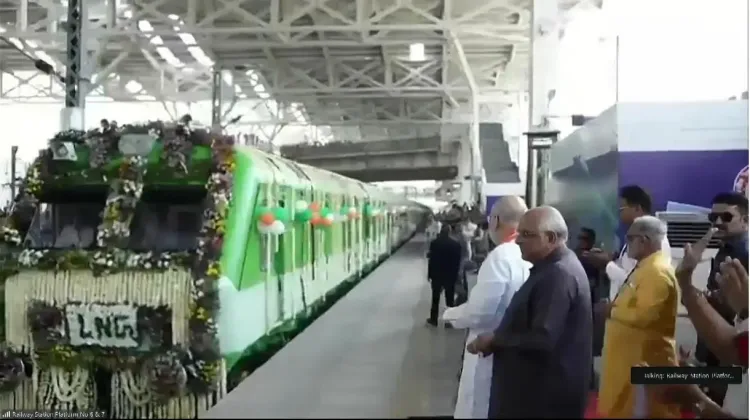
Amit Shah flags off India's first LNG-powered train at Sabarmati
Synopsis
India's first LNG-powered train rolled out of Sabarmati on Sunday — not as a concept but as a field-tested reality, with over 2,000 km of trials already logged. The dual-fuel system can displace up to 40% of diesel per trip and save Railways up to ₹23.9 lakh per eight-coach rake annually, signalling a credible, scalable green pivot for a network that runs on over 3 billion litres of diesel a year.
Key Takeaways
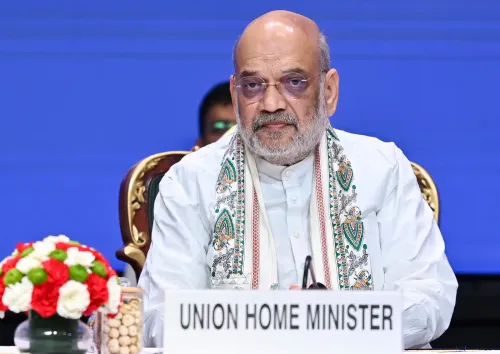
Amit Shah and Gujarat CM Bhupendra Patel flagged off India's first LNG-powered train from Sabarmati on 27 September 2026 .
The diesel-plus-LNG dual-fuel system can replace up to 40% of diesel consumption per trip.
Projected annual savings: ₹11.9 lakh per DPC and ₹23.9 lakh per eight-coach rake .
Each converted DPC carries a 2,200-litre LNG tank , offering roughly 1,600 km of range per fill.
More than 2,000 km of field trials were completed before Sunday's launch.
The launch was part of a broader ₹1,542 crore railway infrastructure package unveiled in Ahmedabad, including a ₹700 crore WAG-12 maintenance shed and the Kavach safety system rollout.
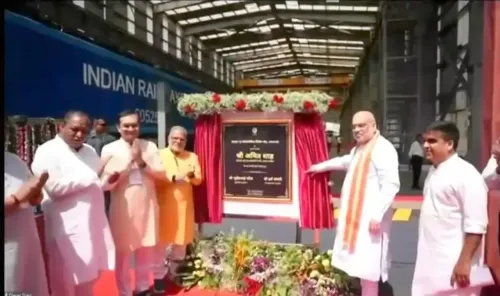
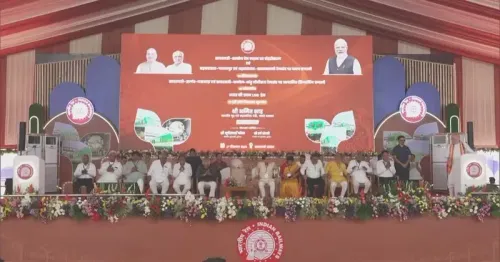
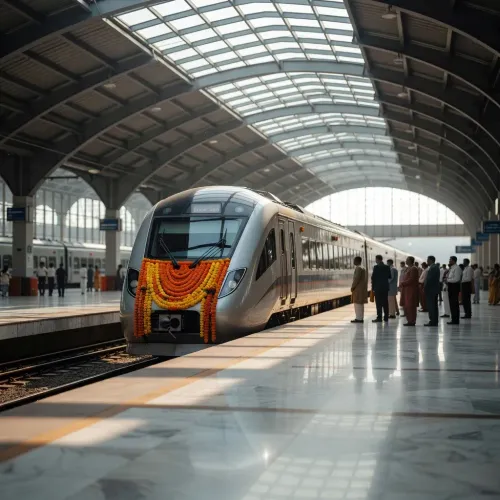
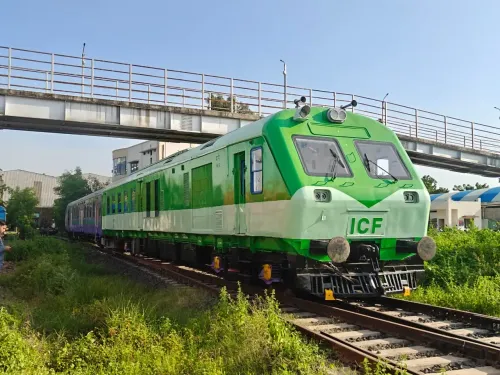
Union Home and Cooperation Minister Amit Shah and Gujarat Chief Minister Bhupendra Patel on Sunday, 27 September 2026, flagged off India's first LNG-powered train from the Sabarmati station in Ahmedabad, marking a landmark shift in Indian Railways' approach to alternative fuels. The launch introduces liquefied natural gas (LNG) as a partial substitute for conventional diesel in rail operations for the first time in the country.
How the Dual-Fuel System Works
The train runs on a diesel-plus-LNG dual-fuel system developed specifically for its Driving Power Cars (DPCs). Two 1,400 HP DPCs at the Sabarmati Integrated Coaching Depot have been retrofitted with the technology, enabling the engine to run on LNG alongside diesel. Crucially, the system retains full power and operational capability of the conventional diesel engine while enabling partial fuel substitution.
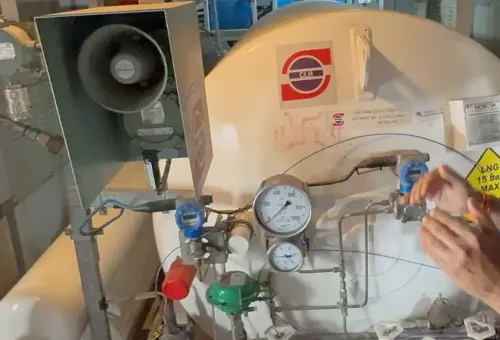
Each converted DPC carries an LNG tank of approximately 2,200 litres, capable of holding around 850–900 kg of usable LNG. A single full LNG fill is expected to support roughly 1,600 km of operation, significantly reducing refuelling frequency on long-distance routes.
Fuel Savings and Emissions Impact
Under the dual-fuel configuration, LNG can replace up to approximately 40% of diesel consumption. According to trial data released by the Railways, this substitution is expected to lower fuel expenditure and reduce emissions of carbon dioxide, nitrogen oxides, and particulate matter. Earlier railway assessments projected annual savings of around ₹11.9 lakh per DPC and approximately ₹23.9 lakh from an eight-coach rake.
The technology has already undergone more than 2,000 km of field trials on the two converted DPCs, covering performance and reliability evaluation before Sunday's formal launch.
Broader Railway Projects Unveiled
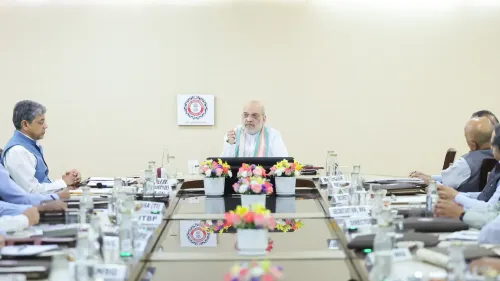
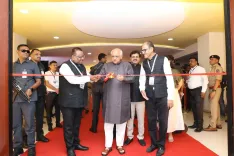
The LNG train flagging-off was part of a wider package of railway projects inaugurated during Shah's visit to Ahmedabad. The package covers projects worth more than ₹1,542 crore spanning railway safety, signalling, line capacity enhancement, and freight infrastructure.
Earlier in the day, Shah inaugurated a ₹700 crore WAG-12 locomotive maintenance shed at Sabarmati and flagged off a WAG-12 electric locomotive. The programme also included the commissioning of the indigenous Kavach train protection system on the Ahmedabad–Palanpur and Ahmedabad–Samakhiyali sections, automatic signalling on two railway sections, and the launch of doubling work on the Sabarmati–Sarkhej section.
Significance for Indian Railways' Green Push
This launch forms part of Indian Railways' broader strategy to decarbonise operations and reduce its dependence on imported diesel. Notably, LNG emits fewer pollutants than diesel at the point of combustion, and the dual-fuel design provides operational flexibility — allowing the engine to revert to diesel if LNG supply is unavailable on a given route. The Railways has been exploring multiple alternative fuel pathways, and the successful completion of over 2,000 km in field trials ahead of this launch lends the programme a degree of proven credibility that earlier pilot announcements lacked.
With the formal inauguration complete, the focus will now shift to whether Railways scales the technology beyond the initial two DPCs and how quickly LNG refuelling infrastructure can be built along key rail corridors.
Point of View
But its real test lies in replication. Two converted DPCs across a network of thousands of diesel locomotives is a pilot, not a programme. The projected savings of ₹23.9 lakh per rake are modest against the capital cost of conversion and the infrastructure investment required to build LNG refuelling corridors at scale. Indian Railways has a history of high-visibility green launches — hydrogen trains, solar coaches, electrification targets — where rollout speed has lagged inauguration optics. The 2,000 km of field trials give this initiative more technical credibility than most predecessors, but the accountability question remains: will Railways publish a clear scale-up roadmap with conversion targets, or will Sabarmati remain a solitary showcase?
NationPress
27 Sept 2026
Frequently Asked Questions
What is India's first LNG-powered train and where was it launched?
India's first LNG-powered train was flagged off from Sabarmati in Ahmedabad on 27 September 2026 by Union Home Minister Amit Shah and Gujarat CM Bhupendra Patel . The train uses a diesel-plus-LNG dual-fuel system installed on two 1,400 HP Driving Power Cars at the Sabarmati Integrated Coaching Depot.
How does the LNG dual-fuel system work on the train?
The system allows the engine to run on a combination of LNG and diesel, with LNG capable of replacing up to approximately 40% of conventional diesel consumption. If LNG is unavailable on a route, the engine can revert entirely to diesel, ensuring operational continuity.
What are the projected savings from using LNG on trains?
According to Railways data, the LNG dual-fuel system is expected to save approximately ₹11.9 lakh per Driving Power Car annually and around ₹23.9 lakh for an eight-coach rake. It also reduces emissions of carbon dioxide, nitrogen oxides, and particulate matter.
How much testing has the LNG train technology undergone?
The two converted DPCs completed more than 2,000 km of field trials before the formal launch, assessing the performance and reliability of the dual-fuel system under operational conditions.
What other railway projects were inaugurated alongside the LNG train?
Shah also inaugurated a ₹700 crore WAG-12 locomotive maintenance shed at Sabarmati, flagged off a WAG-12 electric locomotive, and commissioned the indigenous Kavach train protection system on the Ahmedabad–Palanpur and Ahmedabad–Samakhiyali sections. The total package of railway projects announced was worth more than ₹1,542 crore .