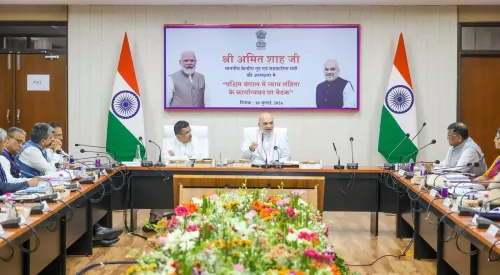
Amit Shah: Criminals Cannot Escape Law and Science

Synopsis
Union Home Minister Amit Shah declared on June 19, 2026 that no criminal can escape the combined strength of law and science, underscoring the MHA's drive to make forensic investigation mandatory under India's new criminal codes enacted in 2023 and in force since July 2024.
Key Takeaways
Amit Shah posted on June 19, 2026 that criminals cannot escape the combined strength of law and science.
India's new criminal codes, in force since July 2024 , make forensic examination mandatory for offences carrying seven or more years of imprisonment.
The Criminal Procedure (Identification) Act, 2022 expanded collection of biological and biometric samples to strengthen scientific evidence.
The National Forensic Sciences University , set up in Gandhinagar in 2020 , is the primary institution scaling up forensic training capacity.
National conviction rates for many serious offences remain below 50 percent , a key driver behind the forensic-first legislative push.
State compliance with mandatory forensic probe timelines and upcoming Union Budget allocations for labs are the next key indicators to watch.
Union Home Minister Amit Shah on Friday, June 19, 2026 asserted that no criminal, however cunning, can evade the combined force of law and science — a statement that arrives against the backdrop of sweeping reforms to India's criminal justice framework that mandate forensic investigation as a standard policing tool.
Context
Shah posted on X: 'Regardless of how cunning criminals are they cannot escape the combined strength of law and science.' The remark, brief but pointed, encapsulates the philosophy driving the Ministry of Home Affairs (MHA) push to embed scientific methods into routine police work across India.
The statement comes roughly two years after three landmark criminal laws — the Bharatiya Nyaya Sanhita, the Bharatiya Nagarik Suraksha Sanhita, and the Bharatiya Sakshya Adhiniyam — replaced colonial-era codes in July 2024. A central feature of those laws is the mandatory forensic examination of crime scenes in cases where the offence attracts seven or more years of imprisonment.
Policy Backdrop
The compulsory forensic probe requirement, introduced through the new criminal codes enacted in December 2023, marked a structural shift: for the first time, scientific evidence collection became a legal obligation rather than an optional investigative step. The Criminal Procedure (Identification) Act, 2022 had already expanded the permissible collection of biological and biometric samples, laying the evidentiary groundwork that the 2023 codes built upon.
Institutional capacity has been scaled up in parallel. The National Forensic Sciences University (NFSU), established in Gandhinagar in 2020, was created specifically to train forensic professionals and provide scientific support to state police forces. Long-running infrastructure programmes such as the Crime and Criminal Tracking Network and Systems (CCTNS) and expanded funding for Central Forensic Science Laboratories (CFSLs) have further deepened the technology backbone available to investigators.
The broader motivation is measurable: conviction rates for many serious offences in India have historically remained below 50 percent, a figure that policymakers argue can improve significantly when prosecutions are anchored in forensic evidence rather than relying predominantly on witness testimony.
Stakeholders and Impact
State police forces are the primary implementers of the new forensic mandates, and compliance varies. States must deploy trained forensic teams to crime scenes within stipulated timelines — a requirement that has exposed gaps in laboratory capacity and trained manpower in several jurisdictions. State governments have been pressed to invest in mobile forensic units and accredited labs to meet the statutory obligation.
For forensic laboratories — both central and state-run — the policy shift translates into a significant increase in case load. The NFSU and affiliated institutions have expanded intake of forensic science graduates to address the pipeline problem. Citizens and victims of crime stand to benefit if higher evidentiary standards translate into faster trials and stronger convictions.
What's Next
Attention will now turn to state-level compliance reports on mandatory forensic probes under the 2023 laws, with the next Union Budget expected to signal whether fresh allocations for forensic infrastructure are forthcoming. Shah's post reinforces that the political messaging around evidence-based policing will remain prominent as the new criminal codes complete their second year of operation. Any gap between legislative intent and ground-level implementation is likely to draw scrutiny from courts and civil society alike.
Point of View
Consistently framing the legislative overhaul as a modernisation of justice rather than a political project. By invoking science alongside law, the Home Ministry signals that the credibility of the reform rests on institutional capacity, not just statutory change. The real test, however, lies in state-level forensic infrastructure: mandating forensic probes means little if laboratories are under-staffed or backlogs persist. The post implicitly raises the bar against which the MHA's own governance record will be measured in the years ahead.
NationPress
21 Sept 2026
Frequently Asked Questions
What did Amit Shah say about criminals and science on June 19 2026?
Amit Shah posted on X that 'regardless of how cunning criminals are they cannot escape the combined strength of law and science,' reaffirming the government's emphasis on forensic-based policing under the new criminal codes.
What is the mandatory forensic investigation rule in India?
Under the Bharatiya Nagarik Suraksha Sanhita enacted in December 2023 and in force since July 2024 , forensic examination of crime scenes is compulsory in cases where the offence carries a sentence of seven or more years of imprisonment.
What is the National Forensic Sciences University and where is it located?
The National Forensic Sciences University (NFSU) is a central university established in 2020 in Gandhinagar, Gujarat to train forensic professionals and provide scientific support to law enforcement agencies across India.
Why are India's conviction rates low and how does forensic science help?
Conviction rates for many serious offences in India have historically remained below 50 percent , largely because prosecutions relied heavily on witness testimony. Mandatory forensic evidence collection is intended to build stronger, science-backed cases that are harder to challenge in court.
What are India's three new criminal laws?
The three laws — Bharatiya Nyaya Sanhita , Bharatiya Nagarik Suraksha Sanhita , and Bharatiya Sakshya Adhiniyam — replaced the Indian Penal Code, the Code of Criminal Procedure, and the Indian Evidence Act respectively, and came into force in July 2024 .