Amit Shah on cooperatives: small capital, big collective gains
Synopsis
Union Home Minister Amit Shah articulated the philosophy behind India's cooperative movement on 8 August 2026 — that pooling small capital creates large-scale enterprise benefiting many. His Ministry of Cooperation, formed in July 2021, is the institutional vehicle for realising that vision at national scale.
Key Takeaways
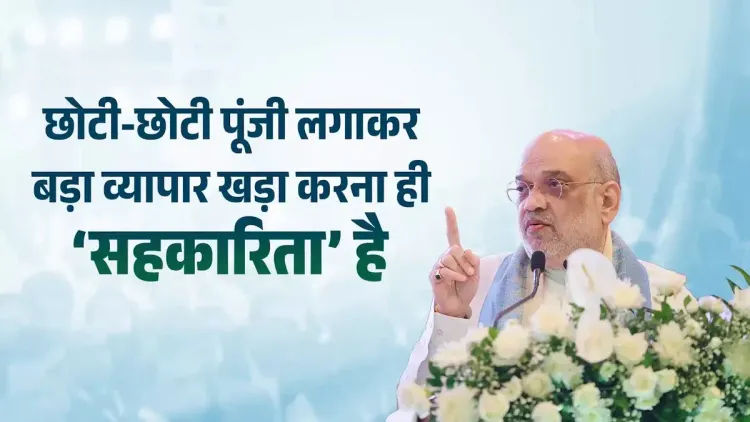
On 8 August 2026 , Amit Shah posted in Hindi that the cooperative concept is to build big business through small pooled capital for collective benefit.
The Ministry of Cooperation was created in July 2021 as India's first dedicated central ministry for the cooperative sector, with Shah as minister.
India's cooperative legislative framework dates to the Cooperative Credit Societies Act, 1904 and the Cooperative Societies Act, 1912 .
The ministry has prioritised computerisation of primary agricultural credit societies (PACS) and digital integration across the sector.
Key stakeholders are small farmers and cooperative members who rely on pooled resources for credit and market access.
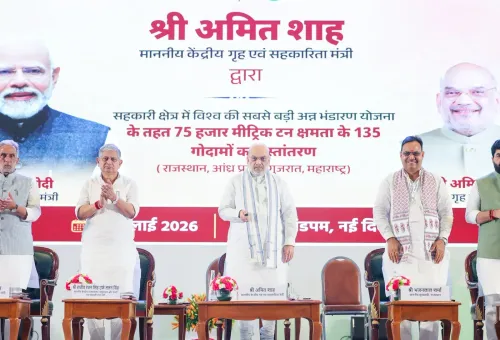
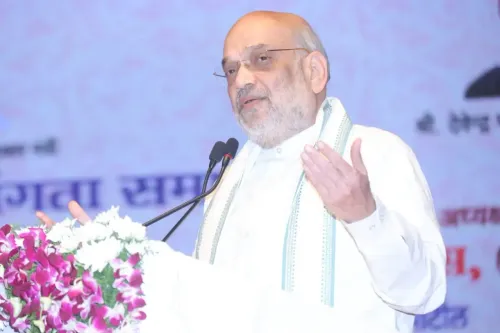
The cooperative model, at its core, is a bet on collective strength — that small contributions pooled together can build enterprises large enough to transform lives. On Saturday, 8 August 2026, Union Home Minister and Minister of Cooperation Amit Shah distilled that idea to its essence on X, posting in Hindi that the concept of cooperation is to build big business by investing small capital, so that many people can benefit.
Shah wrote: 'सहकारिता का कॉन्सेप्ट है कि छोटी-छोटी पूंजी लगाकर बड़ा व्यापार खड़ा किया जाए, जिससे अनेक लोगों का भला हो सके.' ('The concept of cooperation is to build big business by investing small capital, so that many people can benefit.')
Why a dedicated ministry changed the equation
India's cooperative movement is not new — its legislative roots stretch back to the Cooperative Credit Societies Act, 1904 and the Cooperative Societies Act, 1912. For over a century, cooperatives have served as vehicles for rural credit, agricultural marketing, and grassroots enterprise. Yet for decades the sector lacked a dedicated central advocate. That changed in July 2021, when the Government of India carved out a standalone Ministry of Cooperation — with Shah at its helm — to give the movement focused institutional attention for the first time. The ministry's mandate goes beyond symbolism. The present administration has pushed for digital integration of primary agricultural credit societies (PACS), reforms to the Multi-State Cooperative Societies Act, and a broader effort to formalise and scale what has historically been a fragmented sector. The target constituency is clear: small farmers and cooperative members who lack the individual capital to access credit or markets on their own terms.The arithmetic of collective capital
Shah's framing — small capital in, large enterprise out, many beneficiaries — is both a philosophy and a pitch. It positions cooperatives not as welfare instruments but as genuine business vehicles, capable of competing in modern markets when members pool resources. This is a deliberate reframing: cooperatives as engines of enterprise, not just safety nets. India has one of the world's largest cooperative ecosystems, spanning dairy, sugar, credit, fisheries, and housing. The challenge the ministry has repeatedly acknowledged is that scale and digital access remain uneven, with many primary societies still operating on paper registers. The push for computerisation of PACS and linkage to national digital infrastructure is the operational bet behind Shah's philosophical point. The cooperative model's promise has always been its arithmetic: what one smallholder cannot do alone, a thousand can do together. Shah's post is a reminder that the current administration has staked significant institutional capital on making that arithmetic work at national scale.Point of View
Where cooperatives are positioned as a bridge between smallholder agriculture and formal markets. Watching whether this rhetorical moment precedes concrete policy action — such as MSCS Act amendments or new PACS digital mandates — will be the real test of its significance.
NationPress
8 Aug 2026
Frequently Asked Questions
What is Amit Shah's role in India's cooperative sector?
Amit Shah is India's Union Minister of Cooperation, heading the dedicated Ministry of Cooperation created in July 2021 . He oversees policy, reform, and institutional development for the country's cooperative movement.
What did Amit Shah post about cooperatives on 8 August 2026?
Shah posted in Hindi that the concept of cooperation is to build large business by investing small capital, so that many people can benefit — a concise statement of the cooperative model's core philosophy.
When was India's Ministry of Cooperation created?
The Ministry of Cooperation was established in July 2021 as a standalone central ministry, the first of its kind in India, to give focused institutional support to the cooperative sector.
What are primary agricultural credit societies (PACS) in India?
PACS are grassroots cooperative institutions that provide short-term credit to farmers. The government has been working to computerise and digitally integrate them under the Ministry of Cooperation's reform agenda.
How old is India's cooperative movement?
India's cooperative movement has legislative roots going back to the Cooperative Credit Societies Act, 1904 and the Cooperative Societies Act, 1912 , making it over a century old.