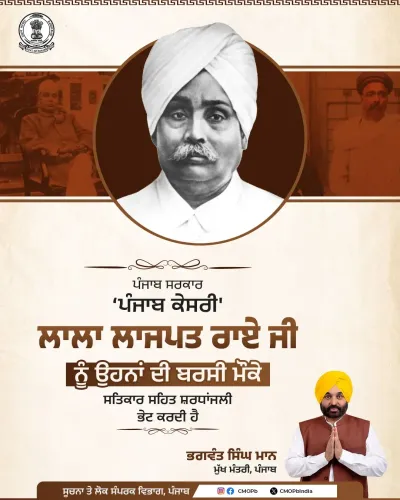
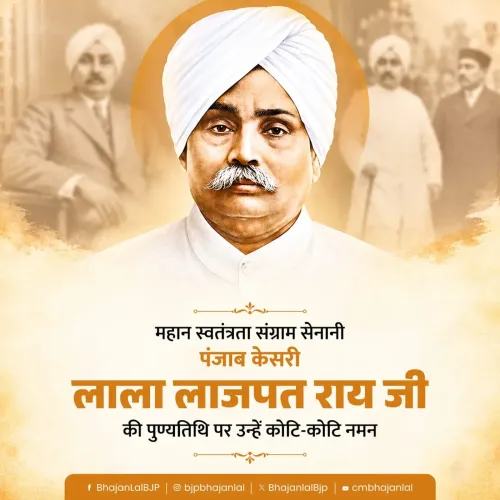
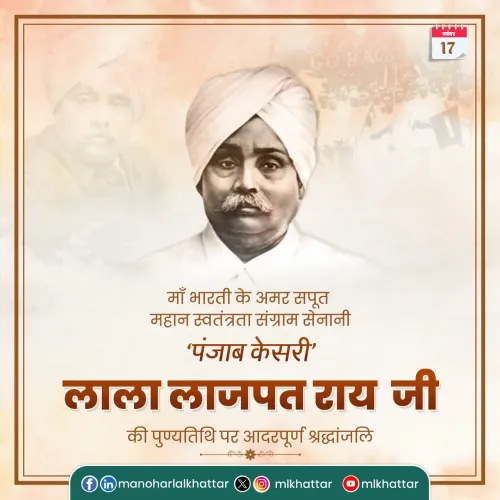
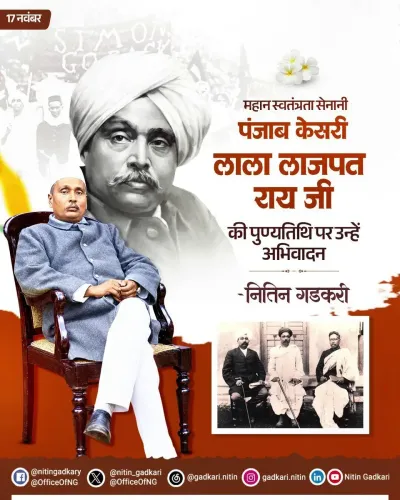
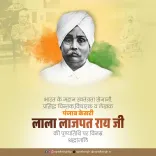
Amit Shah Pays Homage to Lala Lajpat Rai on Martyrdom Day
Synopsis
Union Home Minister Amit Shah marked the martyrdom anniversary of Lala Lajpat Rai on November 17, 2026, honouring the Punjab Kesari's defiance of the Simon Commission, his Swadeshi vision and his enduring role in India's independence movement.
Key Takeaways
Amit Shah posted a tribute to Lala Lajpat Rai on November 17, 2026 , the 98th anniversary of Rai's death.
Rai, known as Punjab Kesari , died on November 17, 1928 , from injuries sustained during the Simon Commission protest lathi-charge in Lahore .
Shah highlighted Rai's three legacy pillars: education, Swadeshi and seva (public service).
Rai was a member of the iconic Lal-Bal-Pal nationalist trio and founded the Servants of the People Society in 1921 .
His death directly inspired Bhagat Singh, Sukhdev and Rajguru , accelerating the independence movement in northern India.
Annual tributes to Rai on November 17 have been a fixture of official Indian commemoration since the 1950s .
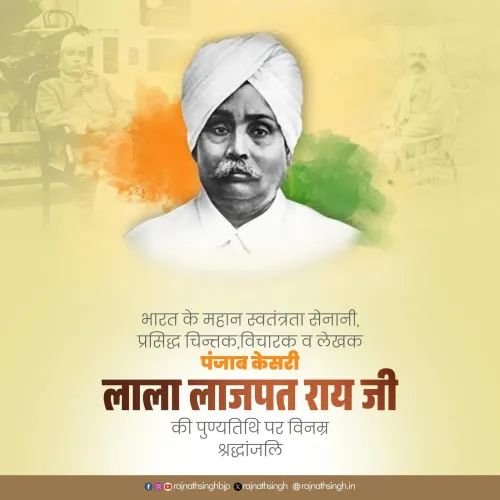
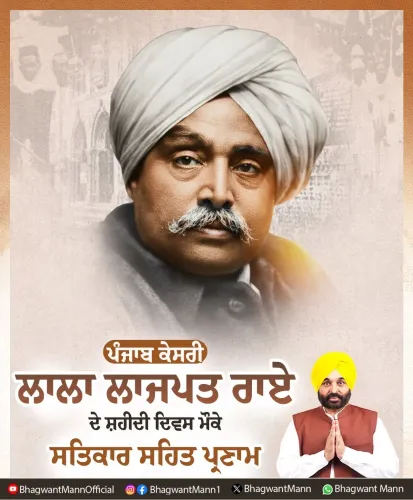
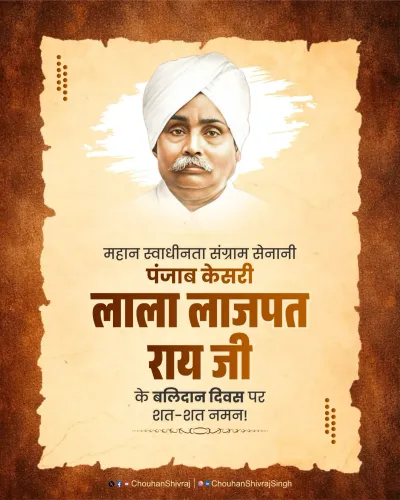
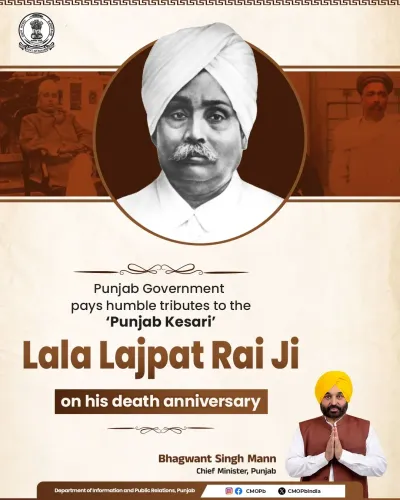
Ninety-eight years after Lala Lajpat Rai succumbed to injuries inflicted by colonial police batons in Lahore, India's senior-most home minister paused to remember the man who refused to let an empire pass unopposed. Union Home Minister Amit Shah posted a heartfelt tribute on Tuesday, November 17, 2026 — the death anniversary of the freedom fighter revered across Punjab and beyond as Punjab Kesari (the Lion of Punjab).
Shah wrote that Lala Lajpat Rai 'ignited the flame of freedom in every heart through his powerful ideas, indomitable courage and patriotism.' He noted that Rai united diverse sections of society against injustice and oppression, while simultaneously laying the foundations of nation-building through education, Swadeshi and public service. 'His struggle will forever be inscribed in golden letters in the history of India's freedom movement,' Shah said, offering his koti-koti naman — a salute repeated a hundred million times over.
The blow that shook a nation — Lahore, 1928
Lala Lajpat Rai was part of the towering Lal-Bal-Pal trio — alongside Bal Gangadhar Tilak and Bipin Chandra Pal — who gave Indian nationalism its first full-throated, confrontational voice in the early twentieth century. On October 30, 1928, Rai led a non-violent protest march in Lahore against the all-British Simon Commission, which had arrived to review constitutional reforms without a single Indian member. Police superintendent James Scott ordered a lathi-charge; Rai bore the brunt of the blows. He died on November 17, 1928 — eighteen days later — his final public words reported as a defiant declaration that every blow struck against him was a nail in the coffin of British rule in India.
The incident sent shockwaves through the nationalist movement, radicalising a younger generation. It directly inspired Bhagat Singh, Sukhdev and Rajguru to avenge Rai's death — an act that in turn accelerated the momentum of the independence struggle across northern India.
Swadeshi, education and the Punjab Kesari legacy
Shah's tribute specifically highlighted three pillars Rai stood for: education, Swadeshi and seva (service) — themes that extend well beyond the protest barricades. Rai founded the Servants of the People Society in 1921, an organisation that trained young men for social work and national reconstruction. He was deeply engaged with the question of indigenous economic self-reliance, writing and organising around the Swadeshi movement that sought to break India's dependence on British goods. His writings, including works on the political condition of India and on figures like Mazzini and Garibaldi, shaped the intellectual imagination of a generation of nationalists.
The annual commemoration on November 17 has drawn official tributes from national leaders since the decades following independence, with particular resonance in Punjab — the state whose identity Rai came to symbolise. Senior leaders across parties typically mark the date, but BJP figures have consistently foregrounded Rai's Swadeshi credentials and his resistance to colonial institutions as themes that echo present-day policy priorities.
A pattern of reclaiming early nationalist memory
Shah's post fits a broader and deliberate pattern among senior BJP leaders of publicly commemorating early-twentieth-century nationalists — particularly those associated with assertive, Swadeshi-oriented or Punjab-rooted traditions. These tributes serve simultaneously as acts of historical memory and as political signalling, connecting the party to a lineage of resistance that predates the Congress-dominated narrative of the independence movement. Whether that framing resonates or invites contestation, the underlying history of Lala Lajpat Rai needs no embellishment: a man beaten for demanding his country's dignity, dead at 63, still capable of inspiring prime-time tributes nearly a century later.
On the streets of Lahore in 1928, a baton could silence a voice for eighteen days. It could not silence the idea.
Point of View
Not an abstract calendar milestone. The deliberate emphasis on Swadeshi, education and self-reliance maps Rai's legacy onto themes the BJP government actively champions in its economic and social-policy messaging. Senior BJP figures have made the annual reclamation of pre-Congress nationalist memory a consistent political-cultural project, and Rai — assertive, Punjab-rooted, institution-building — fits that frame cleanly. The tribute is sincere in its historical content, but it also does political work: anchoring the party in a lineage of resistance that stretches back decades before 1947.
NationPress
17 Nov 2026
Frequently Asked Questions
Why is November 17 observed as Lala Lajpat Rai's martyrdom day?
Lala Lajpat Rai died on November 17, 1928, eighteen days after sustaining injuries from a police lathi-charge during a protest against the Simon Commission in Lahore, making the date his official martyrdom anniversary.
Who was Lala Lajpat Rai and why is he called Punjab Kesari?
Lala Lajpat Rai was a prominent Indian freedom fighter and nationalist leader. He earned the title Punjab Kesari, meaning 'Lion of Punjab', for his fearless leadership of the independence movement in the Punjab region and his defiant resistance to British colonial rule.
What was the Simon Commission and why did Lala Lajpat Rai oppose it?
The Simon Commission was a British-appointed body formed in 1927 to review India's constitutional setup; it had no Indian members. Lajpat Rai led protests against it in Lahore on October 30, 1928, arguing that Indians had the right to determine their own constitutional future.
What is the Lal-Bal-Pal trio in Indian history?
Lal-Bal-Pal refers to the trio of Lala Lajpat Rai, Bal Gangadhar Tilak and Bipin Chandra Pal — three nationalist leaders who advocated for assertive, Swadeshi-oriented resistance to British colonial rule in the early twentieth century.
What organisation did Lala Lajpat Rai found?
Lala Lajpat Rai founded the Servants of the People Society in 1921, an organisation dedicated to training young Indians for social service and national reconstruction.