IISc study flags groundwater risk in Andhra's ₹1 lakh crore 'Fruit Bowl' plan
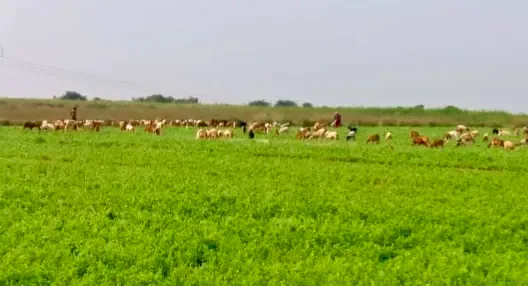
Synopsis
A landmark IISc study reveals that just 26% of wealthier farmers consume the lion's share of groundwater in Rayalaseema, while poorer rainfed farmers quietly replenish it — a finding that directly challenges Andhra Pradesh's ₹1 lakh crore plan to turn the drought-prone region into the 'Fruit Bowl of the World.' Researchers warn that even a modest expansion of water-intensive orchards could push the fragile water balance into overexploitation.
Key Takeaways
IISc researchers introduced a new Blue Water Potential (BWP) framework revealing deep inequalities in groundwater use across farming communities in Rayalaseema, Andhra Pradesh .
Perennial orchards (pomegranate, sweet lime, grapes) show a negative BWP of 1,000–1,200 mm/year , while rainfed groundnut and grasslands show a positive BWP of 200–300 mm/year .
A minority of 26% of wealthier farmers exploit most groundwater resources; poorer rainfed farmers and pastoralists are the primary replenishers.
The Andhra Pradesh government's ₹1 lakh crore plan aims to expand horticultural area from 8.41 lakh hectares to 14.41 lakh hectares in Rayalaseema.
Researchers warn that even modest orchard expansion could trigger groundwater overexploitation and call for a robust water impact assessment before the project scales.
The study includes open-source software by Rutuja Chitra-Tarak to compute BWP for any farming region globally.
A new study by researchers at the Indo-French Cell for Water Sciences (IFCWS) at the Indian Institute of Science (IISc), Bengaluru, has found that wealthier farmers extract the bulk of groundwater resources in semi-arid agricultural regions, while poorer farmers and pastoralists are the primary contributors to groundwater recharge — a dynamic that carries direct implications for Andhra Pradesh's ambitious ₹1 lakh crore horticultural expansion plan for Rayalaseema.
What the Study Found
The research, conducted at a village in the semi-arid Rayalaseema region of southern Andhra Pradesh, introduces a new metric called the Blue Water Potential (BWP) — designed to measure whether a given farming system contributes to or depletes groundwater reserves under optimal conditions. A positive BWP indicates net groundwater recharge; a negative BWP signals that irrigation demand outstrips the system's contribution to replenishment.
The findings reveal stark contrasts across crop types. Perennial irrigated orchards — including pomegranate, sweet lime, and grapes — recorded heavily negative BWP values, consuming roughly 1,000–1,200 mm per year more water than they return to the aquifer. By contrast, rainfed groundnut crops and grasslands exhibited a positive BWP of 200–300 mm per year.
The Social Inequality Dimension
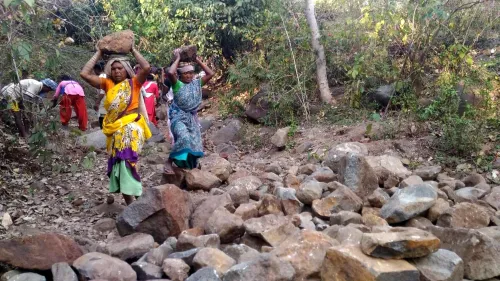
The study highlights a critical but often overlooked interdependence: a minority of 26% of wealthier farmers appear to exploit the majority of groundwater resources through horticulture, while a large majority of poorer rainfed groundnut farmers and pastoralists are responsible for replenishing those same aquifers. Yet, according to the researchers, policymakers consistently undervalue the contribution of this latter group.
'Conventional water accounting methods often focus on how much water agriculture consumes, without adequately considering who extracts groundwater and whose farming practices help replenish it. This can obscure the links between groundwater depletion, agricultural livelihoods, and social inequality,' the study notes.
The researchers argue that this hidden interdependence — where profitable irrigated agriculture depends on recharge generated by economically disadvantaged rainfed and grazing communities — must be incorporated into policy frameworks.
Implications for Andhra's Fruit Bowl of the World Project
The findings carry direct relevance for the Andhra Pradesh government's recently announced plan to transform the historically water-scarce Rayalaseema region into the so-called 'Fruit Bowl of the World.' The project, valued at ₹1 lakh crore, seeks to expand the region's horticultural area from 8.41 lakh hectares to 14.41 lakh hectares through large-scale irrigation infrastructure.
The study warns that even modest increases in fruit orchard coverage — crop systems with heavily negative BWP — could be sufficient to tip the region into groundwater overexploitation, particularly if that expansion comes at the expense of rainfed and grazing land that currently sustains the water balance. 'The regional water balance so far seems positive, but our results suggest that small increases in the area of cropping systems with highly negative BWP such as fruit trees would suffice to induce groundwater overexploitation, especially if this increase happens at the expense of the area with positive BWP,' said Charlotte Hemingway, first author and researcher at IFCWS.
What Researchers Are Calling For
Professor M Sekhar, co-author and faculty member at IISc's Department of Civil Engineering, stressed the need for a comprehensive water impact assessment before the project scales. 'A robust assessment is needed to determine the water that will be imported through canals to improve the current fragile water balance at the village scale against climate risks as well as to sustainably satisfy the future needs of altered crops,' he said.
The study also includes open-source software, developed by co-author and IISc alumna Rutuja Chitra-Tarak, that enables users to compute BWP for any cropping system or geographic region. The authors hope the tool will support the design of sustainable agricultural development policies across India and beyond.
Broader Policy Context
This comes amid growing concerns about groundwater depletion across peninsular India, where erratic monsoons and intensifying agriculture have put aquifer levels under sustained pressure. Notably, Rayalaseema has historically struggled with water scarcity, making it a region where the trade-offs between agricultural ambition and hydrological sustainability are especially acute. The IISc team's framework — which embeds social categorisation into water budgeting — represents a methodological departure from conventional assessments that treat agricultural water use as a monolithic variable. The research now awaits uptake by state and national policymakers before the Andhra expansion proceeds at scale.
Point of View
And the fact that it targets a historically water-scarce region makes the stakes higher. The question policymakers have so far not answered is whether the proposed canal imports can genuinely substitute for the recharge currently provided by rainfed systems — or whether the project will simply accelerate the dispossession of the farmers who currently keep the aquifer alive.
NationPress
12 Nov 2026
Frequently Asked Questions
What did the IISc study on Rayalaseema groundwater find?
The study found that a minority of 26% of wealthier farmers exploit the majority of groundwater resources through horticulture, while poorer rainfed groundnut farmers and pastoralists are the primary contributors to groundwater recharge. It introduced a new metric called Blue Water Potential (BWP) to quantify each farming community's net impact on groundwater.
What is Blue Water Potential (BWP) and why does it matter?
BWP is a new indicator developed by IFCWS-IISc researchers to measure whether a farming system contributes to or depletes groundwater under optimal conditions. A positive BWP means more water is recharged than consumed; a negative BWP means irrigation demand exceeds recharge. It matters because it embeds social categories into water budgeting, revealing inequalities that conventional methods miss.
Why does this study affect Andhra Pradesh's Fruit Bowl of the World project?
The Andhra Pradesh government's ₹1 lakh crore project plans to expand Rayalaseema's horticultural area from 8.41 lakh hectares to 14.41 lakh hectares. Since fruit orchards like pomegranate and grapes have heavily negative BWP values, researchers warn this expansion could tip the region's already fragile water balance into groundwater overexploitation, especially if it reduces rainfed land that currently replenishes aquifers.
What do the IISc researchers recommend for the Andhra horticulture project?
Co-author Professor M Sekhar of IISc's Department of Civil Engineering has called for a robust water impact assessment to determine whether canal imports can offset groundwater stress before the expansion proceeds. Researchers also recommend using the study's open-source BWP tool to model sustainable crop mixes for the region.
Which crops have the highest negative impact on groundwater in the study?
Perennial irrigated orchards — including pomegranate, sweet lime, and grapes — showed the most negative BWP, consuming roughly 1,000–1,200 mm per year more water than they return to the aquifer. Rainfed groundnut crops and grasslands, by contrast, showed a positive BWP of 200–300 mm per year.