Anurag Thakur corners Congress on EVM stand after state wins
Synopsis
BJP MP Anurag Thakur publicly asked whether Congress governments in Himachal Pradesh, Telangana and Kerala — all won via EVMs — should resign, exposing a long-standing inconsistency in the opposition's anti-EVM narrative.
Key Takeaways
Anurag Thakur , BJP Lok Sabha MP from Hamirpur , challenged Congress on November 4, 2026 over its EVM credibility stance.
Congress formed governments in Himachal Pradesh (2022) and Telangana (2023) through EVM-based elections it has elsewhere questioned.
Thakur asked whether Congress-led state governments should resign if the party genuinely disputes EVM integrity.
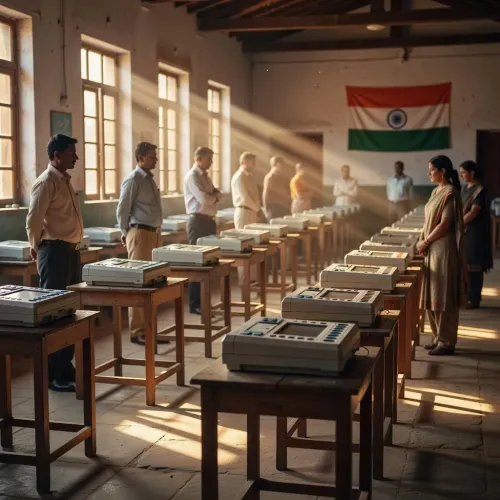
Electronic Voting Machines have been used in Indian national elections since 2004 and have been upheld by courts and the Election Commission.
The BJP has consistently framed EVM complaints as a pattern of selective objection — raised after losses, dropped after wins.
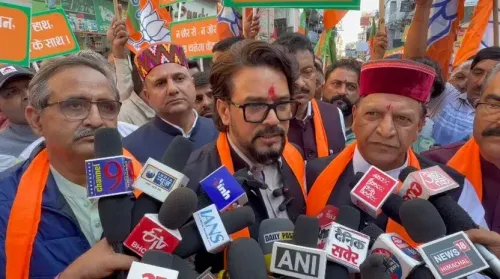
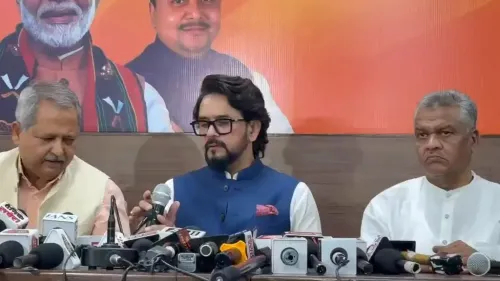
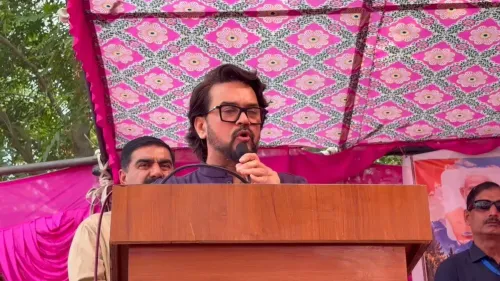
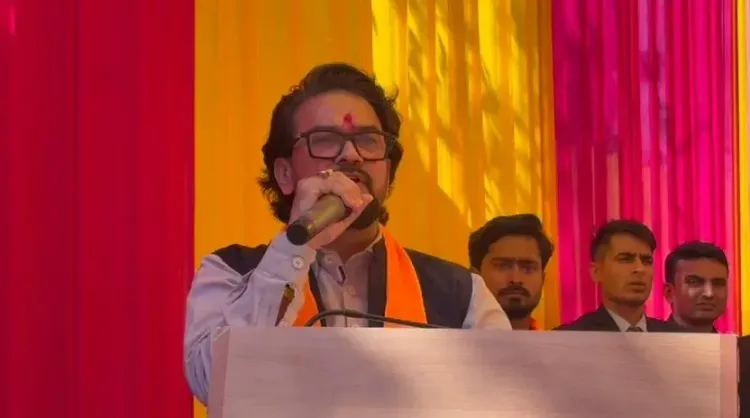
A pointed question from Hamirpur cut through Indian political discourse on Wednesday, November 4, 2026 — if Electronic Voting Machines are rigged, why aren't Congress's own state governments stepping down? BJP MP Anurag Thakur, posting from Hamirpur, turned the opposition's long-running EVM narrative back on itself with surgical precision.
Thakur's post, in Hindi, reads: 'Himachal, Telangana aur Kerala mein Congress ki sarkar EVM se chunkar aayi' — 'The Congress government in Himachal, Telangana and Kerala came to power through EVMs' — before delivering the sting: should these governments now resign? The rhetorical question is not idle. It goes straight to the credibility of a position opposition parties have held for years.
The EVM credibility trap Congress keeps walking into
Electronic Voting Machines have been a recurring flashpoint in Indian democracy ever since opposition voices began raising doubts, almost exclusively in the aftermath of defeats. Himachal Pradesh fell to Congress in 2022. Telangana followed in 2023. Both victories arrived on the same EVM infrastructure that the party has questioned whenever results go the other way.
That asymmetry is precisely Thakur's target. The BJP has consistently argued that EVM complaints are a loser's alibi — accepted quietly when the same machines deliver Congress wins, loudly challenged when they don't. By naming three specific states, Thakur grounds what could have been an abstract argument in concrete, dateable electoral facts.
Thakur's Hamirpur platform and the larger BJP counter-narrative
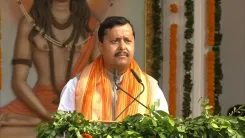
Anurag Thakur, a multiple-term Lok Sabha MP from Hamirpur, Himachal Pradesh and former Union Minister for Information & Broadcasting and Youth Affairs & Sports, has been one of the BJP's most aggressive front-bench communicators. His posts from Hamirpur carry both local resonance — Himachal is a Congress-governed state — and national reach.
The reference to 'SIR' in connection with Kerala remains unclear; the research background flags it as unverified and NationPress does not assert its meaning. What is clear is the structural argument: all three state governments were formed through the same EVM-based electoral process whose integrity Congress has publicly questioned at the national level.
A question the opposition has not answered cleanly
India's Election Commission has repeatedly defended EVM integrity, citing end-to-end security protocols, independent audits, and the machine's unbroken record across decades of elections since nationwide adoption in 2004. Courts have upheld the system. And yet the debate refuses to die — revived reliably after every major BJP win, and just as reliably shelved after every Congress one.
Thakur's post does not demand a policy change. It demands consistency. That is a harder ask — and one that Congress has not yet publicly addressed following this salvo from Hamirpur.
Point of View
He makes it difficult for Congress to dismiss as rhetoric. The broader arc here is a party that has struggled to build a credible, consistent position on electoral infrastructure — winning on EVMs in one cycle and questioning them in the next is a vulnerability the BJP will keep exploiting, especially ahead of any future assembly or Lok Sabha election cycle. The post also signals that Hamirpur, a Congress-governed state, remains contested political terrain for Thakur personally.
NationPress
4 Nov 2026
Frequently Asked Questions
What did Anurag Thakur say about Congress and EVMs?
Thakur pointed out that Congress governments in Himachal Pradesh, Telangana and Kerala were all elected via EVMs, and asked whether these governments should resign if the party doubts the machines' integrity.
Which states did Anurag Thakur mention in his EVM post?
He specifically named Himachal Pradesh, Telangana and Kerala as states where Congress came to power through EVM-based elections.
When were EVMs introduced in Indian elections?
EVMs were piloted in Indian elections from the 1980s and used nationwide for the first time in the 2004 Lok Sabha general elections.
Has Congress responded to Thakur's EVM challenge?
As of November 4, 2026, no formal public response from Congress leadership to Thakur's specific post has been reported.
Why do opposition parties question EVMs?
Opposition parties, primarily after electoral defeats, have alleged EVM tampering or unreliability — a claim the Election Commission of India and courts have consistently rejected.