Anurag Thakur Hails ₹5,070 Cr Floating Solar Scheme
Synopsis
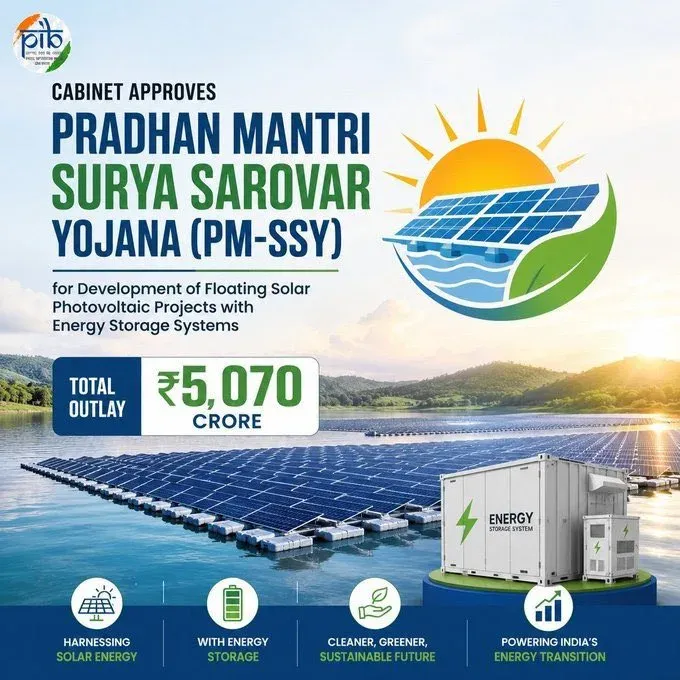
The Union Cabinet has approved the Pradhan Mantri Surya Sarovar Yojana, a ₹5,070 crore scheme to deploy 5,000 MW of floating solar on Indian reservoirs with 10,000 MWh storage, targeting 10 million tonnes of annual CO₂ cuts and 17,000 jobs. BJP MP Anurag Thakur welcomed the move as a step toward a self-reliant, greener India.
Key Takeaways
Cabinet has approved the Pradhan Mantri Surya Sarovar Yojana with a total outlay of ₹5,070 crore .
The scheme targets 5,000 MW of floating solar capacity on reservoirs and inland water bodies, integrated with a minimum 10,000 MWh of energy storage.
Annual CO₂ emissions reduction projected at nearly 10 million tonnes .
Expected to generate between 16,000 and 17,000 employment opportunities .
Explicitly promotes domestic solar manufacturing under the Aatmanirbhar Bharat framework.
Builds on the policy lineage of the National Solar Mission (2010) and PM-KUSUM (2019) , scaling floating solar to grid-level ambition.
India's reservoirs are about to pull double duty. The Union Cabinet has approved the Pradhan Mantri Surya Sarovar Yojana, a ₹5,070 crore scheme to build 5,000 MW of floating solar capacity on inland water bodies — paired with energy storage systems of at least 10,000 MWh — in what the government frames as a decisive push to generate clean power without consuming scarce land. BJP MP Anurag Thakur, reacting on 31 July 2026, called it 'a visionary step towards a greener, sustainable and self-reliant Viksit Bharat.'
Floating Solar: India's Answer to the Land Problem
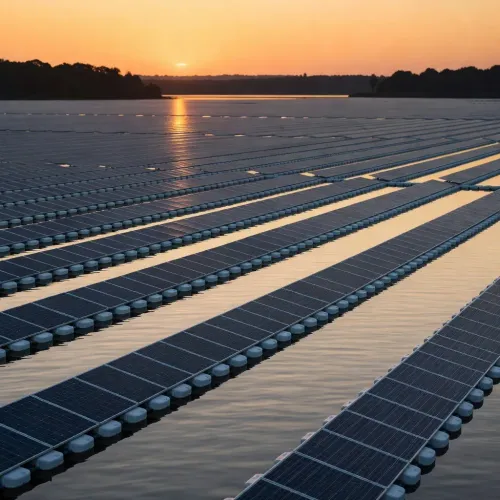
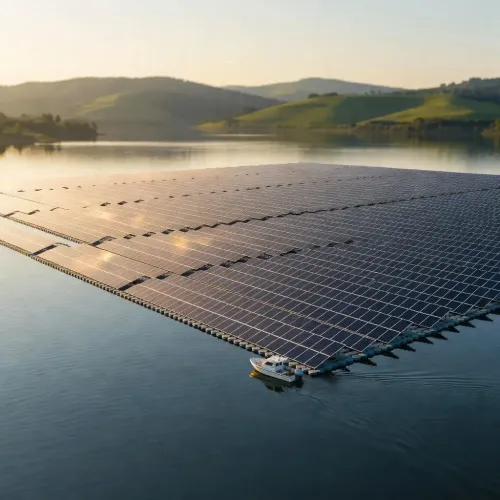
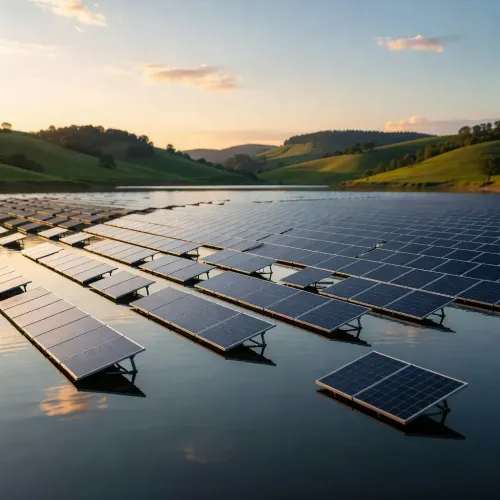
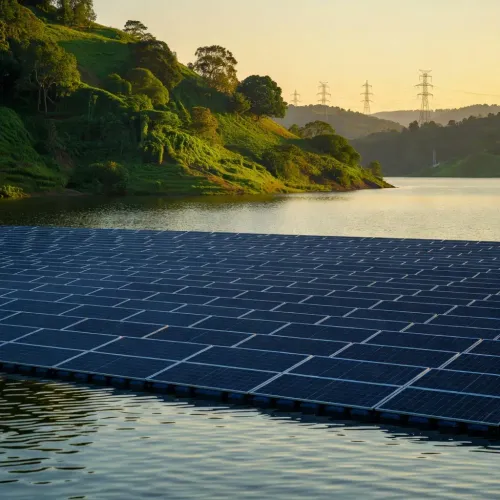
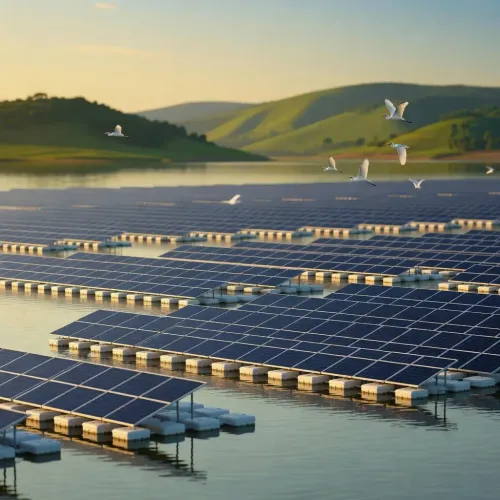
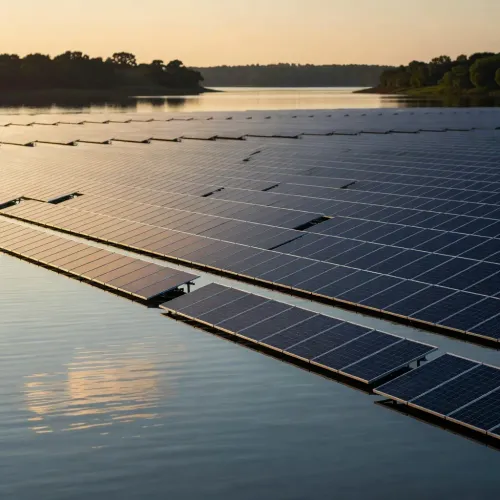
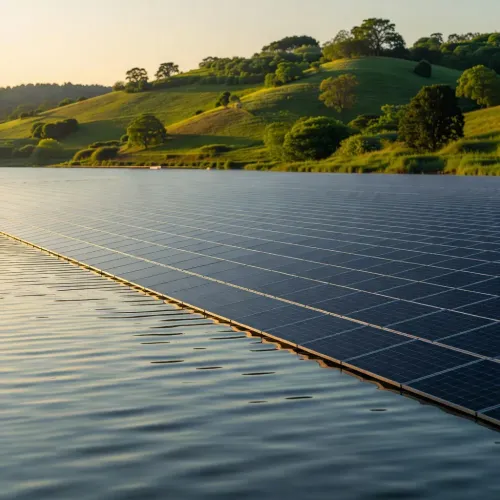
Land scarcity has been the quiet chokepoint in India's solar ambitions for years. Utility-scale ground-mounted plants demand vast tracts of flat, unshaded terrain — a commodity increasingly contested by agriculture, housing, and ecology. Floating solar on reservoirs sidesteps that constraint entirely, using water surfaces that are otherwise idle. The PM Surya Sarovar Yojana formalises this approach at national scale, targeting India's network of irrigation reservoirs and inland water bodies as the host infrastructure.
The integrated storage mandate — a minimum of 10,000 MWh — is the scheme's engineering backbone. Solar generation peaks at noon; grid demand peaks in the evening. Without storage, variable renewable power strains grid operators. By bundling dispatch-ready storage into every project, the scheme is designed to deliver firm, schedulable power rather than intermittent generation — a critical distinction as India's renewable share rises.
The Numbers Behind the Scheme
At 5,000 MW of installed capacity, the scheme is projected to cut nearly 10 million tonnes of CO₂ emissions annually — roughly equivalent to taking several million petrol cars off the road each year. It is also expected to generate between 16,000 and 17,000 direct employment opportunities, spanning project construction, operations, and domestic equipment supply chains.
That last point connects to a broader industrial goal. The scheme explicitly promotes domestic manufacturing under the Aatmanirbhar Bharat framework, the self-reliance initiative launched in 2020 to reduce India's dependence on imported solar modules — a vulnerability exposed sharply during supply-chain disruptions in recent years. Production-linked incentive structures for solar equipment are already in place; the Surya Sarovar Yojana becomes a guaranteed demand anchor for that domestic industry.
From National Solar Mission to Reservoir-Scale Ambition
The policy lineage here runs deep. India's National Solar Mission, launched in 2010, set the original grid-solar trajectory. The PM-KUSUM scheme, approved in 2019, extended solar to agricultural land and small water bodies for farm-pump solarisation. The Surya Sarovar Yojana represents the next logical escalation — moving from farm-level installations to reservoir-scale, storage-integrated, grid-feeding infrastructure. Each step has expanded both the ambition and the engineering complexity.
PM Narendra Modi, who has championed the International Solar Alliance as a multilateral instrument for global solar deployment, now has a flagship domestic scheme that mirrors that international pitch: large-scale, storage-backed, land-light solar generation.
What Comes Next for 5,000 MW
Approval is the starting gun, not the finish line. The immediate watch-points are the issuance of detailed project guidelines, tender timelines for the 5,000 MW capacity, and — critically — coordination between central authorities and state irrigation and power departments over which reservoirs get selected. Reservoir rights, water-use agreements, and state grid infrastructure will all need alignment before a single panel goes into the water.
India has set itself non-fossil power targets that demand exactly this kind of large-block, reliable renewable addition. The Surya Sarovar Yojana, if executed on schedule, gives grid planners a firm block of dispatchable clean capacity. The reservoirs are ready. The question now is how fast the tenders flow.
Point of View
Dispatchable power. This directly addresses the grid-stability critique that has shadowed India's renewable push. Politically, the scheme also hands the BJP a tangible, costed infrastructure announcement that fuses energy security, climate credentials, and the Aatmanirbhar Bharat industrial narrative — a trifecta with broad electoral and diplomatic utility. The real test, as with PM-KUSUM before it, will be execution speed and state-level coordination, where earlier schemes have repeatedly stalled.
NationPress
31 Jul 2026
Frequently Asked Questions
What is the Pradhan Mantri Surya Sarovar Yojana?
It is a central government scheme approved by the Union Cabinet to develop 5,000 MW of floating solar power on India's reservoirs and inland water bodies, integrated with energy storage systems of at least 10,000 MWh, at a total outlay of ₹5,070 crore.
What is floating solar power and why use reservoirs?
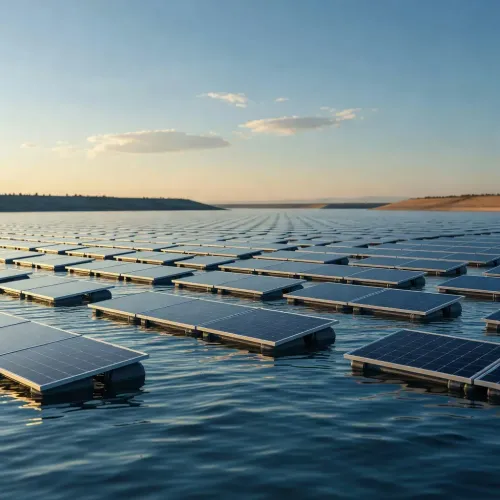
Floating solar involves mounting photovoltaic panels on water surfaces such as reservoirs instead of land. Using reservoirs avoids competition with scarce agricultural or urban land while tapping idle water-surface area for clean power generation.
How many jobs will the Surya Sarovar Yojana create?
The scheme is projected to generate between 16,000 and 17,000 employment opportunities across construction, operations, and domestic equipment manufacturing.
How much will the scheme reduce CO2 emissions?
The government projects the scheme will reduce CO₂ emissions by nearly 10 million tonnes every year once fully operational.
How does this scheme connect to Aatmanirbhar Bharat?
The Surya Sarovar Yojana explicitly promotes domestic manufacturing of solar equipment, acting as a large guaranteed demand source for Indian solar module producers and reducing dependence on imports, in line with the Aatmanirbhar Bharat self-reliance initiative launched in 2020.