Anurag Thakur: India-ASEAN Must Choose Cooperation Over Competition
Synopsis
BJP MP Anurag Thakur has called on India and ASEAN to anchor their shared future in cooperation rather than competition, highlighting that the two together represent nearly one-fourth of the world's population — a pointed signal ahead of upcoming India-ASEAN diplomatic engagements.
Key Takeaways
BJP MP Anurag Thakur posted on 17 November 2026 that India and ASEAN together represent nearly one-fourth of the world's population .
He argued that this shared demographic weight demands a future defined by cooperation, not competition .
India's Act East Policy , rebranded in 2014 from the 1990s Look East Policy, underpins the strategic rationale for deeper India-ASEAN ties.
The India-ASEAN Free Trade Agreement was signed in 2009 ; relations were elevated to a Strategic Partnership in 2012 .
ASEAN is a 10-member bloc founded in 1967 and is central to India's Indo-Pacific security and economic framework.
Upcoming India-ASEAN Summits and Foreign Ministers' Meetings represent the next concrete test of this cooperative ambition.
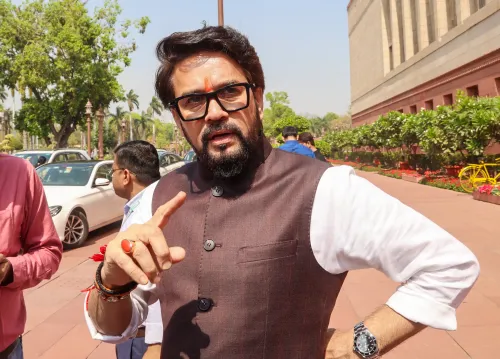
A quarter of humanity shares a common future — and BJP MP Anurag Thakur wants that future shaped by partnership, not rivalry. On Tuesday, 17 November 2026, the former Union Minister posted a pointed reminder that India and ASEAN together represent nearly one-fourth of the world's population, and that this shared demographic weight carries a clear obligation: to let cooperation, not competition, define the relationship.
Thakur's post, in Hindi, states: 'भारत और आसियान मिलकर विश्व की लगभग एक-चौथाई जनसंख्या का प्रतिनिधित्व करते हैं, यह सुनिश्चित करना जरूरी है कि हमारा भविष्य competition से नहीं, cooperation से तय हो.' ('India and ASEAN together represent nearly one-fourth of the world's population; it is essential to ensure that our future is determined not by competition, but by cooperation.')
From 'Look East' to 'Act East': India's Long Pivot Toward ASEAN
India's engagement with ASEAN did not appear overnight. The relationship traces back to the early 1990s Look East Policy, rebranded under the current strategic framework as the Act East Policy in 2014 — a signal that passive orientation had to give way to active outreach. The India-ASEAN Free Trade Agreement, signed in 2009, and the elevation of ties to a Strategic Partnership in 2012, laid the institutional scaffolding that Thakur's post now invokes.
The ten-member ASEAN bloc — founded in 1967 — covers economies stretching from Vietnam and Thailand to Indonesia and the Philippines. For India, it is not simply a trade corridor; it sits at the heart of New Delhi's Indo-Pacific calculus, touching maritime security, digital connectivity, and infrastructure financing.
Why 'Cooperation Over Competition' Is Not Merely Rhetoric
The framing matters. The Indo-Pacific is a theatre where multiple large economies — including China — are actively competing for influence, investment, and alignment. Thakur's explicit elevation of cooperation as the governing logic is a deliberate rhetorical choice, one that echoes the multilateral, rules-based language India has consistently deployed in ASEAN-linked forums.
The numbers support the urgency. A combined bloc representing roughly 1.9 billion people — drawing from India's population of over 1.4 billion and ASEAN's roughly 680 million — creates one of the largest potential markets and strategic partnerships on earth. Whether that potential is harvested through trade facilitation, connectivity projects, or joint maritime frameworks will depend on exactly the cooperative instinct Thakur is championing.
The next concrete test will come at the forthcoming India-ASEAN Summit and senior-level foreign ministers' meetings, where progress on pending connectivity projects and trade facilitation measures is expected to be on the table. Thakur's post lands as a timely signal of where Indian political sentiment stands ahead of those engagements.
One-fourth of the world's people deserve better than a future decided by rivalry. The question is whether the summits that follow will match the ambition of the statement.
Point of View
Arriving as India navigates a crowded Indo-Pacific where Beijing's influence across ASEAN member states continues to deepen. By invoking the sheer demographic scale of the India-ASEAN relationship, he is implicitly making the case that New Delhi and Southeast Asia have more to gain from alignment than from hedging. This aligns with the Act East Policy's core thesis — that India must be a net provider of stability and trade opportunity in the region, not merely a reactive power. The post signals that across party lines, deepening ASEAN engagement remains a durable pillar of Indian foreign policy consensus.
NationPress
17 Nov 2026
Frequently Asked Questions
What did Anurag Thakur say about India and ASEAN?
BJP MP Anurag Thakur stated that India and ASEAN together represent nearly one-fourth of the world's population, and that it is essential to ensure their shared future is determined by cooperation, not competition.
What is India's Act East Policy?
India's Act East Policy, formalised in 2014 as an upgrade of the earlier Look East Policy from the 1990s, prioritises deeper economic, strategic, and people-to-people ties with ASEAN and broader Asia-Pacific nations.
When was the India-ASEAN Free Trade Agreement signed?
The India-ASEAN Free Trade Agreement was signed in 2009, and the two sides upgraded their relationship to a Strategic Partnership in 2012.
How many countries are in ASEAN and when was it founded?
ASEAN is a 10-member bloc founded in 1967. Its members include Indonesia, Malaysia, the Philippines, Singapore, Thailand, Brunei, Vietnam, Laos, Myanmar, and Cambodia.
Why does India view ASEAN as important for its foreign policy?
India views ASEAN as central to its Indo-Pacific strategy, covering maritime security, trade connectivity, digital infrastructure, and building a rules-based regional order as a counterbalance to growing Chinese influence.