Anurag Thakur Plants Trees in Hamirpur, Cites Culture

Synopsis
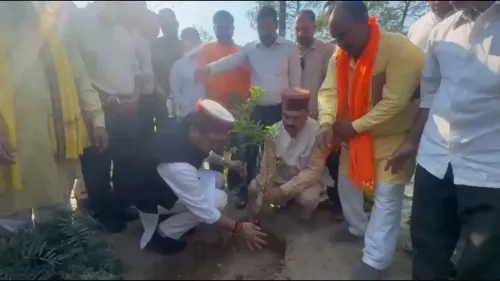
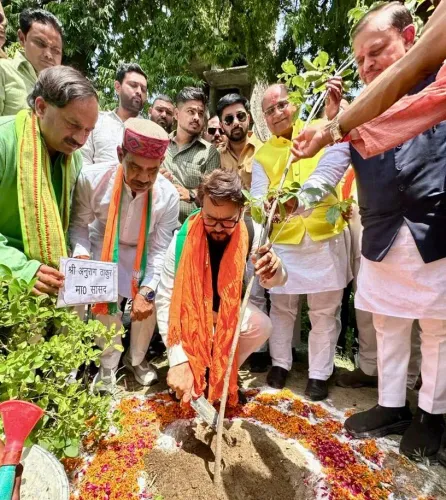
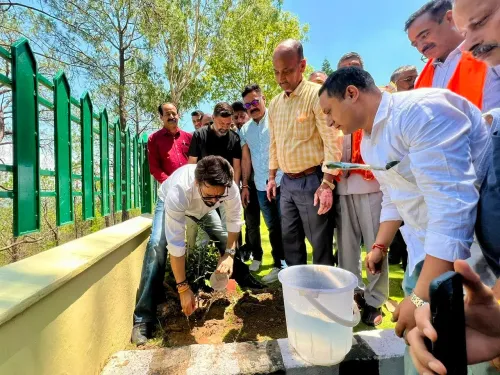
BJP MP Anurag Thakur participated in a tree-plantation drive in Hamirpur on June 6, 2026, framing conservation as a cultural value rather than a trend. His call — 'plant trees, save the earth' — echoes national afforestation schemes and the Himalayan region's deep-rooted forest stewardship legacy.
Key Takeaways
BJP MP Anurag Thakur participated in a tree-plantation drive in Hamirpur, Himachal Pradesh on June 6, 2026 .
He framed environmental conservation as 'part of Indian culture' , explicitly rejecting the idea that it is a 'fashion statement' .
The drive aligns with the national Ek Ped Maa Ke Naam campaign launched in 2024 and the annual Van Mahotsav tradition dating to 1950 .
Hamirpur 's Shivalik foothills terrain makes it ecologically vulnerable to soil erosion and landslides, giving local plantation drives direct community relevance.
The BJP's cultural framing of environmental action mirrors messaging used by the party's MPs across other ecologically sensitive Himalayan constituencies.
India's afforestation policy backbone — the Forest Conservation Act (1980) and the National Afforestation Programme (2000) — provides the institutional context for such drives.
BJP MP Anurag Thakur participated in a tree-plantation drive in his Lok Sabha constituency Hamirpur, Himachal Pradesh, on Saturday, June 6, 2026, framing environmental conservation as a cultural imperative rather than a trend. Posting on X, he declared: 'Paryavaran sanrakshan hamare liye fashion statement nahin, hamari sanskriti ka hissa hai' ('Environmental protection is not a fashion statement for us — it is part of our culture'), accompanied by the call to action 'Vriksh lagayen, dhara bachaen' ('Plant trees, save the earth').
Context
The post, geotagged at Hamirpur, places Thakur visibly in his constituency during what is traditionally the pre-monsoon plantation season in the Shivalik foothills. Hamirpur sits in a terrain that is ecologically sensitive, with forested hillsides vulnerable to soil erosion, deforestation pressure, and seasonal landslides. A video accompanying the post showed ground-level activity consistent with a plantation event, though specific details of the event were not stated in the caption.
The timing aligns with Van Mahotsav, India's annual tree-planting festival observed since 1950, which typically draws participation from elected representatives across the country in the first week of July — and increasingly, in the lead-up to the monsoon in June.
Policy Backdrop
India's afforestation policy architecture stretches back to the Forest Conservation Act of 1980, which regulated the diversion of forest land for non-forestry use. The National Afforestation Programme (2000) built on this by supporting regeneration of degraded forests through Joint Forest Management Committees at the community level. More recently, the Ek Ped Maa Ke Naam campaign, launched in 2024, invited citizens nationwide to plant trees as a tribute to their mothers, embedding afforestation in an emotional and cultural register — the same register Thakur invoked in his post.
Himachal Pradesh has its own layered history of community-led forest stewardship, drawing on the legacy of the Chipko Movement of the 1970s, which originated in the broader Himalayan belt and established a template for grassroots environmental action. The state also implemented the Mid-Himalayan Watershed Development Project from 2006 onward to address soil erosion and improve vegetative cover in rural areas.
Stakeholders and Impact
The immediate beneficiaries of plantation drives in Hamirpur are rural communities, hill farmers, and local youth groups who depend on stable forest cover for watershed health, agricultural productivity, and protection against landslides. Community participation — rather than purely government-led planting — has historically been the more durable model in Himalayan constituencies, and Thakur's cultural framing appears designed to reinforce that ownership.
The BJP has consistently positioned environmental action in Himalayan constituencies as an extension of indigenous tradition rather than as a response to international climate frameworks, a distinction that resonates with rural voters who are wary of top-down mandates but receptive to appeals rooted in local identity.
What's Next
Attention will turn to Himachal Pradesh's state government announcements on monsoon plantation targets for 2026, as well as any parliamentary debate on the Forest Conservation Amendment Act in the upcoming session. Thakur's visible constituency engagement ahead of the monsoon season signals that afforestation is likely to remain a recurring theme in his public communication through the rainy months. Whether the drive feeds into a formal target under a state or central scheme is expected to become clearer as official plantation figures are released.
Point of View
Which the party has often framed as Western-imposed. By geotagging Hamirpur and appearing personally at a plantation drive, he reinforces constituency-level visibility while aligning with central government schemes like Ek Ped Maa Ke Naam. The cultural framing also serves a political function: it pre-empts opposition charges that the BJP is indifferent to ecology by asserting a civilisational claim to environmental stewardship. Across Himalayan constituencies where forest cover and water security are lived concerns, this messaging tends to land more effectively than policy citations alone.
NationPress
24 Oct 2026
Frequently Asked Questions
Why did Anurag Thakur plant trees in Hamirpur?
Anurag Thakur participated in a tree-plantation drive in his Lok Sabha constituency Hamirpur on June 6, 2026, as part of pre-monsoon afforestation efforts, framing the act as an expression of Indian cultural values.
What is the Ek Ped Maa Ke Naam campaign?
Ek Ped Maa Ke Naam is a nationwide tree-plantation campaign launched in 2024 that encourages citizens to plant trees as a tribute to their mothers, embedding afforestation in an emotional and cultural context.
What did Anurag Thakur say about environment conservation?
He said environmental protection is 'not a fashion statement' but 'part of our culture', urging people to plant trees and save the earth — a message posted on X alongside a video from Hamirpur.
What is Van Mahotsav and when is it observed?
Van Mahotsav is India's annual tree-planting festival observed since 1950, typically held in the first week of July, that promotes afforestation and environmental awareness across the country.
Why is Hamirpur ecologically significant?
Hamirpur lies in the Shivalik foothills of Himachal Pradesh, an area prone to soil erosion, deforestation pressure, and landslides, making forest cover and plantation drives directly relevant to the livelihoods of local farming and rural communities.