Article 370 abrogation advanced constitutional equality, says BJP report
Synopsis
Six years after Article 370's abrogation, BJP spokesperson Guru Prakash Paswan argues in Firstpost that the 2019 decision was less a political manoeuvre and more a constitutional reckoning — one that finally extended India's full legal protections to Scheduled Tribes, OBCs, and other marginalised communities in Jammu and Kashmir who had been excluded for seven decades.
Key Takeaways
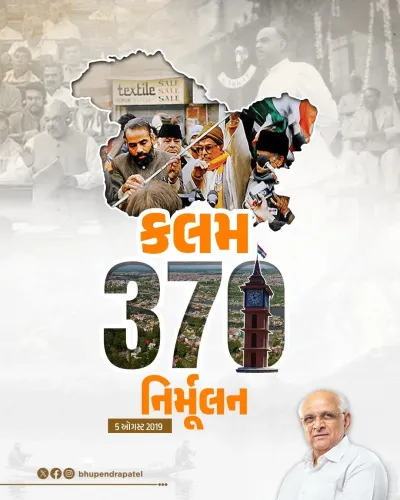
Article 370 was abrogated on 5 August 2019 via a Presidential Order under Prime Minister Narendra Modi ; the Lok Sabha passed the formal resolution on 6 August 2019 .
BJP national spokesperson Guru Prakash Paswan argues in Firstpost that the abrogation's deepest significance lies in extending constitutional equality to marginalised communities in Jammu and Kashmir .
Scheduled Tribes received Assembly seat reservations through the first Delimitation Commission post-abrogation, according to the article.
OBCs and Safai Karamcharis reportedly gained access to political reservations and national labour protections previously unavailable to them in the region.
Jammu and Kashmir was reorganised into two Union Territories — Jammu and Kashmir and Ladakh — simultaneously with the abrogation.
The abrogation of Article 370 on 5 August 2019 should be recognised not merely as a political or territorial milestone but as a foundational step toward constitutional equality and social justice, according to an opinion article published in Firstpost and authored by Bharatiya Janata Party (BJP) national spokesperson Guru Prakash Paswan. Writing on the sixth anniversary of the revocation, Paswan argues that the decision's deeper significance lies in extending the full protections of the Indian Constitution to marginalised communities in Jammu and Kashmir who had long been excluded from them.
Background: What Changed on 5 August 2019
Article 370 had been part of the Constitution of India since it came into force in 1950, granting special autonomous status to the erstwhile state of Jammu and Kashmir. On 5 August 2019, the Centre — led by Prime Minister Narendra Modi — issued a Presidential Order rendering the provision inoperative. The following day, 6 August 2019, the Lok Sabha passed both the bill and the resolution to formally dismantle Article 370, after the Rajya Sabha had already given its approval. Simultaneously, the erstwhile state was reorganised into two separate Union Territories — Jammu and Kashmir and Ladakh.
The Constitutional Equality Argument
Paswan's article contends that public discourse on Article 370 had, for decades, centred on questions of identity and geopolitics, while the aspirations of marginalised communities within the region received comparatively little attention. The constitutional changes of 2019, the piece argues, enabled the full implementation of the Constitution of India and numerous Central laws in Jammu and Kashmir, thereby extending legal safeguards and welfare measures that had long been available to citizens elsewhere in the country.
Notably, the article frames the abrogation as a third-order constitutional reform — one whose impact on ordinary citizens may outlast its immediate political significance. This comes amid a broader national conversation about uniform rights and equal citizenship that has gained traction since 2019.
Key Beneficiary Communities Identified
Among the communities cited as key beneficiaries, the article highlights Scheduled Tribes, who reportedly received stronger institutional recognition — including political reservation through the first Delimitation Commission, which reserved Assembly seats for Scheduled Tribe communities in Jammu and Kashmir. Other Backward Classes (OBCs) are said to have gained political reservation in local bodies under the broader constitutional framework, while Safai Karamcharis and other historically disadvantaged groups reportedly gained wider access to national labour laws and welfare protections.
On women's rights, the article acknowledges that judicial rulings before 2019 had already addressed significant aspects of property rights for women who married outside Jammu and Kashmir. However, it argues that the post-2019 constitutional framework ensures women in the Union Territory are now governed by the same constitutional guarantees applicable across the country.
Paswan's Core Argument
'The story of Article 370 is, therefore, no longer simply about its abrogation. It is about the expansion of constitutional morality. It is about replacing exceptionalism with equality. It is about extending the guarantees of justice, liberty, equality and fraternity to every citizen without distinction. Most importantly, it is about moving one step closer to Dr Ambedkar's dream of a republic where the Constitution protects every citizen equally — not because of where they live, but because they are citizens of India,' Paswan wrote.
What This Marks at the Six-Year Point
As Jammu and Kashmir marks six years since the revocation, the opinion piece calls for the abrogation to be increasingly viewed through the lens of constitutional morality rather than solely through political or security frameworks. Whether that reframing gains broader traction — beyond BJP circles — will depend on ground-level assessments of how welfare and legal protections have actually reached the communities identified in the article.
Point of View
Where it has largely lived, to social justice, where it is harder to contest. The argument has rhetorical force: it is factually true that Central welfare laws did not fully apply in Jammu and Kashmir before 2019. But an opinion piece authored by a party spokesperson is not an independent assessment, and the gap between legal extension and on-ground delivery of welfare for Scheduled Tribes and OBCs in the region remains largely unmeasured by independent bodies. Six years in, the Centre has yet to restore statehood to Jammu and Kashmir — a commitment made during the abrogation debate — which sits in tension with the constitutional equality argument being made here.
NationPress
6 Aug 2026
Frequently Asked Questions
What was Article 370 and when was it abrogated?
Article 370 was a constitutional provision that granted special autonomous status to the erstwhile state of Jammu and Kashmir since 1950. It was rendered inoperative on 5 August 2019 through a Presidential Order issued by the Centre under Prime Minister Narendra Modi, with the Lok Sabha formally passing the resolution the following day.
What is the constitutional equality argument made about Article 370's abrogation?
BJP spokesperson Guru Prakash Paswan argues in Firstpost that the abrogation enabled the full implementation of the Indian Constitution and Central laws in Jammu and Kashmir, extending legal safeguards and welfare measures to marginalised communities — including Scheduled Tribes, OBCs, and Safai Karamcharis — that had long been available to citizens in the rest of the country but not in the region.
Which communities are identified as beneficiaries of the post-2019 changes in Jammu and Kashmir?
According to the Firstpost article, Scheduled Tribes received Assembly seat reservations through the first Delimitation Commission, OBCs gained political reservation in local bodies, Safai Karamcharis got access to national labour laws, and women became subject to the same constitutional property guarantees applicable across India.
What happened to Jammu and Kashmir after Article 370 was abrogated?
The erstwhile state was simultaneously reorganised into two separate Union Territories — Jammu and Kashmir (with a legislature) and Ladakh (without one) — ending its earlier special constitutional status.
Who authored the opinion piece cited in this report?
The opinion article was authored by Guru Prakash Paswan, national spokesperson of the Bharatiya Janata Party (BJP), and published in Firstpost on the sixth anniversary of the abrogation on 6 August 2025.