Arunachal Cabinet Clears MSME Ordinance 2026

Synopsis
The Arunachal Pradesh Cabinet has approved the MSME Ordinance, 2026, aimed at simplifying compliance, fostering entrepreneurship, and creating an investor-friendly climate in India's northeasternmost state. The move aligns with the central government's Act East Policy and national MSME reforms under the Atmanirbhar Bharat framework.
Key Takeaways
The Arunachal Pradesh Cabinet approved the MSME Ordinance, 2026 on 17 June 2026 .
The ordinance aims to simplify regulatory compliance for micro, small and medium enterprises in the state.
The move is designed to promote entrepreneurship and build a more investor-friendly business environment in Arunachal Pradesh .
The reform aligns with the central government's Act East Policy and the Atmanirbhar Bharat MSME revision of 2020 .
Northeastern states have been introducing single-window clearance systems and sector-specific incentives since 2018 to attract private capital.
The next key milestone is the Gazette notification of the ordinance and any associated rules or portal launch.
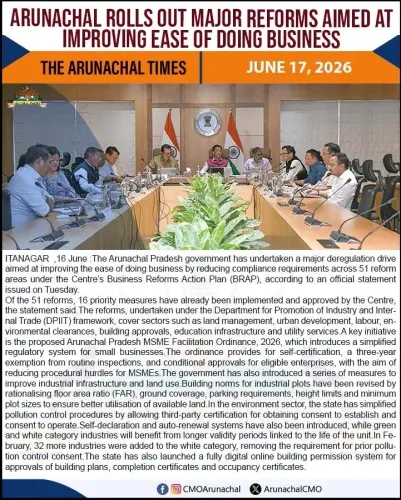
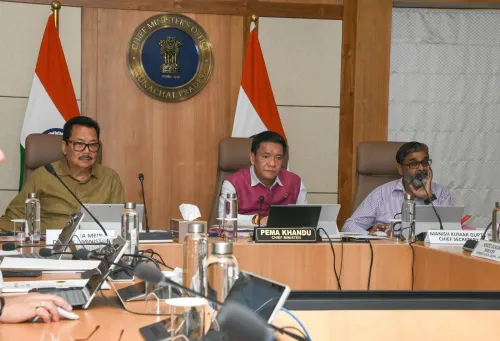
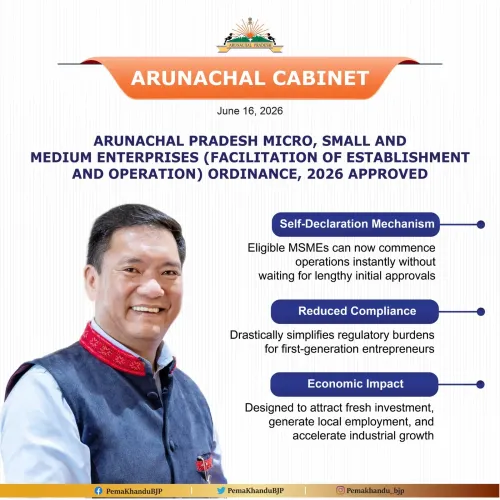
The Chief Minister's Office of Arunachal Pradesh announced on Wednesday, 17 June 2026, that the Arunachal Pradesh Cabinet has approved the MSME Ordinance, 2026, a legislative measure aimed at simplifying regulatory compliance, promoting entrepreneurship, and building a more investor-friendly business environment across the state.
Context
The cabinet communique stated that the ordinance is designed to ease compliance burdens on micro, small and medium enterprises and to create conditions that attract private investment to Arunachal Pradesh. The approval signals the state government's intent to use legislative tools — rather than only administrative orders — to institutionalise MSME-friendly reforms. Ordinances in India carry the force of law between legislative sessions and must be ratified by the state assembly within six weeks of its next sitting.
Policy Backdrop
The national framework for MSME promotion has its roots in the Micro, Small and Medium Enterprises Development Act, 2006, which set out classification criteria and support mechanisms for the sector. A significant revision came in 2020 under the Atmanirbhar Bharat package, when the Government of India raised investment and turnover thresholds for MSME classification, prompting several states to revisit their own compliance regimes. Arunachal Pradesh's 2026 ordinance fits into this broader national push to modernise the regulatory environment for smaller businesses.
The move also aligns with the central government's Act East Policy, which seeks to deepen economic integration between India's northeastern states and Southeast Asia. Northeastern states have progressively introduced single-window clearance systems and sector-specific incentives since 2018 to offset the region's logistical disadvantages and attract manufacturing investment away from established coastal clusters.
Stakeholders and Impact
MSME entrepreneurs operating in Arunachal Pradesh — a state with significant potential in agro-processing, tourism, handicrafts, and hydropower ancillaries — stand to benefit most directly from reduced compliance requirements. Simplified regulations are expected to lower the cost and time of doing business, particularly for first-generation entrepreneurs in smaller towns and semi-urban areas of the state. Potential investors eyeing the state's strategic location — bordering China, Myanmar, and Bhutan — may find a more structured legal environment an additional incentive to commit capital.
The ordinance also carries implications for employment generation. MSMEs are the backbone of India's non-farm employment, and a more enabling regulatory climate in a frontier state like Arunachal Pradesh could help retain skilled youth who might otherwise migrate to larger urban centres for work.
What's Next
The immediate step to watch is the Gazette notification of the ordinance, which will make its provisions legally operative and reveal the specific compliance simplifications it introduces. Any accompanying rules, guidelines, or the launch of a dedicated single-window portal for MSME registration and clearances would be key implementation markers. Observers will also track whether Arunachal Pradesh leverages this legislative development to position itself at upcoming national or regional investor summits as a reformed, investment-ready destination.
Point of View
2026 reflects a broader legislative trend among northeastern states to use statutory instruments — not just administrative orders — to signal durable reform to investors. For Arunachal Pradesh, which has long relied on central transfers and hydropower revenue, building a diversified private-sector economy is a strategic priority, and the ordinance is a step toward institutionalising that ambition. The timing, ahead of likely investor outreach events, suggests the state government is keen to present a reformed regulatory identity. Whether the ordinance translates into measurable improvements in MSME registration and investment flows will depend heavily on implementation quality and the speed of gazette notification.
NationPress
19 Sept 2026
Frequently Asked Questions
What is the MSME Ordinance 2026 in Arunachal Pradesh?
The MSME Ordinance, 2026 is a state legislative measure approved by the Arunachal Pradesh Cabinet on 17 June 2026 to simplify compliance requirements for micro, small and medium enterprises and create a more investor-friendly business environment in the state.
Why did Arunachal Pradesh pass an MSME ordinance?
The state government passed the ordinance to reduce regulatory burdens on small businesses, promote entrepreneurship, and attract private investment, in line with the central government's Act East Policy and national MSME reforms.
How does the Arunachal MSME Ordinance 2026 affect businesses?
The ordinance is expected to lower compliance costs and simplify the process of setting up and operating micro, small and medium enterprises in Arunachal Pradesh, benefiting both existing entrepreneurs and potential investors.
What is the Act East Policy and how is it related?
The Act East Policy is a central government initiative to deepen economic and strategic ties between India's northeastern states and Southeast Asia. The MSME Ordinance 2026 aligns with this policy by improving the investment climate in Arunachal Pradesh, which borders China, Myanmar and Bhutan.
When will the Arunachal MSME Ordinance 2026 come into effect?
The ordinance will become operative after its Gazette notification by the state government. As an ordinance, it carries immediate legal force but must be ratified by the state assembly within six weeks of its next session.