CM Pema Khandu Pushes Arunachal Business Reforms
Synopsis
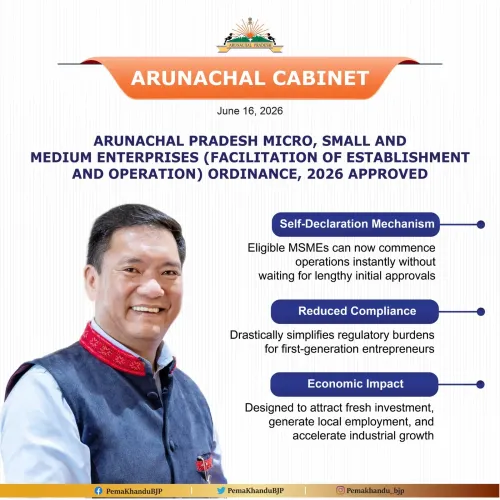
Chief Minister Pema Khandu has spotlighted Arunachal Pradesh's latest business environment reforms, targeting MSME growth, compliance simplification, and investor transparency — part of the state's ongoing alignment with India's national ease of doing business agenda.
Key Takeaways
CM Pema Khandu publicly highlighted Arunachal Pradesh 's ongoing business environment reforms on June 17, 2026 .
The reforms target three pillars: ease of doing business , MSME support , and compliance simplification .
Arunachal Pradesh has participated in DPIIT's Business Reform Action Plan (BRAP) since 2015 , competing with other states on reform benchmarks.
The announcement is part of a broader post- 2014 national push to improve India's ease of doing business profile through state-level reforms.
MSMEs and domestic and cross-border investors are the primary stakeholders expected to benefit from the reforms.
The next DPIIT BRAP rankings will serve as a key independent measure of the state's reform progress.
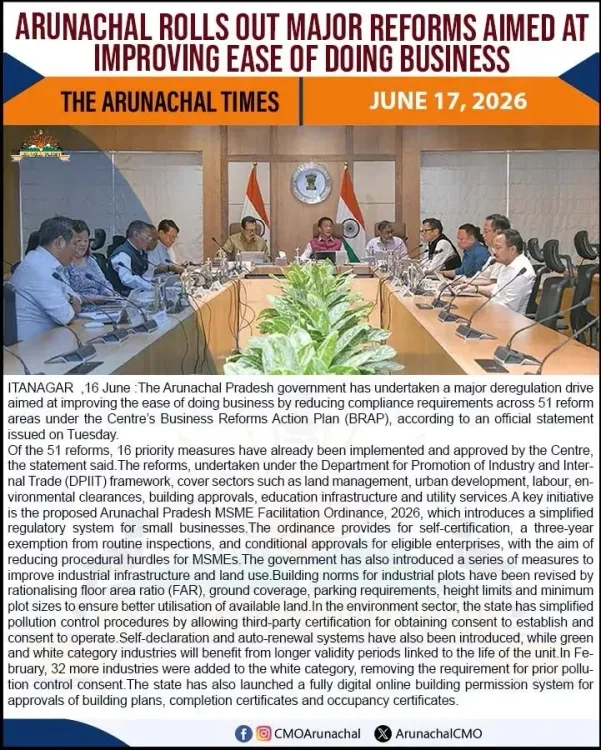
The Chief Minister's Office of Arunachal Pradesh on Wednesday, June 17, 2026, highlighted Chief Minister Pema Khandu's push for sweeping business environment reforms in the state, focusing on easing compliance burdens, strengthening support for MSMEs, and building a more transparent, investor-friendly ecosystem.
Context
The official post from the Chief Minister's Office stated that CM Pema Khandu 'highlighted Arunachal Pradesh's business reforms focused on improving ease of doing business, supporting MSMEs, simplifying compliance and creating a transparent, investor-friendly environment.' The announcement signals a concerted effort by the state government to reposition Arunachal Pradesh as a competitive destination for private investment, particularly in the country's underdeveloped northeastern corridor.
Pema Khandu, who has served as Chief Minister of Arunachal Pradesh since 2016, has increasingly anchored his administration's economic agenda around structural reforms aimed at reducing the regulatory burden on businesses and unlocking growth in a state historically dependent on central transfers and public-sector activity.
Policy Backdrop
Arunachal Pradesh has been a participant in successive rounds of the Department for Promotion of Industry and Internal Trade's (DPIIT) Business Reform Action Plan (BRAP) since 2015. The BRAP framework scores states on hundreds of reform parameters spanning land administration, labour regulation, environmental clearances, and single-window systems, and its annual rankings have become a key lever of competitive federalism in India.
The post-2014 national push to improve India's global ease of doing business profile has prompted all states, including those in the northeast, to align local rules with centrally prescribed reform benchmarks. Northeastern states have historically lagged behind larger states on BRAP rankings, making reform announcements from Itanagar particularly significant in the context of regional economic catch-up.
MSMEs occupy a central place in this reform agenda. Simplified compliance — including self-certification norms, reduced inspection regimes, and faster registration — is widely regarded as the most direct lever for unlocking MSME growth in states with thin industrial bases.
Stakeholders and Impact
The primary beneficiaries of the reforms outlined by CM Khandu are micro, small and medium enterprises operating in or considering entry into Arunachal Pradesh. Simplified compliance frameworks reduce the cost and time burden on small entrepreneurs who typically lack the administrative capacity to navigate complex regulatory environments.
Investors — both domestic and from neighbouring countries such as Bhutan and through cross-border trade corridors — stand to benefit from a more transparent, rule-based business environment. The state's strategic location along the McMahon Line and its proximity to Southeast Asia give it latent potential as a trade and logistics hub, potential that structural reforms could begin to unlock.
What's Next
Attention will now turn to the specifics of the reform package referenced in the Chief Minister's communication, including any upgrades to Arunachal Pradesh's single-window clearance portal, new compliance simplification notifications, or dedicated MSME facilitation programmes. The next round of DPIIT BRAP state rankings will serve as an independent benchmark against which the state's reform claims can be measured.
If the reforms translate into measurable improvements in ranking and investment inflows, Arunachal Pradesh could emerge as a model for other northeastern states navigating the tension between regulatory modernisation and limited administrative capacity. The broader arc points toward a northeast that is increasingly integrated into India's national economic mainstream.
Point of View
The administration is targeting the most politically visible and economically immediate layer of reform — one that resonates with local entrepreneurs as much as with outside investors. The timing, ahead of the next DPIIT BRAP assessment cycle, suggests the announcement is also partly a positioning move within the competitive federalism framework that national rankings have institutionalised. Whether the reforms produce measurable outcomes will depend on implementation depth, particularly the capacity of state agencies to operationalise single-window and self-certification commitments.
NationPress
16 Sept 2026
Frequently Asked Questions
What business reforms has CM Pema Khandu announced for Arunachal Pradesh?
CM Pema Khandu has highlighted reforms focused on improving ease of doing business, simplifying compliance for MSMEs, and creating a more transparent, investor-friendly environment in Arunachal Pradesh.
What is the DPIIT Business Reform Action Plan and how does Arunachal Pradesh fit in?
The DPIIT Business Reform Action Plan (BRAP) is a central government framework that scores and ranks Indian states on hundreds of reform parameters. Arunachal Pradesh has participated in successive BRAP rounds since 2015 as part of efforts to align with national ease of doing business goals.
How do these reforms benefit MSMEs in Arunachal Pradesh?
Simplified compliance norms, reduced inspection regimes, and faster registration processes directly lower the cost and administrative burden on micro, small and medium enterprises, making it easier to start and operate businesses in the state.
Why is ease of doing business important for northeastern states like Arunachal Pradesh?
Northeastern states have historically lagged in investment and industrial activity. Improving the business environment helps attract private capital, integrate the region into national supply chains, and reduce dependence on central government transfers.
When did Pema Khandu become Chief Minister of Arunachal Pradesh?
Pema Khandu has served as Chief Minister of Arunachal Pradesh since 2016 and has made economic reform and development a central pillar of his administration.