CM Pema Khandu: Arunachal Cabinet Regularises 74 RMSA TGTs
Synopsis
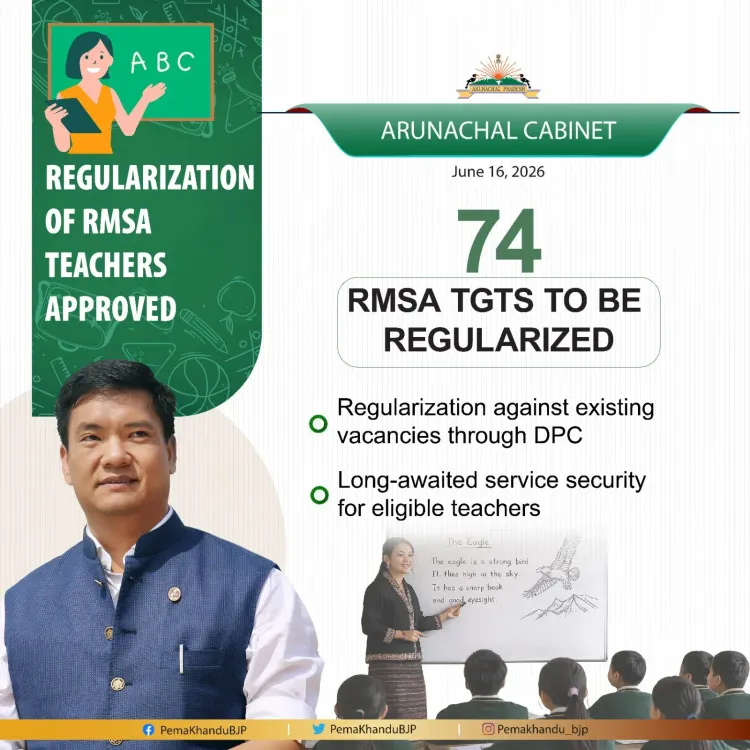
The Arunachal Pradesh cabinet has approved regularisation of eligible erstwhile RMSA Trained Graduate Teachers against 74 resultant vacancies through a Departmental Promotion Committee process, Chief Minister Pema Khandu announced on June 16, 2026, offering permanent status to contractual school teachers.
Key Takeaways
The Arunachal Pradesh State Cabinet approved regularisation of eligible erstwhile RMSA Trained Graduate Teachers (TGTs) on June 16, 2026 .
Regularisation will be processed against 74 existing resultant vacancies in the state education department.
The route chosen is a Departmental Promotion Committee (DPC) process, a standard government mechanism for formalising eligible appointments.
The decision benefits teachers recruited under the Rashtriya Madhyamik Shiksha Abhiyan (RMSA) , a centrally sponsored secondary education scheme launched in 2009 .
The move is part of a broader national pattern of integrating scheme-era contractual teachers into permanent state cadres under the Samagra Shiksha framework.
Secondary school students in Arunachal Pradesh , especially in remote areas, stand to benefit from improved teacher stability.
Arunachal Pradesh Chief Minister Pema Khandu announced on Tuesday, June 16, 2026, that the state cabinet has approved the regularisation of eligible erstwhile Rashtriya Madhyamik Shiksha Abhiyan (RMSA) Trained Graduate Teachers (TGTs) against 74 existing resultant vacancies through a Departmental Promotion Committee (DPC) process.
Context
The cabinet decision addresses the long-standing employment status of teachers recruited under the centrally sponsored RMSA scheme, launched in 2009 to expand access to secondary education across India. In states like Arunachal Pradesh, the scheme led to contractual appointments of TGTs to fill critical staffing gaps in remote secondary schools. These teachers have since operated in a state of employment uncertainty, awaiting formal absorption into the permanent state cadre.
Chief Minister Khandu shared the decision publicly, noting that regularisation will proceed through the established DPC route — a structured administrative mechanism used to assess and promote eligible candidates into substantive government posts.
Policy Backdrop
The regularisation of teachers hired under time-bound central schemes such as RMSA and the Sarva Shiksha Abhiyan (SSA) has been a recurring administrative exercise across multiple Indian states. The broader objective has been to convert temporary, scheme-specific appointments into permanent positions within integrated state education cadres, reducing litigation and improving teacher retention.
Arunachal Pradesh, with its remote terrain and historically acute teacher shortages, has been particularly reliant on centrally sponsored scheme staffing for its secondary schools. The subsequent transition to the Samagra Shiksha framework — which merged RMSA, SSA, and the Teacher Education scheme — has made the absorption of legacy contractual teachers an administrative priority for state governments. Cabinet-level DPC approvals are among the standard instruments used to execute such transitions.
Stakeholders and Impact
The decision directly benefits eligible RMSA TGT teachers who have served the state's secondary education system under contractual arrangements and now stand to receive permanent status. Regularisation typically brings improved job security, pay parity with permanent government teachers, and access to service benefits including pension.
Secondary school students across Arunachal Pradesh — particularly in underserved and geographically isolated areas — are also indirect beneficiaries, as permanent teacher status is associated with lower attrition and more stable classroom environments. The state's Education Department will now oversee the DPC proceedings to identify and process eligible candidates against the 74 vacancies.
What's Next
The immediate focus shifts to the rollout of the DPC process, through which the state will determine how many of the eligible erstwhile RMSA TGTs are formally regularised against the available vacancies. The exercise may also surface additional administrative questions — including whether further resultant vacancies arise from the process itself, and how the state plans to address any remaining contractual teachers not covered under the current approval.
The cabinet decision signals Arunachal Pradesh's continued effort to integrate legacy scheme-era appointments into its mainstream education cadre, a trend that is likely to continue as the state aligns its teacher workforce with the Samagra Shiksha framework's unified staffing norms.
Point of View
The move carries dual value: it addresses a long-pending grievance of a specific teacher constituency while reinforcing the state's commitment to stabilising its education workforce. The use of the DPC mechanism, rather than a direct absorption order, also signals procedural caution — ensuring eligibility is assessed rather than assumed. Broader significance lies in how Arunachal Pradesh manages the remainder of its legacy contractual teacher pool as the Samagra Shiksha framework continues to reshape state education staffing norms.
NationPress
15 Sept 2026
Frequently Asked Questions
What did the Arunachal Pradesh cabinet decide about RMSA teachers?
The Arunachal Pradesh State Cabinet approved the regularisation of eligible erstwhile RMSA Trained Graduate Teachers (TGTs) against 74 existing resultant vacancies through a Departmental Promotion Committee (DPC) process, as announced by Chief Minister Pema Khandu on June 16, 2026.
What is RMSA and why were TGTs hired under it?
RMSA stands for Rashtriya Madhyamik Shiksha Abhiyan, a centrally sponsored scheme launched in 2009 to improve access and quality of secondary education. States like Arunachal Pradesh hired Trained Graduate Teachers (TGTs) on a contractual basis under the scheme to address acute staffing shortages in secondary schools.
What is a Departmental Promotion Committee (DPC) process?
A Departmental Promotion Committee (DPC) is a formal government mechanism used to assess eligible employees for promotion or regularisation into substantive posts, ensuring the process follows established service rules rather than arbitrary absorption.
How many RMSA TGT vacancies will be filled in Arunachal Pradesh?
The cabinet approval covers regularisation against 74 existing resultant vacancies in the state education department, though the DPC process will determine exactly how many eligible teachers are formally regularised.
Will this regularisation benefit students in Arunachal Pradesh?
Yes, indirectly. Permanent teacher status reduces attrition and provides more stable classroom environments, which is particularly significant for secondary schools in Arunachal Pradesh's remote and underserved areas.