Arunachal CMO Marks National Flag Adoption Day
Synopsis
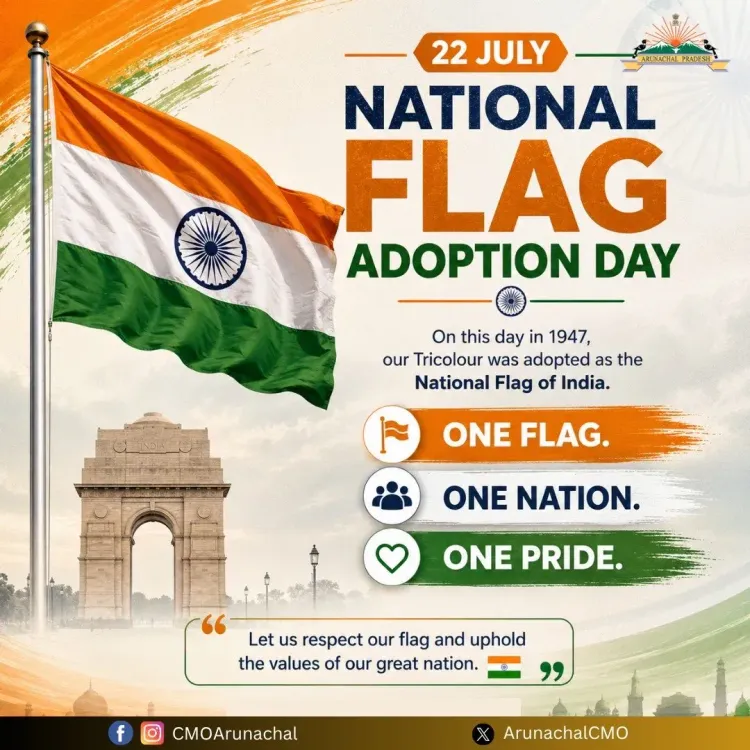
The Chief Minister's Office of Arunachal Pradesh marked National Flag Adoption Day on 22 July, paying tribute to the Tricolour adopted by the Constituent Assembly in 1947 and calling on citizens to uphold its values of courage, peace, unity and progress.
Key Takeaways
The Chief Minister's Office of Arunachal Pradesh observed National Flag Adoption Day on 22 July 2026 .
The Indian Tricolour was adopted by the Constituent Assembly on 22 July 1947 , two days before independence.
The flag was designed by Pingali Venkayya and its colours symbolise courage, peace, and faith respectively.
The CMO called the Tricolour a 'timeless symbol' of the nation's courage, peace, unity and progress.
The observance is especially significant in Arunachal Pradesh , a frontier state bordering China, Bhutan and Myanmar with over 26 major tribal communities.
State-level events and school programmes are expected to continue in the run-up to Independence Day on 15 August .
The Chief Minister's Office of Arunachal Pradesh on Wednesday, 22 July paid tribute to the Indian Tricolour on National Flag Adoption Day, calling it a 'timeless symbol of our nation's courage, peace, unity and progress' and urging citizens to work together towards a stronger and more prosperous India.
Context
The Indian national flag was adopted by the Constituent Assembly on 22 July 1947, exactly two days before the country's formal independence. The date is observed annually as National Flag Adoption Day, a moment for constitutional reflection and reaffirmation of national values.
The Tricolour was designed by Pingali Venkayya and carries deep symbolic weight: the saffron band represents courage and sacrifice, white stands for peace and truth, and green denotes faith and chivalry. The Ashoka Chakra at the centre signifies the eternal wheel of law and progress.
Policy Backdrop
State governments across India routinely mark the 22 July anniversary to foster constitutional patriotism and national integration. The practice carries particular resonance in border states such as Arunachal Pradesh, which shares frontiers with China, Bhutan, and Myanmar and is home to a rich mosaic of tribal communities.
For a strategically sensitive frontier state, public affirmations of national unity through symbols like the Tricolour serve both a civic and a geopolitical function, reinforcing the state's deep ties to the Indian constitutional framework.
Stakeholders and Impact
The message from the Chief Minister's Office is directed at the citizens of Arunachal Pradesh and, by extension, all Indians who observe the day. Schools, government offices, and cultural institutions in the state are expected to hold flag-hoisting ceremonies and awareness programmes in the lead-up to Independence Day on 15 August.
The post's emphasis on 'unity and progress' aligns with broader national integration efforts, especially meaningful in a state with over 26 major tribes and more than 100 sub-tribes, each with distinct languages and traditions.
What's Next
With Independence Day approaching, Arunachal Pradesh is likely to see a series of state-level events, school programmes, and civic drives centred on constitutional values and national pride. The 22 July observance traditionally sets the tone for the fortnight of patriotic programming that culminates on 15 August.
The Chief Minister's Office is expected to continue engaging citizens through official channels as the state joins the rest of the country in marking 79 years of independence.
Point of View
Public affirmations of the Tricolour carry weight beyond the ceremonial. The timing — a fortnight before Independence Day — also signals the start of the state's patriotic-programming calendar, a pattern seen consistently across BJP-governed states that have leaned into constitutional nationalism as a governance narrative. The message is brief but strategically calibrated.
NationPress
22 Jul 2026
Frequently Asked Questions
When was the Indian national flag adopted?
The Indian national flag was adopted by the Constituent Assembly on 22 July 1947 , two days before India's independence on 15 August 1947.
Who designed the Indian Tricolour?
The Indian Tricolour was designed by Pingali Venkayya , a freedom fighter from Andhra Pradesh, whose design was formally accepted by the Constituent Assembly in 1947.
What does National Flag Adoption Day mean?
National Flag Adoption Day is observed on 22 July every year to commemorate the day the Constituent Assembly officially adopted the design of the Indian national flag in 1947.
What do the colours of the Indian flag represent?
Saffron represents courage and sacrifice, white stands for peace and truth, and green denotes faith and chivalry. The Ashoka Chakra in navy blue at the centre symbolises the eternal wheel of law and progress.
Why is Arunachal Pradesh significant for national integration?
Arunachal Pradesh is India's northeasternmost state, sharing borders with China, Bhutan and Myanmar. It is home to over 26 major tribes, making public affirmations of national unity through symbols like the Tricolour especially important for integration and sovereignty.