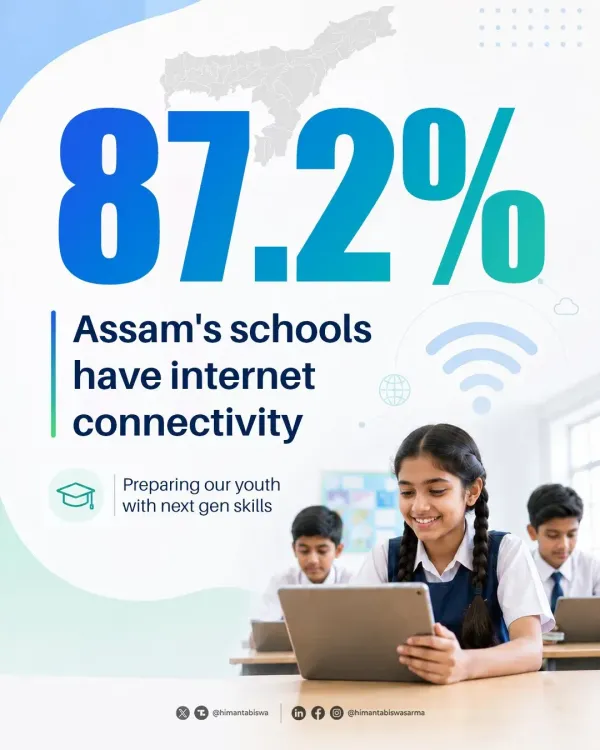
CM Himanta: 87.2% of Assam government schools now have internet
Synopsis
Assam Chief Minister Himanta Biswa Sarma has said 87.2 per cent of government schools in the state are now connected to the internet, citing national recognition from NITI Aayog. The Chief Minister framed the milestone as proof of a turnaround in a sector long flagged for under-performance, and signalled that further reforms are on the way.
Key Takeaways
Assam CM Himanta Biswa Sarma says 87.2 per cent of government schools in the state are now connected to the internet.
The Chief Minister cited recognition from NITI Aayog, the Union government's policy think-tank.
The push aligns with Digital India (2015) and the National Education Policy 2020's mandate on school digital infrastructure.
Delivery is anchored in Samagra Shiksha, the centrally sponsored scheme that succeeded Sarva Shiksha Abhiyan.
Sarma signalled that further reforms in government schools will follow, saying the 'transformation has only begun'.
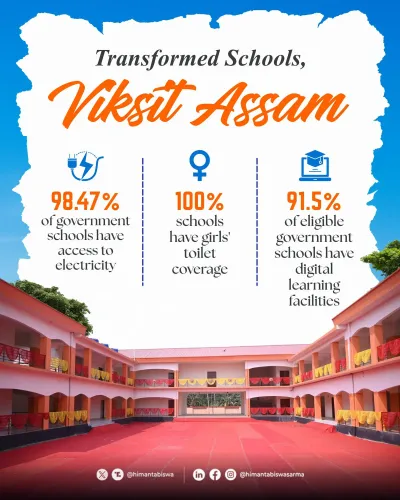
Assam Chief Minister Himanta Biswa Sarma on Wednesday said the state has emerged as one of India's top performers in school internet connectivity, citing recognition from NITI Aayog. In a post on X, the BJP leader said 87.2 per cent of government schools in Assam are now connected to the internet, framing the milestone as part of a wider turnaround in the state's public education system.
'Not long ago, the future of Govt schools in Assam was a matter of concern,' Sarma wrote. 'Today, Assam is among India's top performers in school internet connectivity, with 87.2% of schools connected and recognised nationally by @NITIAayog. And this transformation has only begun.'
Context
The post positions Assam's connectivity gains as evidence of measurable improvement in a sector that the Chief Minister has repeatedly flagged as a priority since taking charge in May 2021. Government schools across the state had long struggled with patchy digital infrastructure, particularly in rural and hill districts where broadband penetration lagged the national average.
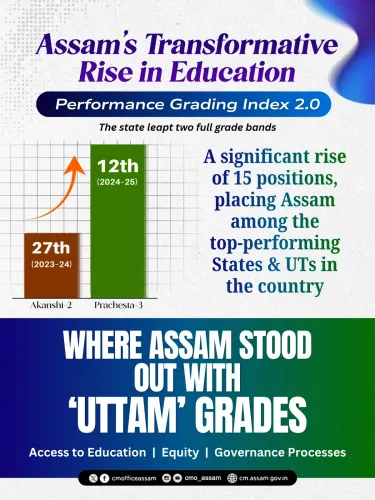
Sarma's reference to recognition by NITI Aayog — the Union government's policy think-tank — links the state-level claim to a central benchmarking framework. NITI Aayog tracks school education performance across states through indices that include indicators on infrastructure, learning outcomes and digital access.
Policy backdrop
The connectivity push sits within a layered policy lineage. The Digital India programme, launched in 2015, set early targets for broadband links to schools and government institutions. The National Education Policy 2020 went further, mandating technology integration and digital infrastructure across all schools as part of a wider curricular overhaul.
Underpinning the physical build-out is Samagra Shiksha, the umbrella centrally sponsored scheme that absorbed the earlier Sarva Shiksha Abhiyan framework first rolled out in 2001. It provides recurring funds for ICT labs, smart classrooms and teacher training in government schools — the same delivery rails Assam has been using to scale connectivity.
Several north-eastern states have reported parallel gains in school connectivity in recent years, with the regional push accelerating after pandemic-era school closures exposed sharp learning gaps for students without digital access at home.
Stakeholders and impact
The most direct beneficiaries are students in Assam's government schools, who account for the bulk of the state's school-going population and disproportionately come from low-income and rural households. Reliable school internet makes it possible to deliver digital content, run online assessments, and link classrooms to teacher-training resources hosted on national platforms.
For school administrators, connectivity also feeds into routine governance — attendance dashboards, mid-day meal monitoring and real-time reporting to the state education department. For the BJP-led state government, the indicator offers a quantifiable data point to anchor its education narrative ahead of the next round of state-level performance rankings.
The Chief Minister did not specify a timeline for full saturation, but his closing line — that the 'transformation has only begun' — signals that further investments in school digital infrastructure are likely to follow.
What's next
Attention will turn to the next iteration of NITI Aayog's school education performance index and to whether Assam sustains its position once neighbouring states report updated figures. The state's supplementary budget cycles will indicate the scale of any additional allocations aimed at closing the remaining gap toward full school internet coverage.
If sustained, Assam's connectivity trajectory could become a reference point for other north-eastern states still building out school broadband — and a recurring talking point for the Chief Minister as he frames public education as a marker of governance delivery.
Point of View
Sarma converts a sectoral indicator into a governance scorecard — a pattern increasingly visible across BJP-run states. The framing also reflects a broader north-eastern shift, where chief ministers are using education and connectivity data to reposition their states from laggards to performers. The real test will be whether learning outcomes follow the infrastructure curve.
NationPress
22 Sept 2026
Frequently Asked Questions
What did Himanta Biswa Sarma say about Assam school internet connectivity?
Assam Chief Minister Himanta Biswa Sarma said 87.2 per cent of government schools in the state are now connected to the internet and that Assam has been recognised nationally by NITI Aayog as one of India's top performers on this indicator.
What is NITI Aayog's role in measuring school education?
NITI Aayog is the Government of India's policy think-tank and publishes indices that benchmark states on school education, including indicators on infrastructure, digital access and learning outcomes.
Which policies drive school internet connectivity in India?
School internet connectivity is driven primarily by the Digital India programme launched in 2015 and the National Education Policy 2020, with delivery funded through Samagra Shiksha, the centrally sponsored scheme that absorbed Sarva Shiksha Abhiyan.
Why is school connectivity important for Assam?
Reliable school internet allows government school students, who form the bulk of Assam's school-going population, to access digital learning content, online assessments and teacher-training resources, while also helping administrators monitor attendance and welfare schemes in real time.
When did Himanta Biswa Sarma become Chief Minister of Assam?
Himanta Biswa Sarma became Chief Minister of Assam in May 2021 and is a senior BJP leader who also serves as convenor of the North-East Democratic Alliance.