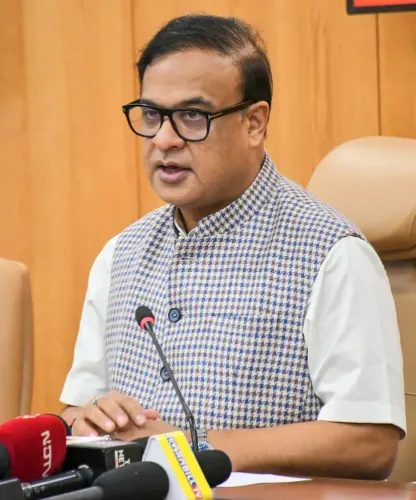
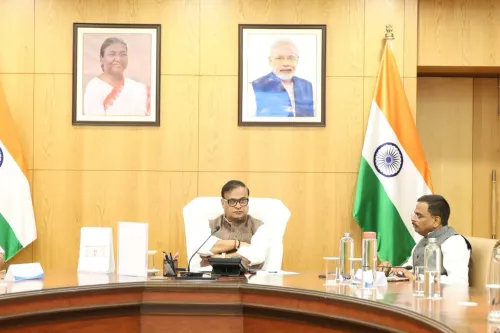
CM Himanta Flags India's Rise to 4th in Global AI Rankings
Synopsis
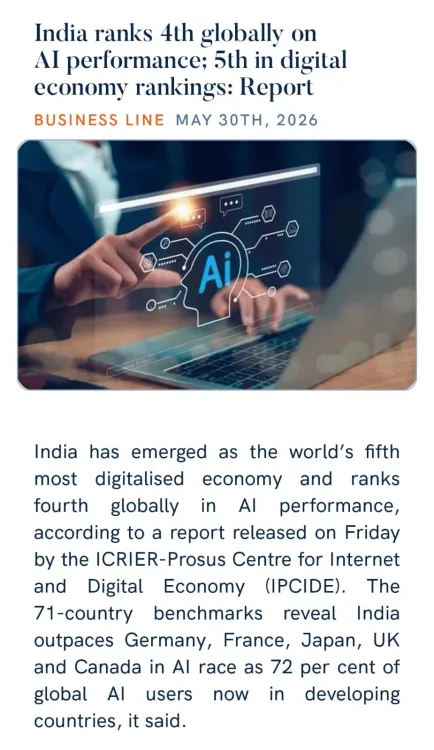
A report shared by Assam Chief Minister Himanta Biswa Sarma places India fourth globally on AI performance and fifth in digital economy rankings, reflecting the cumulative impact of Digital India, the NITI Aayog AI strategy, and the IndiaAI Mission.
Key Takeaways
Assam CM Himanta Biswa Sarma shared the report on 31 May 2026 via the NaMo App.
India ranked 4th globally on AI performance and 5th in digital economy rankings according to the cited report.
India's rise is underpinned by the Digital India programme (2015) , NITI Aayog's National AI Strategy (2018) , and the IndiaAI Mission .
Digital public infrastructure including Aadhaar and UPI has been a key driver of the digital economy ranking.
The IT industry, AI startups, and research institutions are the primary beneficiaries of the improved global standing.
Future milestones in IndiaAI Mission compute procurement and AI governance legislation will influence India's trajectory in upcoming indices.
Assam Chief Minister Himanta Biswa Sarma on Sunday, 31 May 2026, shared a report highlighting that India has climbed to fourth place globally on AI performance and fifth in digital economy rankings, underscoring the country's accelerating technological ascent.
Context
The rankings were shared by CM Sarma via the NaMo App, amplifying a report that positions India among the world's leading nations in both artificial intelligence capability and broader digital economic strength. The post arrives as global competition for AI leadership intensifies, with major economies racing to establish dominance in compute infrastructure, data ecosystems, and AI talent pipelines.
India's placement at fourth on AI performance reflects a measurable leap from its earlier position in similar indices, signalling that years of coordinated policy investment are beginning to register on international scorecards.
Policy Backdrop
India's digital and AI ambitions trace directly to a sequence of landmark policy interventions. The Digital India programme, launched in 2015, laid the foundational infrastructure — from broadband connectivity to e-governance platforms — that underpins today's rankings. NITI Aayog followed in 2018 with the National Strategy for Artificial Intelligence under the #AIforAll framework, which mapped out sectoral priorities spanning agriculture, healthcare, education and smart mobility.
More recently, the IndiaAI Mission, approved by the Union Cabinet, committed a multi-year outlay to expand domestic compute capacity, curate large-scale datasets, and build skilling pipelines capable of producing AI-ready talent at scale. Parallel incentives for semiconductor fabrication and data centre investment have reinforced this ecosystem, reducing India's dependence on foreign critical technology infrastructure.
India's homegrown digital public infrastructure — notably Aadhaar and UPI — has also drawn global attention as a replicable model, contributing to the country's strong showing in digital economy metrics.
Stakeholders and Impact
The rankings carry direct significance for India's IT industry, a sector employing millions and contributing substantially to export earnings. A high AI performance rank strengthens the country's pitch to global technology companies considering India as a destination for research and development investment.
AI startups and research institutions stand to benefit from the reputational uplift, as international rankings influence venture capital flows and academic collaboration. For Northeast India — a region CM Sarma has championed through the North-East Democratic Alliance (NEDA) — dedicated digital connectivity and skilling allocations under central schemes mean that the national ranking gains are increasingly mirrored at the regional level as well.
Citizens interacting daily with digital government services — from direct benefit transfers to digital health records — are the ultimate stakeholders, as improved rankings typically correlate with faster, more reliable public digital infrastructure.
What's Next
Attention will now turn to the IndiaAI Mission's compute procurement milestones, which are expected to further consolidate India's position in future AI performance indices. Any fresh parliamentary action on AI governance rules — a domain where India has yet to produce comprehensive legislation — could also shape the country's standing in indices that weight regulatory maturity alongside raw performance metrics.
As global standards bodies deepen engagement with emerging economies, India's trajectory suggests it will seek a larger norm-setting role in international AI governance, potentially translating its performance ranking into diplomatic and economic leverage.
Point of View
If validated by the underlying methodology, would represent a significant milestone in a decade-long arc from Digital India to the IndiaAI Mission — a policy lineage that spans multiple Union Budgets and cabinet approvals. For Northeast India specifically, Sarma's signal is also a reminder that digital infrastructure investments in the region are framed as part of a national success story, not peripheral outlays. The missing piece remains AI governance legislation, and how India addresses that gap will determine whether its performance rank translates into a durable standard-setting role internationally.
NationPress
15 Oct 2026
Frequently Asked Questions
What rank did India get in the global AI performance index?
According to the report shared by Assam CM Himanta Biswa Sarma on 31 May 2026, India ranked 4th globally on AI performance .
What is India's rank in the digital economy rankings?
The same report places India at 5th position in digital economy rankings globally.
What policies helped India improve its AI ranking?
India's rise is linked to the Digital India programme (2015) , NITI Aayog's National Strategy for Artificial Intelligence (2018) under the #AIforAll framework, and the more recent IndiaAI Mission , which funds compute, datasets and skilling.
Why did Himanta Biswa Sarma share India's AI ranking?
CM Sarma shared the report via the NaMo App to highlight India's growing global stature in technology, a theme aligned with the ruling party's emphasis on digital governance achievements.
What is the IndiaAI Mission?
The IndiaAI Mission is a Union Cabinet-approved initiative with a multi-year financial outlay aimed at expanding India's domestic AI compute infrastructure, curating large-scale datasets, and building AI talent pipelines across the country.