CM Himanta's Assam jumps to 12th in Education Index
Synopsis
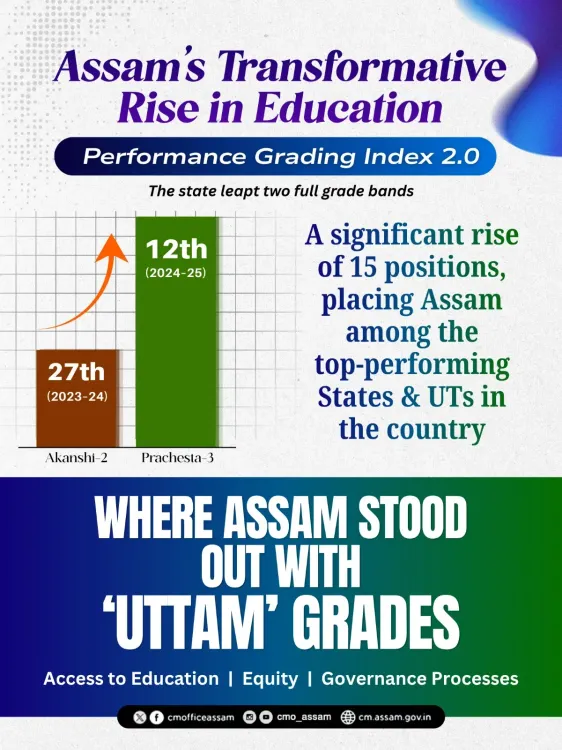
Assam has jumped from 27th to 12th in the central government's Performance Grading Index 2.0, earning 'Uttam' grades in access, equity and governance. The Chief Minister's Office credited the gains to focused policies under CM Himanta Biswa Sarma, marking one of the more significant rank improvements in the index's recent cycles.
Key Takeaways
Assam climbed from 27th to 12th in the Performance Grading Index 2.0 , a central government school education ranking.
The state received 'Uttam' grades — the highest tier — in the categories of access, equity, and governance .
The PGI, introduced in 2019 by the Ministry of Education , uses UDISE+ data to assess states and union territories.
The improvement was announced by the Chief Minister's Office of Assam on 27 May 2026 .
The gains align with the goals of the National Education Policy 2020 and central scheme Samagra Shiksha .
The next PGI cycle report and state budget allocations for school infrastructure will be key indicators of sustained progress.
The Chief Minister's Office of Assam announced on Wednesday, 27 May 2026 that the state has climbed from 27th to 12th in the Performance Grading Index (PGI) 2.0, a central government framework that evaluates states on school education parameters. The office attributed the jump to strong leadership and focused policy interventions under Chief Minister Dr. Himanta Biswa Sarma.
Context
The Performance Grading Index was first introduced by the Ministry of Education in 2019 to rank states and union territories on school education outcomes using data sourced from the UDISE+ platform. The index evaluates performance across dimensions including access, equity, governance, and learning outcomes. Assam's jump of 15 positions in PGI 2.0 is among the more significant rank gains reported by any state in successive cycles of the assessment.
The CMO's post noted that Assam has received 'Uttam' grades — the highest tier in the PGI grading scale — specifically in the categories of access, equity, and governance. These three pillars have gained increasing weight in central assessments as the government aligns state performance with the goals of the National Education Policy (NEP) 2020.
Policy Backdrop
The National Education Policy, approved in July 2020, set new benchmarks for states by prioritising equitable access to schooling, improved governance structures, and quality learning outcomes. Central schemes such as Samagra Shiksha have served as the primary funding and implementation vehicle for states seeking to align with these goals. Multiple states that have restructured their school administration and enrolment frameworks under Samagra Shiksha have reported measurable gains in successive PGI cycles.
Northeastern states, including Assam, have shown variable but measurable progress in national education rankings since the index was first published. The region's geographic and infrastructural challenges have historically weighed on access and equity scores, making Assam's reported 'Uttam' grades in those categories particularly notable within the regional context.
Stakeholders and Impact
The most direct beneficiaries of improved PGI performance are school students and teachers across Assam's public education system. Higher rankings in access and equity indicators typically reflect improvements in enrolment rates, reduction of dropout figures, and the availability of schooling infrastructure in remote and underserved districts. Governance gains, meanwhile, signal stronger administrative oversight of teacher recruitment, attendance, and resource deployment.
For the Himanta Biswa Sarma government, which has been in office since May 2021, the ranking improvement offers a measurable data point in a policy domain that has been a stated priority. The BJP-led administration in Assam has repeatedly cited education reform as a pillar of its governance agenda, and an independent central assessment lends institutional weight to those claims.
What's Next
Attention will now turn to the release of the next PGI cycle report, which will indicate whether Assam can sustain or improve upon its 12th rank nationally. State budget allocations for school infrastructure and teacher recruitment will be closely watched as indicators of whether the policy momentum is being backed by continued financial commitment. Analysts tracking northeastern education outcomes will also monitor whether the 'Uttam' grades in access and equity translate into measurable improvements in learning outcome scores, which remain a separate and often harder-to-move metric in the index.
Point of View
Offering an independent, centrally-administered metric to substantiate its education reform narrative ahead of future electoral cycles. The 'Uttam' grades in access and equity are especially meaningful for a northeastern state where geographic and infrastructural barriers have historically suppressed these scores. However, the more demanding test will come when learning outcome indicators — which are harder to move through administrative reform alone — are scrutinised in subsequent PGI cycles. The broader pattern of NEP 2020-aligned states reporting rank gains also means Assam's improvement, while real, must be contextualised within a nationwide policy push rather than read as an isolated achievement.
NationPress
11 Oct 2026
Frequently Asked Questions
What is the Performance Grading Index 2.0?
The Performance Grading Index 2.0 is a framework developed by India's Ministry of Education to grade states and union territories on school education parameters including access, equity, governance, and learning outcomes, using data from the UDISE+ platform.
What rank has Assam achieved in PGI 2.0?
Assam has risen to 12th position nationally in PGI 2.0, up from 27th in a previous cycle, according to the Chief Minister's Office of Assam.
What does 'Uttam' grade mean in PGI 2.0?
'Uttam' is the highest performance tier in the PGI grading scale. Assam has received 'Uttam' grades in the categories of access, equity, and governance.
Who is the Chief Minister of Assam?
Dr. Himanta Biswa Sarma has been the Chief Minister of Assam since May 2021 , leading a BJP-led state government.
How does PGI 2.0 relate to NEP 2020?
PGI 2.0 evaluates states on parameters that closely align with the goals of the National Education Policy 2020, including equitable access to schooling, governance reform, and quality outcomes, incentivising states to adopt NEP-aligned policies.