CM Himanta Flags Assam's 15-Place PGI 2.0 Jump

Synopsis
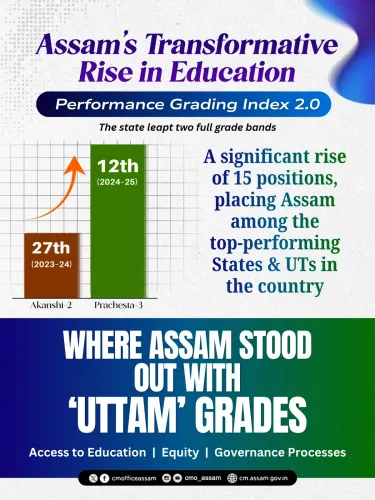
Assam Chief Minister Himanta Biswa Sarma announced on 25 May 2026 that Assam has jumped 15 places in the Ministry of Education's PGI 2.0, attributing the gain to a governance-driven push for equitable, quality school education under the Viksit Assam vision.
Key Takeaways
Assam has risen 15 places in the Ministry of Education's PGI 2.0 , according to CM Himanta Biswa Sarma .
The Performance Grading Index measures state-level school education quality, access, infrastructure, and equity.
CM Sarma linked the improvement to a 'razor sharp governance focus' on education as part of the Viksit Assam vision.
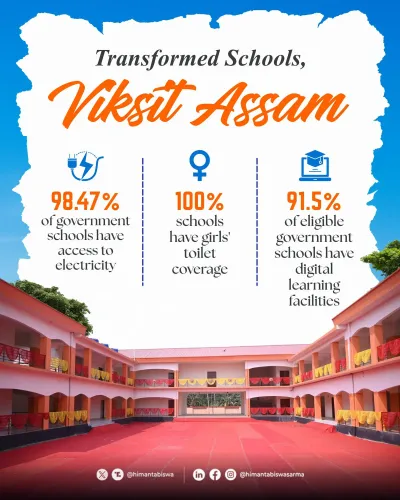
Assam has pursued teacher recruitment and school infrastructure upgrades under the Samagra Shiksha scheme since 2021 .
The Viksit Assam blueprint is aligned with the national Viksit Bharat 2047 human-capital development goal.
Next milestones include the forthcoming annual PGI report and Assam's 2026-27 education budget allocations.
Assam Chief Minister Himanta Biswa Sarma on Monday, 25 May 2026, highlighted the state's significant climb in the Ministry of Education's Performance Grading Index (PGI) 2.0, saying Assam had leaped 15 places by prioritising quality education and equitable access as part of its Viksit Assam development vision.
Context
Posting on X, CM Sarma stated: 'Assam is not just building education infra but also ensuring that everyone has equal access to it.' He credited a 'razor sharp governance focus' on education for the state's rise in PGI 2.0, the updated framework used by the Union Ministry of Education to grade states on school-education outcomes including access, equity, infrastructure, and learning results.
The Performance Grading Index was first introduced by the Ministry of Education in 2019 to create a data-driven accountability mechanism for state governments. PGI 2.0 is a revised iteration with expanded parameters, reflecting the priorities of the National Education Policy 2020 around equitable access and measurable learning outcomes.
Policy Backdrop
Since CM Sarma took office in May 2021, the Assam government has undertaken teacher recruitment drives and school infrastructure upgrades under the centrally sponsored Samagra Shiksha scheme. These initiatives have been framed as foundational to Viksit Assam, the state's own development blueprint aligned with the national Viksit Bharat 2047 goal of transforming India into a developed economy by its centenary of independence.
Northeastern states have received targeted administrative and financial attention under the North-East Democratic Alliance (NEDA), which Sarma convenors. Outcome-based monitoring through periodic PGI releases has been a central tool through which the Union government tracks whether states translate spending into measurable improvements in school education.
Stakeholders and Impact
The primary beneficiaries of any sustained improvement in Assam's education metrics are students enrolled in government schools across the state, particularly in rural and remote areas where access gaps have historically been widest. The state's Education Department and district-level administrators are the key implementation actors whose governance performance the PGI 2.0 ranking reflects.
A 15-place jump in a national ranking carries political significance for the BJP-led state government, reinforcing its narrative of delivery-oriented governance ahead of future electoral cycles. It also signals to the Ministry of Education that its index is functioning as intended — incentivising competitive improvement among states.
What's Next
Attention will now turn to the release of the next annual PGI report and Assam's 2026-27 education budget allocations, which will indicate whether the state can consolidate and extend its gains. Analysts watching the Northeast will track whether the ranking improvement translates into measurable on-ground outcomes — enrolment rates, learning levels, and dropout reduction — particularly among marginalised communities.
If Assam sustains its upward trajectory, it could emerge as a benchmark governance model for other Northeastern states under the NEDA framework, reinforcing the broader Viksit Bharat human-capital development narrative heading into the second half of the decade.
Point of View
Using a central government index — rather than self-reported data — to validate Assam's education reforms, lending the claim institutional credibility. The framing connects state-level delivery to the nationally resonant Viksit Bharat 2047 narrative, positioning Assam as a model for Northeast development under BJP governance. The emphasis on 'equal access' alongside infrastructure signals a deliberate shift toward equity metrics, which are harder to game than input-based indicators. This pattern of using PGI rankings as political proof-points reflects a broader trend of competitive federalism in Indian education governance, where states increasingly treat outcome indices as reputational assets.
NationPress
10 Oct 2026
Frequently Asked Questions
What is PGI 2.0 and how does it rank states?
PGI 2.0 is the updated Performance Grading Index released by India's Ministry of Education to evaluate states and union territories on school education quality, access, equity, infrastructure, and governance. States are graded on a composite score, and the index is designed to incentivise competitive improvement.
How many places has Assam jumped in PGI 2.0?
According to CM Himanta Biswa Sarma , Assam has leaped 15 places in PGI 2.0 , which he attributed to a focused governance push on education quality and equitable access.
What is Viksit Assam?
Viksit Assam is the Assam government's state-level development vision, aligned with the national Viksit Bharat 2047 goal of making India a developed nation by the centenary of its independence. Education is a key pillar of this vision.
What education schemes is Assam implementing to improve school outcomes?
Assam has undertaken teacher recruitment drives and school infrastructure upgrades primarily under the centrally sponsored Samagra Shiksha scheme since CM Sarma took office in May 2021 , alongside broader governance reforms.
Why does the PGI ranking matter for Assam?
A higher PGI ranking signals that Assam is improving on measurable school education outcomes, which strengthens the state government's governance credentials, can attract additional central funding, and benchmarks progress for students in government schools across the state.