CM Himanta Announces ₹100 Cr Tech Push in Assam Budget 2026
Synopsis
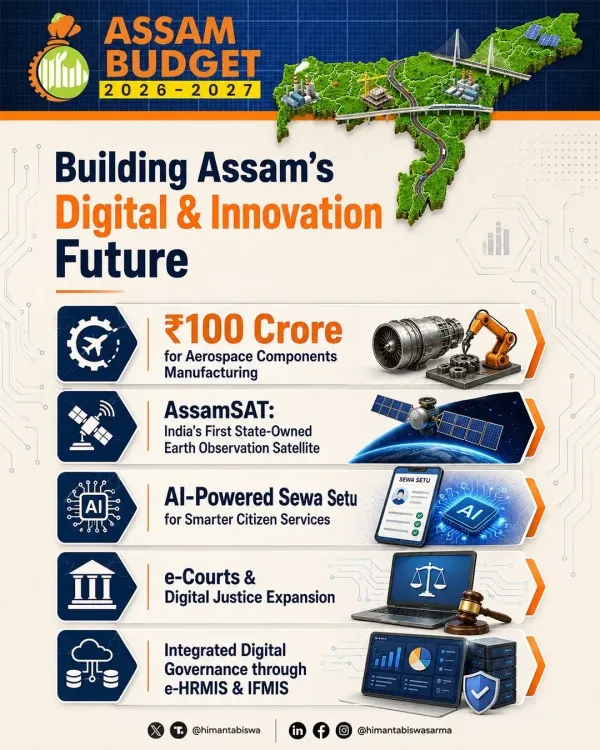
Assam Chief Minister Himanta Biswa Sarma unveiled a ₹100 crore technology package in the Assam Budget 2026, covering aerospace manufacturing, the AssamSAT satellite programme, and AI-driven citizen services — marking a significant shift in the state's development strategy toward high-tech sectors.
Key Takeaways
₹100 crore has been allocated in Assam Budget 2026 for technology-focused initiatives.
The package covers three areas: aerospace manufacturing , the AssamSAT satellite programme, and AI-powered citizen services .
CM Himanta Biswa Sarma described the move as 'a major leap in digital governance' for the state.
The initiative aligns with India's Digital India programme and the liberalisation of the national space sector since 2020 .
Detailed scheme guidelines and tender processes will follow the formal budget presentation in the state assembly.
Assam could serve as a model for other NEDA -aligned northeastern states pursuing tech-led development.
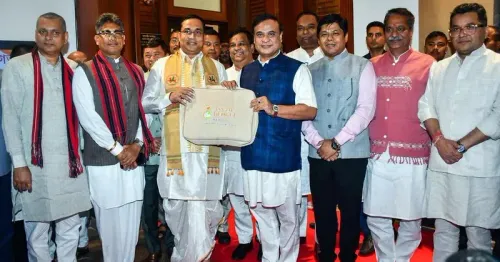
Assam Chief Minister Himanta Biswa Sarma announced on Friday, 10 July 2026 that the state's budget for 2026 earmarks ₹100 crore for a cluster of technology initiatives — spanning aerospace manufacturing, a dedicated state satellite programme called AssamSAT, and artificial-intelligence-powered citizen services — positioning Assam as a digitally advanced state in India's northeast.
Context
The announcement came via a post by CM Sarma on X (formerly Twitter), where he described the investment as 'a major leap in digital governance' aimed at building 'a smarter, technology-enabled future' for Assam. The hashtag #AssamBudget2026 accompanied the post, signalling that the outlay is part of a formal budget allocation rather than a standalone policy declaration.
The three pillars — aerospace manufacturing, AssamSAT, and AI-driven public services — represent a notable broadening of the state's technology ambitions, moving beyond conventional e-governance into high-end manufacturing and space technology.
Policy Backdrop
Assam's announcement fits within the decade-long arc of India's Digital India programme, launched in 2015, which incentivised states to expand digital infrastructure and citizen-facing services. Northeastern states, many of them aligned under the North-East Democratic Alliance (NEDA) — of which CM Sarma is convenor — have progressively synchronised their budgets with national priorities on digital infrastructure and high-tech manufacturing.
The inclusion of aerospace manufacturing is particularly significant. India's broader push to develop a domestic aerospace and space-tech ecosystem, accelerated by the liberalisation of the space sector in 2020, has opened avenues for state governments to attract private aerospace investors. A dedicated satellite — AssamSAT — would place Assam among a small group of Indian states actively pursuing space-based assets for governance and development purposes.
AI-powered citizen services, the third pillar, reflect a pattern visible across multiple Indian states that are deploying machine-learning tools for grievance redressal, land records, and welfare delivery — often in partnership with central government platforms and private technology firms.
Stakeholders and Impact
The primary beneficiaries of the AI and digital services component are Assam's approximately 3.5 crore residents, who stand to gain faster, more transparent access to government schemes and administrative services. Tech startups and entrepreneurs in the northeast could find new procurement and partnership opportunities if the budget provisions translate into open tenders.
Aerospace manufacturers — both domestic and foreign — are a key audience for the manufacturing investment. The northeast has historically attracted limited industrial investment owing to connectivity constraints, and a dedicated budget line signals the state's intent to change that calculus. Scheme guidelines and tender processes following the formal budget presentation will determine how quickly private capital can be mobilised.
What's Next
The immediate milestones to watch are the tabling of the full Assam Budget 2026 in the state assembly, which will provide legislative backing and line-item details for the ₹100 crore technology allocation. Detailed scheme guidelines, request-for-proposal documents for aerospace manufacturing, and any memoranda of understanding with central agencies — particularly the Indian Space Research Organisation (ISRO) or the IN-SPACe regulatory body — will clarify the scope and timeline of AssamSAT.
If the allocations are operationalised as announced, Assam could emerge as a template for other NEDA-aligned northeastern states seeking to combine digital governance reform with high-value manufacturing investment — a combination that national policymakers have long urged the region to pursue.
Point of View
A state satellite, and AI services into a single ₹100 crore budget headline is a calculated political and economic signal — it projects Assam as a forward-looking state capable of competing for high-value investment beyond its traditional agricultural and oil-sector identity. The move fits a broader pattern among NEDA-governed northeastern states of using technology announcements to attract central government attention and private capital simultaneously. The inclusion of AssamSAT is the most ambitious element; state-level satellite programmes remain rare in India, and execution will depend heavily on coordination with central space authorities. Whether this translates into tangible outcomes or remains aspirational will hinge on the granularity of the scheme guidelines that follow the budget presentation.
NationPress
9 Oct 2026
Frequently Asked Questions
How much money has Assam allocated for technology in Budget 2026?
Assam has earmarked ₹100 crore in its 2026 budget for a technology package covering aerospace manufacturing, the AssamSAT satellite, and AI-powered citizen services.
What are AI-powered citizen services in Assam?
AI-powered citizen services refer to government services enhanced by artificial intelligence — such as faster grievance redressal, digital welfare delivery, and automated land records — that Assam plans to expand using its Budget 2026 allocation.
How does Assam Budget 2026 relate to Digital India?
The Assam Budget 2026 technology investments align with the national Digital India programme launched in 2015, which encourages states to build digital infrastructure and citizen-facing services, and with India's broader push to develop aerospace and space-tech capabilities.
What is NEDA and what role does CM Himanta play?
The North-East Democratic Alliance (NEDA) is a BJP-led political alliance of northeastern Indian states. CM Himanta Biswa Sarma serves as its convenor and is also the Chief Minister of Assam since 2021.