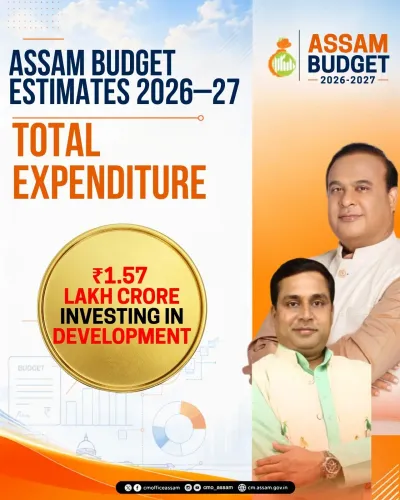
Assam Budget 2026: Aggregate Receipts Pegged at ₹2,88,309.45 Crore
Synopsis
The CMO of Assam has released key highlights of the state budget for FY 2026–27, pegging aggregate receipts at ₹2,88,309.45 crore. This includes a Public Account of ₹1,34,466.22 crore and a Contingency Fund of ₹2,000 crore, outlining the state's total fiscal envelope for the year.
Key Takeaways
Aggregate receipts for Assam in FY 2026–27 are estimated at ₹2,88,309.45 crore , covering all three state funds.
The Public Account component alone stands at ₹1,34,466.22 crore , reflecting fiduciary receipts such as provident funds and deposits.
The Contingency Fund is set at ₹2,000 crore , providing emergency fiscal headroom for unforeseen expenditure.
The budget highlights were officially communicated by the Chief Minister's Office of Assam on 10 July 2026 .
Detailed scheme-wise allocations and expenditure heads are expected to follow through Assam Legislative Assembly debates.
CM Himanta Biswa Sarma has overseen Assam's budgetary process since taking office in 2021 .
The Chief Minister's Office of Assam on Friday, 10 July 2026 released key highlights of Assam Budget 2026, disclosing that aggregate receipts for FY 2026–27 are estimated at ₹2,88,309.45 crore, a figure that consolidates the Consolidated Fund, the Public Account, and the Contingency Fund.
Context
The headline aggregate receipt figure of ₹2,88,309.45 crore is composed of two major supplementary components: the Public Account, estimated at ₹1,34,466.22 crore, and the Contingency Fund, set at ₹2,000 crore. The remaining balance forms the Consolidated Fund receipts, which cover tax revenue, non-tax revenue, and grants-in-aid from the Centre. The CMO's post, tagged #AssamBudget2026, marks the official communication of these top-line numbers to the public.
Policy Backdrop
Under Article 202 of the Constitution of India, every state is required to lay before the legislature an annual statement of estimated receipts and expenditure — the Annual Financial Statement. Assam follows this constitutional mandate, with the budget tabled in the Assam Legislative Assembly and debated across sessions before final passage. The Public Account, distinct from the Consolidated Fund, captures receipts such as provident fund collections, small savings, and other deposits held by the state in a fiduciary capacity rather than as its own revenue.
The Contingency Fund of Assam, placed at ₹2,000 crore for FY 2026–27, is an imprest maintained to enable the government to meet unforeseen expenditure pending legislative authorisation. Its size reflects the state's assessment of emergency fiscal headroom required over the fiscal year.
Stakeholders and Impact
The aggregate receipt estimate directly shapes how much the Government of Assam can deploy across departments — from infrastructure and irrigation to health, education, and social welfare. Assam's citizens, state government employees, local businesses, and contractors engaged in public works are all stakeholders in how these receipts translate into on-ground expenditure. A larger Public Account component also signals active management of state-level savings and deposit schemes that benefit ordinary residents.
Chief Minister Himanta Biswa Sarma, who has overseen the state's finances since assuming office in 2021, has consistently positioned successive budgets as instruments of economic acceleration and welfare delivery in the Northeast. The scale of the FY 2026–27 receipt estimates, if matched by expenditure execution, would represent a significant fiscal footprint for the state.
What's Next
The headline receipt figures are only the opening frame of the budget story. Detailed expenditure heads, scheme-wise allocations, capital outlay breakdowns, and the fiscal deficit position are expected to emerge through assembly debates and the full budget documents. Quarterly fiscal monitoring reports will subsequently track whether actual receipts keep pace with estimates — a key measure of fiscal credibility. Analysts and legislators will watch closely for allocations to infrastructure, agriculture, and the state's flagship welfare programmes in the detailed budget papers.
Point of View
A structural feature common to many Indian states with expanding social-sector commitments. For CM Himanta Biswa Sarma, presenting a budget of this magnitude is both a governance signal and a political statement ahead of continued development-focused positioning in the region. The proof, however, will lie in expenditure execution rates and the deficit numbers that fuller budget documents will eventually reveal.
NationPress
10 Jul 2026
Frequently Asked Questions
What are Assam's total budget receipts for FY 2026-27?
The aggregate receipts for Assam in FY 2026–27 are estimated at ₹2,88,309.45 crore , including the Consolidated Fund, Public Account, and Contingency Fund.
What is the Assam Public Account in Budget 2026?
The Public Account of Assam for FY 2026–27 is estimated at ₹1,34,466.22 crore . It covers fiduciary receipts such as provident fund collections, small savings, and state-held deposits.
What is the Assam Contingency Fund for 2026-27?
The Contingency Fund of Assam is set at ₹2,000 crore for FY 2026–27, maintained as an imprest to meet unforeseen expenditure without prior legislative approval.
Who presented the Assam Budget 2026 highlights?
The key highlights of #AssamBudget2026 were released by the Chief Minister's Office of Assam on 10 July 2026 via an official post on X.
What is the difference between the Consolidated Fund and Public Account in a state budget?
The Consolidated Fund holds a state's own revenues and borrowings used for government expenditure, while the Public Account holds funds the government manages in a fiduciary capacity — such as provident funds and deposits — which are not the state's own revenue.