Assam Budget 2026: CM Office Unveils Agri Export Push
Synopsis
Assam's Budget 2026 targets agricultural export growth through organic certification for high-value crops, a new Guwahati air cargo facility backed by NABARD, and enhanced support for Farmer Producer Organisations under the Mukhya Mantri Utkarsh Yojana.
Key Takeaways
The Assam Budget 2026 announced on 10 July 2026 includes a dedicated push to promote organic certification for high-value crops to boost export competitiveness.
An air cargo facility in Guwahati will be developed to strengthen export logistics for agricultural produce from Northeast India.
NABARD , India's apex rural development bank, has been named as a key support partner for the certification and logistics initiatives.
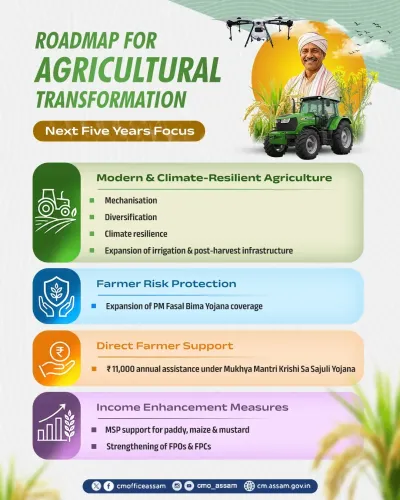
Farmer Producer Organisations (FPOs) will be strengthened through the state's Mukhya Mantri Utkarsh Yojana , targeting better market access for small and marginal farmers.
The measures align with the central government's national target of promoting 10,000 FPOs and doubling India's agricultural exports through improved value chains.
The Chief Minister's Office of Assam announced key agricultural provisions from the Assam Budget 2026 on Friday, 10 July 2026, outlining plans to promote organic certification for high-value crops, upgrade export logistics, and strengthen farmer collectives across the state.
Context
The budget highlights focus on making Assam a competitive player in agricultural exports by addressing two structural gaps: certification credibility and physical connectivity to markets. The government announced it will promote organic certification for high-value crops and develop an air cargo facility in Guwahati — the state's primary commercial hub and the gateway to Northeast India — to move perishable and premium produce to export markets faster.
NABARD, India's apex development finance institution for agriculture and rural development, has been named as a support partner for these initiatives. The apex bank has historically funded certification infrastructure and logistics upgrades across states with agro-climatic export potential.
Policy Backdrop
Assam's agricultural export ambition rests on its natural advantages in tea, spices, fruits, and medicinal plants — crops that command premium prices in international markets when certified organic. State governments across the Northeast have long grappled with connectivity constraints that raise the cost of moving produce to ports and airports, making a dedicated Guwahati air cargo facility a long-sought infrastructure fix.
The budget also invokes Farmer Producer Organisations (FPOs), registered collectives first promoted nationally in 2013 under the Small Farmers' Agribusiness Consortium to improve the bargaining power of small and marginal farmers. The central government had set a target of forming 10,000 FPOs across states to build market linkages and reduce dependence on intermediaries.
Assam's budget proposes to strengthen FPOs specifically through the Mukhya Mantri Utkarsh Yojana, a state-level scheme that will channel support to these collectives. This aligns with the central government's broader push to double agricultural exports through improved value chains and collective farmer institutions.
Stakeholders and Impact
The primary beneficiaries are small and marginal farmers in Assam who grow high-value crops but have historically lacked access to organic certification processes and direct export channels. FPO strengthening under the Mukhya Mantri Utkarsh Yojana is intended to give these farmers collective leverage in negotiations with buyers and access to formal credit.
Agricultural exporters operating out of the Northeast stand to benefit from reduced logistics costs and transit times if the Guwahati air cargo facility becomes operational. For perishable organic produce — a category where shelf-life is a critical export constraint — air connectivity is often the difference between a viable and non-viable trade route.
What's Next
The immediate focus will be on rollout timelines and funding releases for the Guwahati air cargo facility and the Mukhya Mantri Utkarsh Yojana component supporting FPOs. Coordination between the state government, NABARD, and certification bodies will determine how quickly farmers can access organic labelling that unlocks premium export pricing.
If the logistics and certification infrastructure materialises on schedule, Assam could emerge as a model for how Northeast states leverage their agro-climatic strengths to compete in global organic and specialty food markets — a template other states in the region are likely to watch closely.
Point of View
Which is politically useful for visibility. The Guwahati air cargo facility, if it advances, addresses a structural constraint that has long hobbled Northeast India's export potential and could have multiplier effects beyond agriculture. The open question is implementation cadence: Northeast infrastructure projects have historically faced delays, and the credibility of this budget announcement will depend on how quickly ground-level activity follows.
NationPress
10 Jul 2026
Frequently Asked Questions
What is the Assam Budget 2026 plan for agricultural exports?
The Assam Budget 2026 proposes to promote organic certification for high-value crops and develop an air cargo facility in Guwahati with NABARD support to strengthen export logistics.
What is the Mukhya Mantri Utkarsh Yojana in Assam?
The Mukhya Mantri Utkarsh Yojana is a state government scheme under which Assam plans to strengthen Farmer Producer Organisations (FPOs), improving market access and support for small and marginal farmers.
What is NABARD's role in Assam's agricultural export push?
NABARD, India's apex development bank for agriculture and rural development, has been named as a support partner for Assam's organic certification infrastructure and export logistics upgrades announced in the 2026 budget.
What are Farmer Producer Organisations and why do they matter for Assam?
Farmer Producer Organisations are registered collectives of farmers promoted since 2013 to improve bargaining power and market linkages. In Assam, they are seen as a vehicle to help small farmers access organic certification and export channels.
Why is a Guwahati air cargo facility important for Assam's farmers?
Guwahati is the primary commercial hub of Northeast India, and an air cargo facility there would reduce transit times for perishable organic produce, making exports to international markets more viable for Assam's farmers.