Assam Budget 2026: Land Revenue to Go Digital via e-Khazana

Synopsis
Assam's 2026 budget proposes expanding land revenue collection through e-Khazana, Gram Panchayats, Urban Local Bodies, and Gaon Pradhans, while widening the scope of compulsory registration to formalise more land transactions across the state.
Key Takeaways
The Assam Budget 2026 proposes expanding land revenue collection channels beyond centralised offices.
New collection points will include e-Khazana (online portal), Gram Panchayats , Urban Local Bodies , and Gaon Pradhans .
More legally recognised transactions will be brought under compulsory registration to formalise informal land deals.
The reform targets both rural and urban landholders across Assam .
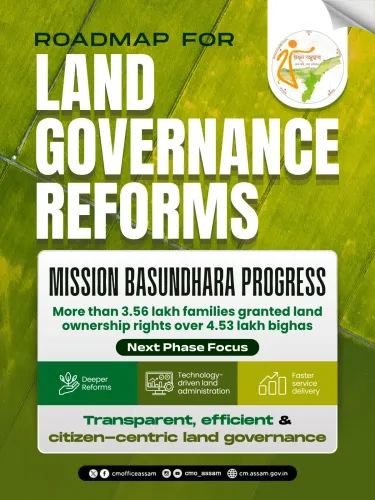
The move continues Assam's multi-year digitisation of land records under the Digital India Land Records Modernisation Programme framework.
Increased formalisation is expected to raise stamp duty revenue and establish clearer property titles.
The Chief Minister's Office of Assam on Friday, 10 July 2026, shared key highlights from Assam Budget 2026, announcing that the state government will expand land revenue collection channels to include e-Khazana, Gram Panchayats, Urban Local Bodies, and Gaon Pradhans, while simultaneously broadening the scope of compulsory registration for legally recognised transactions.
Context
The announcement, posted under the hashtag #AssamBudget2026, signals a deliberate push to decentralise and digitise one of the state's most fundamental revenue functions. As the post states, the goal is to make land revenue collection 'more accessible' by bringing it closer to citizens — both through digital infrastructure and through trusted village-level institutions. The move also targets the formalisation of land transactions by bringing more of them under compulsory registration.
e-Khazana is Assam's online portal for land revenue payments and record management, already in use as part of the state's broader digitisation agenda. By routing collections through Gram Panchayats and Gaon Pradhans — village-level revenue functionaries historically responsible for local land assessment — the government is blending technology with deeply rooted institutional structures.
Policy Backdrop
Assam has pursued progressive digitisation of land records across multiple prior budgets, operating within the framework of the Digital India Land Records Modernisation Programme. This latest step continues a long-running shift away from manual, centralised khajana collection toward hybrid models that combine digital payment gateways with traditional village institutions.
The emphasis on compulsory registration reflects a pattern seen across Northeast India, where states have been working to bring informal land deals into the formal system. Formalisation serves a dual purpose: it establishes clearer property titles for landowners and raises stamp duty realisation for the state exchequer. Across India more broadly, states have increasingly assigned routine revenue functions to panchayats and local bodies to reduce leakages and improve last-mile service delivery.
Stakeholders and Impact
Rural households and landowners stand to benefit most directly. For citizens in remote areas of Assam, travelling to a central revenue office to pay land dues has historically been a burden. Access through Gram Panchayats and Gaon Pradhans — institutions already embedded in village life — could significantly reduce that friction.
Urban Local Bodies are included in the expanded network, suggesting the reform is designed to cover both rural and peri-urban landholders. The compulsory registration component will affect buyers, sellers, and intermediaries involved in property transactions that currently fall outside the formal registration system, pushing informal deals into a documented, legally recognised framework.
What's Next
The key variables to watch are the rollout schedule for the expanded collection points and any legislative amendments — particularly to the Assam Land Revenue Regulation or the relevant Registration Act — that may be introduced during the 2026-27 fiscal year to give the compulsory registration push statutory teeth. Implementation details, including which transaction categories will be brought under mandatory registration, are yet to be officially specified.
If executed at scale, the reform could meaningfully increase the state's own-tax revenue while reducing the administrative burden on centralised revenue offices — a model that other Northeast Indian states may watch closely.
Point of View
The two measures reflect a broader fiscal strategy of expanding the state's own revenue base without introducing new taxes. Whether the reform delivers on its promise will depend almost entirely on implementation speed and the legislative scaffolding the government provides in the months ahead.
NationPress
10 Jul 2026
Frequently Asked Questions
What is e-Khazana in Assam?
e-Khazana is Assam's online portal for land revenue payments and land record management, introduced as part of the state's digital governance initiatives. The Assam Budget 2026 proposes expanding its use as a primary collection channel.
What does compulsory registration of land transactions mean in Assam?
Compulsory registration means that certain property transactions must be formally documented and registered with the government rather than being settled informally. Assam Budget 2026 proposes bringing more categories of legally recognised transactions under this mandatory framework to reduce informal land deals.
Who are Gaon Pradhans in Assam?
Gaon Pradhans are village-level revenue functionaries in Assam who have historically been responsible for local land assessment and collection. Under the Assam Budget 2026 proposal, they will serve as additional collection points for land revenue.
How will Assam Budget 2026 affect rural landowners?
Rural landowners in Assam will be able to pay land revenue closer to their homes through Gram Panchayats and Gaon Pradhans , reducing the need to travel to centralised revenue offices. The expanded e-Khazana portal also offers a digital payment option.
What is the Digital India Land Records Modernisation Programme?
It is a central government framework under which Indian states, including Assam , have been digitising land records and revenue processes over multiple years. Assam Budget 2026 's land revenue proposals continue this multi-budget digitisation trajectory.