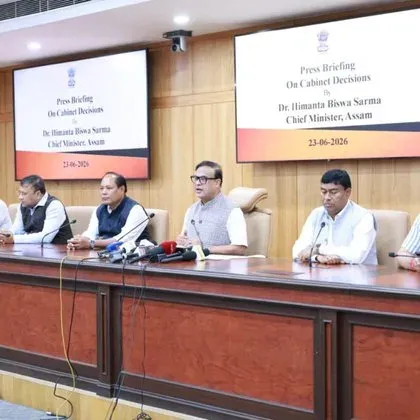
Assam Cabinet Clears ₹303.69 Cr Investment, 300 Jobs in Kamrup

Synopsis
The Assam Cabinet has approved a ₹303.69 crore investment targeting 300 new jobs in Kamrup district, the Chief Minister's Office announced on 25 October 2026, reinforcing the state's push to expand the Northeast's industrial base.
Key Takeaways
The Assam Cabinet approved an investment of ₹303.69 crore on 25 October 2026 .
The investment is projected to create 300 new job opportunities in Kamrup district .
Kamrup's proximity to Guwahati makes it a key target for Assam's industrialisation drive.
The announcement was made by the Chief Minister's Office of Assam on X.
Actual job creation will hinge on project implementation, regulatory clearances, and infrastructure delivery.
Three hundred new jobs and more than three hundred crore rupees flowing into one of Assam's most strategically positioned districts — that is the headline from Guwahati on Saturday, 25 October 2026, as the Assam Cabinet formally approved an investment of ₹303.69 crore, targeting fresh employment in Kamrup district. The Chief Minister's Office of Assam announced the decision via an official post on X, signalling the state government's continued push to deepen the Northeast's industrial footprint.
The cabinet's green light — worth just over ₹303 crore — is earmarked to create 300 direct job opportunities in Kamrup, a district that straddles the greater Guwahati urban agglomeration and has emerged as a focal point for Assam's industrialisation ambitions. For a region that has historically depended on agriculture and the public sector, each approved investment carries an outsized multiplier effect on local livelihoods.Kamrup's Growing Industrial Pull
Kamrup occupies a pivotal position in Assam's economic geography. Its proximity to Guwahati — the commercial nerve centre of Northeast India — makes it a natural magnet for investment in manufacturing, logistics, and services. State governments have periodically channelled capital into the district as part of broader efforts to diversify the Northeast's economy away from dependence on the primary sector. Saturday's approval continues that trajectory, adding another data point to a pattern of incremental but accumulating cabinet-level commitments.
The cabinet decision is a procedural gateway: approval signals intent and unlocks the administrative machinery, but the harder test lies in implementation — land acquisition, regulatory clearances, infrastructure provisioning, and, ultimately, whether the promised 300 jobs materialise on the ground for local workers.
Northeast Investment Push: Pattern and Stakes
Assam has in recent years positioned itself as an investor-friendly destination within the Northeast, leveraging central government incentives for the region alongside state-level schemes. Each cabinet-approved project — whether in Kamrup or elsewhere — contributes to a cumulative case the state makes to private capital: that the regulatory and political environment is stable enough to commit funds at scale.
For the local workforce in Kamrup, 300 jobs may sound modest against the district's broader employment deficit, but direct investments of this size typically anchor supply chains and services that generate secondary employment well beyond the headline figure. The quality and permanence of those jobs — skilled versus unskilled, formal versus contractual — will define whether the investment delivers lasting economic mobility or a short construction-phase spike.
The eyes of industry bodies and potential investors in the Northeast will now shift to the timeline: how fast the project moves from cabinet approval to ground-breaking, and whether Assam can demonstrate execution speed that matches its approval momentum.
Point of View
The investment is medium-scale by national standards but meaningful in a region where large private commitments remain relatively scarce. The political optics are clear: the ruling dispensation needs visible, quantifiable wins on employment before the next electoral cycle, and cabinet-approved investment figures serve as credible milestones it can point to. The real test — which analysts will watch — is whether Kamrup's approval-to-execution track record holds, and whether the 300 jobs land in formal, well-paying roles rather than short-term construction work.
NationPress
24 Oct 2026
Frequently Asked Questions
How much has the Assam Cabinet approved for investment in Kamrup?
The Assam Cabinet approved an investment of ₹303.69 crore for a project in Kamrup district, as announced on 25 October 2026.
How many jobs will the Assam Cabinet investment create?
The approved investment is expected to create 300 new job opportunities in Kamrup district.
Where is Kamrup district located in Assam?
Kamrup is a district in Assam situated around the greater Guwahati region, making it a strategic hub for industrial and infrastructure projects in the Northeast.
Who approved the ₹303.69 crore investment in Assam?
The Assam Cabinet — the state's council of ministers — formally approved the investment, with the announcement made by the Chief Minister's Office of Assam.
What is the significance of Assam's cabinet investments for the Northeast?
Cabinet-approved investments in Assam contribute to the Northeast's broader industrialisation drive by attracting private capital, creating jobs, and building the case for further investment in the region.