Assam CM Himanta receives Madhubani painting of Siya Ram from Governor
Synopsis
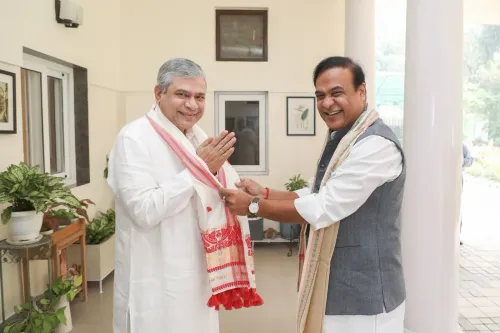
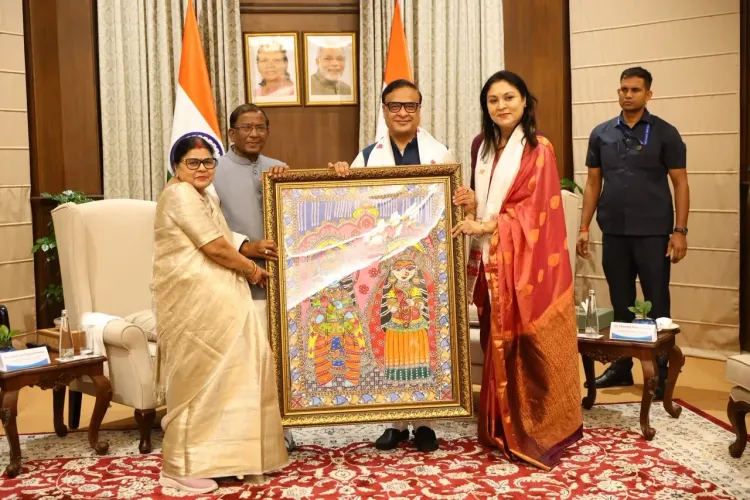
Assam Chief Minister Himanta Biswa Sarma and his wife Riniki Bhuyan Sarma received a grand Madhubani painting of Siya Ram from Governor Laxman Prasad Acharya and Smt. Kumud Devi at a Sneha Milan programme in Lok Bhavan, blending constitutional cordiality with classical Indian artistic heritage.
Key Takeaways
Assam CM Himanta Biswa Sarma and wife Riniki Bhuyan Sarma received a Madhubani painting of Siya Ram as a gift.
The gift was presented by Assam Governor Laxman Prasad Acharya and Smt.
Kumud Devi at Lok Bhavan .
The occasion was a Sneha Milan Karyakram , a ceremonial social gathering between constitutional functionaries.
Madhubani (Mithila) painting is a classical Indian folk art form with Geographical Indication (GI) tag protection, known for Ramayana depictions.
The exchange reflects a broader pattern of embedding traditional Indian artistic heritage into official state ceremonies.
Assam Chief Minister Himanta Biswa Sarma and his wife Riniki Bhuyan Sarma received a grand Madhubani painting depicting Siya Ram as a gift from Assam Governor Laxman Prasad Acharya and Smt. Kumud Devi at Lok Bhavan on the occasion of a Sneha Milan (affectionate gathering) programme.
Context
The Chief Minister shared the moment on social media, noting that the Governor and Smt. Kumud Devi presented Riniki and him with 'a grand Madhubani painting of Siya Ram' at Lok Bhavan. The occasion was a Sneha Milan Karyakram — a ceremonial social gathering that brings together constitutional functionaries and their families in an informal, culturally rooted setting.
Madhubani, also known as Mithila painting, is a classical Indian folk art tradition originating in the Mithila region of Bihar. Depictions of Ramayana figures — particularly Siya Ram (Sita and Ram) — are among the most iconic motifs in this art form, rendered in bold lines and vivid natural colours on cloth or handmade paper.
Policy Backdrop
The exchange of traditional regional art at official functions reflects a broader pattern across Indian states of embedding classical artistic heritage into the ceremonial fabric of governance. Since 2020, public cultural programmes at state and central levels have increasingly featured Ramayana and Mahabharata iconography, aligning official events with India's classical literary and artistic traditions.
Madhubani paintings have received sustained support under central and state-level craft promotion schemes, with Geographical Indication (GI) tag protection reinforcing their cultural and commercial standing. Their presence in Governor-CM exchanges signals the art form's stature as a dignified diplomatic and ceremonial gift.
Stakeholders and Impact
Assam Governor Laxman Prasad Acharya and Smt. Kumud Devi presented the artwork personally, underscoring the warmth of the constitutional relationship between the Raj Bhavan and the Chief Minister's office. Such gestures are recognised as soft-power expressions of inter-institutional cordiality within the Indian federal structure.
For artisans and practitioners of Madhubani painting, visibility at high-profile official events reinforces the art form's prestige and can stimulate demand. Cultural organisations and state craft boards tracking the promotion of traditional Indian arts will note the gesture as consistent with ongoing efforts to mainstream classical folk traditions in public life.
What's Next
The Sneha Milan format — informal yet ceremonially significant — is likely to recur as a vehicle for cultural exchange between Assam's constitutional offices. Observers of state-level cultural programming will watch for subsequent gatherings that similarly spotlight regional artistic traditions. The Madhubani painting now in the Chief Minister's possession may also find a place in public-facing state spaces, further amplifying the art form's reach.
Point of View
The choice of art as a diplomatic token between constitutional offices has grown more intentional since the mainstreaming of classical Indian epic imagery in public life. For CM Himanta Biswa Sarma, whose political identity is closely tied to cultural nationalism in the North-East, receiving such a gift publicly reinforces a shared symbolic vocabulary between the Raj Bhavan and the Chief Minister's office. The episode also quietly elevates Madhubani art's profile at a moment when craft-based heritage is being actively woven into India's soft-power narrative.
NationPress
19 Sept 2026
Frequently Asked Questions
What is the Sneha Milan programme in Assam?
The Sneha Milan Karyakram is a ceremonial social gathering that brings together Assam's constitutional functionaries — such as the Governor and Chief Minister — and their families in an informal, culturally rooted setting to foster inter-institutional warmth.
What is a Madhubani painting?
Madhubani, also called Mithila painting, is a classical Indian folk art originating in the Mithila region of Bihar. It is known for bold geometric lines and vivid colours, and frequently depicts scenes and figures from the Ramayana, including Siya Ram (Sita and Ram).
Who gifted the Madhubani painting to Assam CM Himanta Biswa Sarma?
Assam Governor Laxman Prasad Acharya and his wife Smt. Kumud Devi presented the Madhubani painting of Siya Ram to CM Himanta Biswa Sarma and his wife Riniki Bhuyan Sarma at Lok Bhavan.
Where is Lok Bhavan in Assam?
Lok Bhavan is an official venue in Assam associated with the Governor's office, used for formal and cultural programmes involving senior state officials.
Why are Ramayana themes common in Madhubani paintings?
Ramayana figures such as Siya Ram are among the oldest and most iconic motifs in Madhubani art, rooted in the cultural and religious traditions of the Mithila region where the art form originated.