CM Himanta Pays Tribute to Mahapurush Madhavdev on His Tithi
Synopsis
On Mahapurush Madhavdev's birth anniversary tithi, the Chief Minister's Office of Assam conveyed CM Himanta Biswa Sharma's tributes, reaffirming the state government's resolve to preserve and promote Assam's rich neo-Vaishnava cultural heritage rooted in the 16th-century Ekasarana Dharma tradition.
Key Takeaways
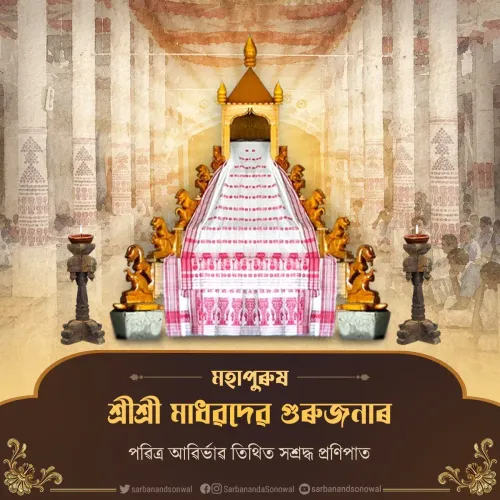
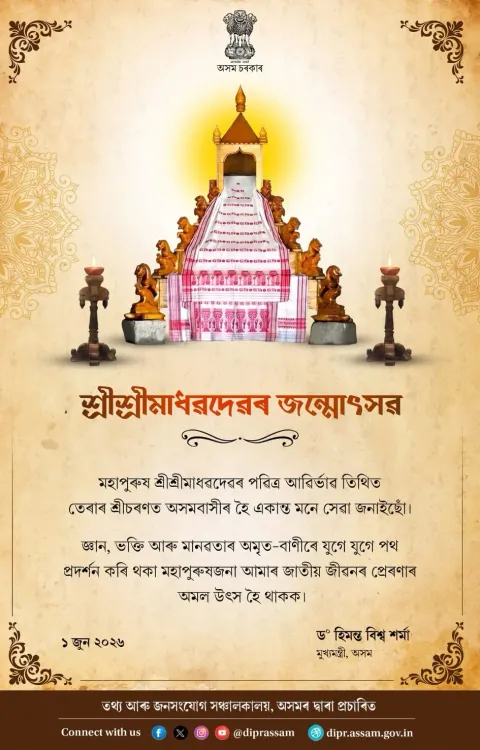
The Chief Minister's Office of Assam paid tribute to Mahapurush Srimanta Madhavdev on his aavir bhaav tithi on June 1, 2026 .
CM Himanta Biswa Sharma offered the tributes on behalf of all people of Assam, per the official post.
1489–1596) was the foremost disciple of Sankardev and a key figure in establishing the Ekasarana Dharma neo-Vaishnava movement in Assam.
The state government reaffirmed its commitment to preserving Assam's Vaishnava cultural heritage, including Sattra institutions, Borgeet and Ankiya Naat traditions.
Institutional support for Sattra infrastructure dates to at least 1998 , when the Srimanta Sankardev Kalakshetra was established in Guwahati .
Over 900 Sattras across Assam serve as custodians of the neo-Vaishnava manuscript, music and performance heritage.
The Chief Minister's Office of Assam, on behalf of Chief Minister Dr. Himanta Biswa Sharma, on Monday, June 1, 2026, offered floral tributes to Mahapurush Srimanta Madhavdev on the occasion of the saint's aavir bhaav tithi (birth anniversary tithi), reaffirming the state government's commitment to preserving Assam's Vaishnava heritage.
The post, shared in Assamese, states that Madhavdev's ideals 'continue to guide society on the path of unity, devotion and humanity' and that the state government, under CM Sharma's leadership, 'remains firmly resolved to carry forward its efforts for the preservation and promotion of Assam's rich cultural heritage.'
Context
Srimanta Madhavdev (c. 1489–1596) was a towering 16th-century Assamese saint, poet and scholar who became the foremost disciple of Srimanta Sankardev, the founder of the Ekasarana Dharma neo-Vaishnava movement. Together, the two saints reshaped Assamese religious and cultural life, emphasising single-minded devotion to Vishnu-Krishna and rejecting caste hierarchy. Madhavdev's literary contributions — including Borgeets (devotional songs) and Ankiya Naat (one-act plays performed in Sattras) — remain living traditions performed across Assam to this day. His aavir bhaav tithi, observed each year according to the Assamese lunar calendar, draws devotees to Sattras (Vaishnava monasteries) across the state, particularly in Barpeta, Bardowa and Narayanpur, sites closely associated with his life and work.Policy Backdrop
State support for Sattra institutions and neo-Vaishnava traditions has been a consistent thread in Assam's cultural policy for decades. The Srimanta Sankardev Kalakshetra, established in 1998 in Guwahati, stands as the most visible institutional expression of this commitment — a sprawling cultural complex dedicated to the heritage of Sankardev and Madhavdev. Since CM Sharma assumed office in May 2021, the government has stated cultural heritage preservation as a core priority alongside infrastructure development and welfare schemes. Successive Assam administrations have linked the Sankardev-Madhavdev legacy to assertions of indigenous Assamese cultural continuity, manuscript preservation drives, and more recently to cultural tourism promotion. State budgets have periodically included allocations for Sattra development grants and conservation of associated manuscripts and performance traditions.Stakeholders and Impact
Vaishnavite communities across Assam — numbering in the millions — look to the state's engagement with Sattra institutions as a signal of political and administrative support for their religious and cultural life. The roughly 900-plus Sattras spread across the state serve not only as centres of worship but as custodians of manuscripts, music, dance and drama traditions unique to the Assamese neo-Vaishnava school. For Sattra heads (Satradhikars) and cultural practitioners, official tributes on occasions such as Madhavdev's tithi carry institutional weight, reinforcing the expectation of continued budgetary and administrative support. Younger Assamese cultural practitioners engaged in reviving Borgeet and Ankiya Naat also watch government signals closely for programme funding and performance opportunities.What's Next
The tribute comes at the start of June 2026, ahead of the Assam state budget cycle and potential cultural department announcements. Observers will watch for any follow-through in the form of fresh Sattra development grants, manuscript digitisation initiatives, or commemorative events tied to the tithi season. The government's stated resolve to 'carry forward' heritage preservation efforts suggests continued institutional attention to this policy area, though specific new schemes announced around this occasion remain to be confirmed through official notifications.Point of View
But the CMO's framing — emphasising 'unity, devotion and humanity' alongside a pledge of continued preservation — signals that the Vaishnava heritage plank remains central to the Sharma administration's cultural identity politics. Linking governance resolve to a revered saint's ideals is a well-worn template across Indian state governments, yet in Assam it carries particular weight given the Sattra network's deep social reach and its role as a marker of indigenous Assamese identity distinct from both mainland Hindu nationalism and minority-community assertions. The real test of the stated commitment will come in budget allocations and scheme notifications, not ceremonial posts. Observers of Assam's cultural policy will watch whether the tithi tribute translates into measurable institutional support for manuscript conservation and Sattra infrastructure in the months ahead.
NationPress
15 Oct 2026
Frequently Asked Questions
Who was Mahapurush Madhavdev?
Mahapurush Srimanta Madhavdev (c. 1489–1596) was a 16th-century Assamese saint, poet and scholar, the foremost disciple of Srimanta Sankardev. He co-established the Ekasarana Dharma Vaishnava movement and enriched Assamese literature and performing arts through Borgeet devotional songs and Ankiya Naat one-act plays performed in Sattras.
What is Madhavdev's aavir bhaav tithi?
The aavir bhaav tithi is the birth anniversary of Madhavdev , observed according to the Assamese lunar calendar. It is a significant occasion for Vaishnavite communities across Assam, with devotional programmes held at Sattras associated with his life, particularly in Barpeta , Bardowa and Narayanpur .
What is the Ekasarana Dharma movement?
Ekasarana Dharma is a neo-Vaishnava movement founded by Srimanta Sankardev in 15th–16th century Assam, emphasising single-minded devotion to Vishnu-Krishna and rejecting caste distinctions. Madhavdev was its most prominent disciple and helped spread the movement through literature, music and drama.
What are Sattras in Assam?
Sattras are Vaishnava monasteries established as part of the Ekasarana Dharma tradition. Assam has over 900 Sattras that serve as centres of worship, manuscript preservation and performance of Borgeet and Ankiya Naat . They are recognised as key custodians of Assamese cultural heritage.
What has the Assam government done to preserve Vaishnava heritage?
The Assam state government has supported Sattra institutions through cultural department grants and infrastructure funding over several decades. The Srimanta Sankardev Kalakshetra , established in Guwahati in 1998 , is the flagship institution dedicated to this heritage. The Sharma administration (since May 2021) has stated cultural heritage preservation as a stated governance priority.