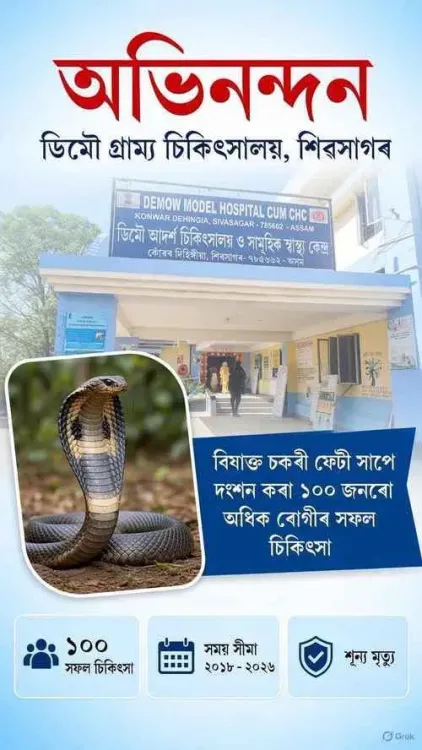
Assam CM Himanta hails Demow CHC's zero-death cobra bite record
Synopsis
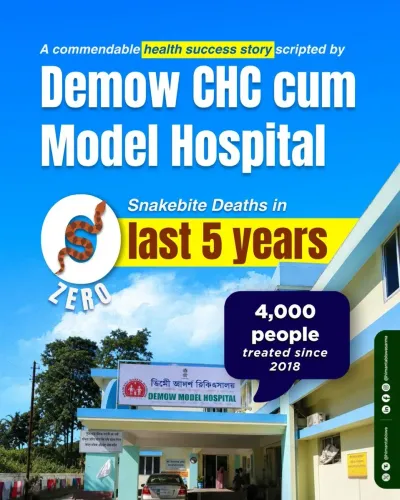
Demow Model CHC in Sivasagar, Assam has treated over 100 cobra bite victims since 2018 with zero fatalities, earning praise from CM Himanta Biswa Sarma and spotlighting Assam's National Health Mission-backed push to upgrade rural emergency care.
Key Takeaways
Demow Model CHC in Sivasagar district, Assam has treated over 100 cobra bite victims since 2018 with zero deaths .
Chief Minister Dr Himanta Biswa Sarma personally appreciated the CHC team's dedication on 25 October 2026 .
Assam began designating select facilities as Model CHCs under the National Health Mission from 2018 , targeting snakebite and rural emergency response.
Model CHCs received targeted training, antivenom stockpiling, and triage protocols for envenomation cases.
The achievement highlights the potential for state-wide replication of the Demow protocol to reduce preventable snakebite deaths across Assam.
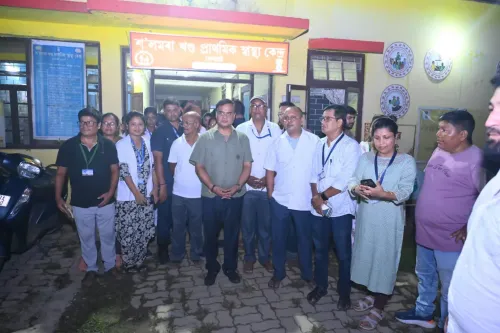
In a corner of Sivasagar district, Assam, a rural health centre has quietly been winning a war against one of the subcontinent's deadliest emergencies — and the numbers are striking. Demow Model Community Health Centre (CHC) has successfully treated more than 100 cobra bite victims since 2018, recording zero deaths — a feat that drew personal appreciation from Chief Minister Dr Himanta Biswa Sarma on Sunday, October 25, 2026.
A rural facility that refused to lose a single patient
Snakebite is a silent public-health crisis in agricultural Assam, where flooded paddy fields and dense undergrowth make encounters with cobras a grim seasonal reality. For years, patients in remote districts faced the brutal arithmetic of distance: the nearest referral hospital too far, the golden hour too short. Demow Model CHC changed that equation by building rapid-response capacity at the community level itself.
The Chief Minister's Office noted that CM Dr Sarma 'appreciated the dedication and commitment of the CHC's healthcare team in saving lives' — a rare direct acknowledgement of frontline rural health workers who rarely make headlines.
How Assam's Model CHC programme set the stage
The milestone did not happen in a vacuum. From 2018, Assam began designating select facilities as Model CHCs under the National Health Mission, targeting districts vulnerable to snakebite, flood-related injuries, and other rural emergencies. These centres received focused training and equipment — including antivenom stockpiling and triage protocols for envenomation — precisely to prevent the kind of preventable deaths that once sent mortality statistics climbing every monsoon.
Demow CHC's eight-year, zero-fatality record for cobra bites is the clearest proof yet that the model works when staffed with committed healthcare workers and backed with the right supplies.
What the Demow protocol could mean for the rest of Assam
The bigger question now is replication. Assam has dozens of CHCs serving snakebite-prone agricultural and flood-affected communities, and the state health department's next move — whether to formally document the Demow protocol and roll it out statewide, and whether upcoming budgets will shore up antivenom supply chains — will determine how many more lives this model can save. A single facility's success story is inspiring. A system-wide shift would be transformative.
Point of View
Publicly amplifying this record serves a dual purpose: it validates the National Health Mission investment in model CHCs and elevates frontline workers as a political constituency worth celebrating. The harder test lies ahead — whether the state can systematically document and transfer the Demow protocol to other snakebite-prone CHCs, or whether this remains an isolated success dependent on individual staff commitment rather than institutional design.
NationPress
25 Oct 2026
Frequently Asked Questions
What is Demow Model CHC and where is it located?
Demow Model Community Health Centre is a rural healthcare facility in Demow, Sivasagar district, Assam , upgraded under the National Health Mission as a model centre for emergency care including snakebite treatment.
How many cobra bite patients has Demow CHC treated and what is the death toll?
According to the Chief Minister's Office of Assam, Demow Model CHC has treated over 100 cobra bite victims since 2018 , recording zero deaths in that period.
What did CM Himanta Biswa Sarma say about Demow CHC?
CM Dr Himanta Biswa Sarma appreciated the 'dedication and commitment of the CHC's healthcare team in saving lives,' according to the official post from the Chief Minister's Office of Assam on 25 October 2026 .
What is Assam's Model CHC programme under the National Health Mission?
From 2018 , Assam began designating select Community Health Centres as Model CHCs under the National Health Mission , equipping them with training, antivenom stockpiles, and envenomation triage protocols to reduce preventable rural deaths.
Will the Demow snakebite protocol be rolled out to other CHCs in Assam?
That remains the key question. Analysts are watching whether the Assam state health department formally documents the Demow approach and allocates budget to replicate it — including antivenom supply chain investments — across other snakebite-prone districts.