CM Himanta Unveils Assam's Medical Innovation Institute
Synopsis
Assam CM Himanta Biswa Sarma announced the Assam Advanced Healthcare Innovation Institute on 11 November 2026, targeting domestically developed robotic surgical arms, affordable MRI scanners, and insulin pumps, with a December 2027 opening and work already said to be under way.
Key Takeaways
Assam CM Himanta Biswa Sarma announced the Assam Advanced Healthcare Innovation Institute on 11 November 2026 .
The institute's stated deliverables include a robotic surgical arm , an affordable MRI scanner for small hospitals, and a Made-in-India insulin pump .
The institute is scheduled to open in December 2027 ; Sarma says work is 'already delivering,' though specific delivery claims remain unverified from public records.
The initiative aligns with India's PLI scheme for medical devices (2020) and the National Health Policy 2017 push for affordable indigenous medical technology.
Formal engineering-institution partnerships and central government or PLI funding linkages have not yet been publicly detailed.
An indigenously manufactured, cost-optimised MRI scanner could serve as a replicable model for resource-constrained hospitals across the northeast and rural India.
When a surgeon and an engineer share a corridor, Assam Chief Minister Himanta Biswa Sarma says, the results are a robotic surgical arm, an MRI scanner small hospitals can actually afford, and an insulin pump stamped 'Made in India.' On Wednesday, 11 November 2026, Sarma announced the Assam Advanced Healthcare Innovation Institute — a state-led interdisciplinary hub designed to collapse the distance between clinical need and engineering solution.
What the Institute Promises to Build
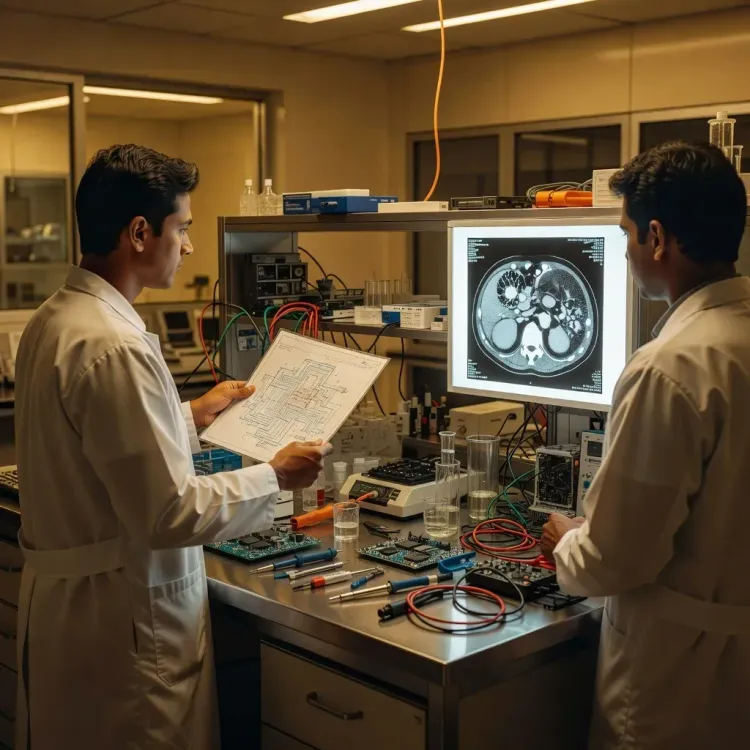
The institute is positioned not as a research outpost but as an active development pipeline. Sarma's post signals three flagship deliverables: a robotic surgical arm, an affordable MRI scanner targeted at smaller district hospitals, and a domestically manufactured insulin pump. Each product addresses a specific gap — surgical precision in under-resourced settings, diagnostic imaging beyond metro hospitals, and affordable chronic-disease management for a country where diabetes affects hundreds of millions.
The scheduled opening is December 2027, though Sarma's framing — 'already delivering' — suggests prototype or early-stage work is already under way. The research background marks specific delivery claims as unverified from established public records, so those details warrant independent confirmation as the institute's official documentation becomes available.
The Atmanirbhar Logic Behind the Lab
India's Production Linked Incentive (PLI) scheme for medical devices, notified in 2020, set the national frame: reduce import dependence on high-value equipment, encourage domestic manufacturing, and bring down per-unit costs. The National Health Policy 2017 had already called for affordable indigenous medical technology and stronger public-private research collaboration. The Assam institute is a state-level answer to both mandates.
The broader pattern across Indian states has been to seed innovation clusters that sit outside established metro R&D institutions — bringing engineering colleges, medical colleges, and device manufacturers into shared physical space. Assam, as a northeastern state historically dependent on equipment supply chains stretching from distant manufacturing centres, stands to gain disproportionately if even one or two of these devices reaches production scale.
Why Small Hospitals Are the Real Target
The sharpest line in Sarma's announcement is the affordable MRI. Full-scale MRI installations cost several crore rupees in capital expenditure alone — a figure that puts the technology out of reach for community health centres and district hospitals serving rural Assam and the broader northeast. An indigenously designed, cost-optimised scanner would not just serve Assam; it would create a replicable template for every resource-constrained public hospital in the country.
Insulin pumps carry a similar argument. Currently dominated by imported devices, the market leaves millions of insulin-dependent patients dependent on costly foreign supply chains. A domestically manufactured alternative could reduce per-device costs significantly and open up a category of diabetes management that is currently inaccessible to most patients outside urban India.
What Still Needs to Be Answered
Key questions trail the announcement: which engineering institutions are formal partners, whether any central PLI funding has been tied to the institute's device pipeline, and what regulatory pathway through the Central Drugs Standard Control Organisation (CDSCO) the devices will follow. Those details will determine whether the institute produces market-ready products or remains a demonstration facility. As Sarma's government moves toward the December 2027 opening, the answers will come — and the northeast will be watching closely.
Point of View
The announcement also reinforces a governance identity built on northeast-first development, countering the narrative that innovation infrastructure only accumulates in metros. The PLI alignment is deliberate; it positions Assam to access central incentives while building a local industrial ecosystem. The credibility test arrives with December 2027: prototype demonstrations versus market-ready, CDSCO-cleared products are very different outcomes, and that distinction will define whether this is a policy landmark or a headline.
NationPress
11 Nov 2026
Frequently Asked Questions
What is the Assam Advanced Healthcare Innovation Institute?
It is a state-initiated interdisciplinary hub announced by Assam CM Himanta Biswa Sarma to develop affordable medical devices — including a robotic surgical arm, an MRI scanner for small hospitals, and an insulin pump — through collaboration between medical and engineering professionals.
When will the Assam Advanced Healthcare Innovation Institute open?
CM Sarma has stated the institute is scheduled to open in December 2027, while also indicating that development work is already under way.
How does this fit with India's Atmanirbhar Bharat push for medical devices?
India's PLI scheme for medical devices, notified in 2020, incentivises domestic manufacturing of high-value equipment like MRI machines. The Assam institute is a state-level initiative that directly mirrors that national self-reliance agenda.
Why is an affordable MRI scanner significant for Assam and northeast India?
Full-scale MRI installations cost several crore rupees, putting them out of reach for most district and community hospitals. A cost-optimised, indigenously designed scanner could bring diagnostic imaging to underserved facilities across the northeast and rural India.
Will the devices developed at the institute be commercially available?
Specific commercialisation plans, regulatory pathways through CDSCO, and industry partnerships have not yet been publicly announced; those details are expected as the institute moves toward its December 2027 launch.