Assam Polls to be Conducted in Single Phase Thanks to Better Infrastructure: CEO Anurag Goel
Synopsis
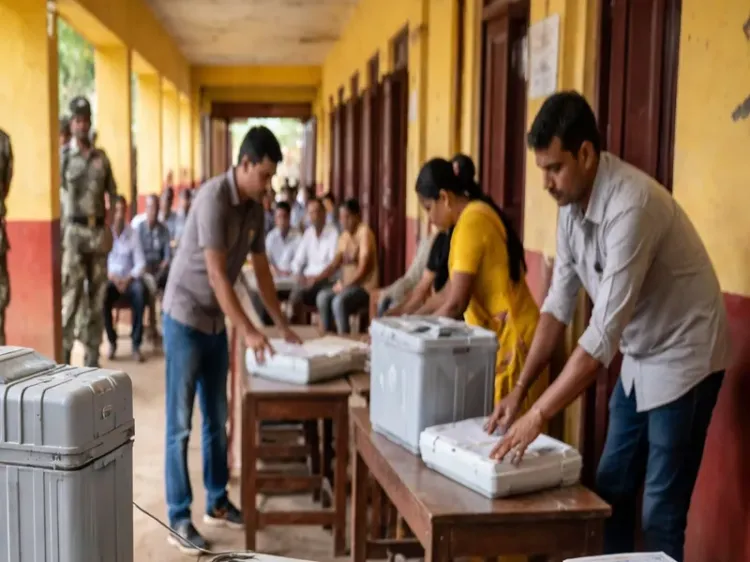
As Assam gears up for its Assembly elections, improved infrastructure and connectivity will allow for a seamless single-phase voting process. CEO Anurag Goel highlights the readiness of authorities and security agencies to ensure free and fair elections on April 9.
Key Takeaways
Single-phase elections: Enabled by improved infrastructure.
Security preparedness: 74,000 police personnel deployed.
Voter demographics: 2.5 crore registered voters in Assam.
Innovative voting: EVMs will feature colored candidate photographs.
Monitoring for peace: Special cell for tracking fake news.
Guwahati, March 16 (NationPress) Enhanced infrastructure and improved connectivity throughout Assam are pivotal in facilitating the upcoming Assembly elections to occur in a single phase, stated Chief Electoral Officer (CEO) Anurag Goel on Monday.
During a press briefing following the Election Commission of India's announcement of the election schedule, Goel emphasized that the improved infrastructure—including upgraded road connectivity, new bridges, and a greater number of public buildings—has bolstered the authorities' confidence in conducting elections across all 126 constituencies on April 9.
“The advancements in infrastructure, along with the availability of buildings and bridges, have fostered our confidence in executing the elections in a single phase,” Goel remarked.
He noted that both civil administration and security agencies are thoroughly prepared to guarantee the smooth execution of the polls.
Inspector General of Police (Law and Order) Akhilesh Kumar Singh, serving as the chief security officer for the elections, mentioned that the law and order situation in Assam has significantly improved over the years.
Singh highlighted that the repeal of the Armed Forces (Special Powers) Act in most areas of the state has played a crucial role in creating a more secure environment.
“Single-phase polling demands extensive planning and logistics. Compared to previous years, both civil and police administrations are now better equipped to facilitate a seamless electoral process,” Singh noted.
For the elections, Assam has requested 828 companies of Central Armed Police Forces (CAPF), with 200 companies having already arrived.
Additionally, over 74,000 personnel from the Assam Police, including home guards, will be assigned to election duties.
Security measures have been reinforced throughout the state, with vigilant monitoring along inter-state and inter-district borders.
Officials reported that 134 border checkpoints have been established, where flying squads and stationary surveillance teams will maintain constant oversight.
Authorities also indicated that international borders will be sealed according to standard election protocols during the polling period.
To uphold law and order, security forces have intensified area domination exercises and confidence-building initiatives to ensure that voters can cast their ballots freely and without intimidation.
Officials are also implementing measures to curb the transportation of illegal liquor and other prohibited materials during the election period.
In a proactive step, the state CID has established a dedicated social media monitoring cell to identify fake news and AI-generated content that could threaten peace during the elections.
A dedicated helpline has been launched for the public to report such incidents.
Goel confirmed that the election notification has been issued following approval from the Governor, officially initiating the electoral process.
As per official data, Assam boasts more than 2.5 crore voters, with the largest demographic being the 20–29 age group, comprising over 66 lakh electors.
The state also has 2,482 centenarian voters and nearly 100,000 individuals above the age of 85, with over six lakh voters aged between 18 and 19.
A total of 31,486 polling stations have been designated across the state, with the CEO’s office requesting four additional auxiliary polling stations.
Dalgaon Assembly constituency has the highest electorate count with over three lakh voters, while Amri has the fewest, with just over one lakh.
More than 1.5 lakh civil polling personnel will be deployed during the election process, along with micro-observers and sector officers.
For the first time in Assam, the ballot papers on Electronic Voting Machines (EVMs) will feature colored photographs of candidates, and comprehensive webcasting will be implemented at polling stations.
Mobile phone deposit facilities will also be accessible at polling stations to ensure the confidentiality of voting.
Point of View
The upcoming Assembly elections in Assam reflect a significant advancement in electoral logistics and infrastructure, showcasing a commitment to facilitating a democratic process. With robust preparations by both civil authorities and security forces, the elections are poised to uphold the integrity and accessibility of voting for over 2.5 crore citizens.
NationPress
29 Sept 2026
Frequently Asked Questions
What is the date for the Assam Assembly elections?
The Assam Assembly elections are scheduled for April 9.
How many voters are registered in Assam?
Assam has more than 2.5 crore registered voters.
What measures are taken for security during the elections?
There will be the deployment of 74,000 Assam Police personnel, along with 828 companies of Central Armed Police Forces.
What is new about the voting process in Assam this year?
For the first time, ballot papers on Electronic Voting Machines will feature colored photographs of candidates.
How is the law and order situation in Assam during the elections?
The law and order situation has improved significantly, contributing to a secure environment for conducting elections.