Assam GI tags: Four products gain recognition with NABARD support

Synopsis
Four of Assam's most culturally rooted products — including the Bihu Pepa bamboo flute and tribal handlooms — have secured GI certification, taking NABARD's Assam tally to 12. The real challenge now shifts from recognition to market access: can the value-chain push actually deliver premium returns to the weavers and craftsmen who need it most?
Key Takeaways
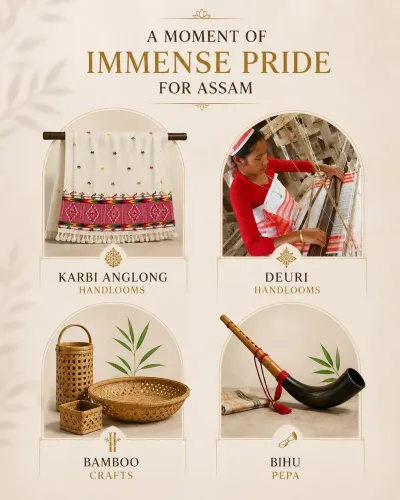
Four Assam products — Karbi Anglong Handloom Products , Assam Bihu Pepa , Assam Bamboo Crafts , and Deuri Handloom Products — have been granted Geographical Indication (GI) status.
The certifications were facilitated by NABARD , which has now supported 12 GI-certified products in Assam.
GI status provides legal protection against unauthorised imitation and is expected to unlock premium pricing and wider market access for artisans.
Loken Das , Chief General Manager of NABARD Assam, said the focus will shift to building a full value chain covering branding, marketing, and enterprise development.
The development is expected to benefit thousands of rural artisans, weavers, and craftsmen across the state.
Four traditional products from Assam have received Geographical Indication (GI) certification from the Geographical Indications Registry of the Government of India, in a development officials described on Sunday, 14 June as a landmark step toward protecting the state's indigenous heritage and strengthening rural livelihoods. The newly tagged products span handloom, craft, and folk-music traditions that are deeply embedded in Assam's tribal and agrarian communities.
The Four Newly GI-Tagged Products
The certifications cover Karbi Anglong Handloom Products, Assam Bihu Pepa, Assam Bamboo Crafts, and Deuri Handloom Products. Together, they represent a cross-section of Assam's living cultural traditions — from the bamboo flute integral to Bihu celebrations to the distinctive weaves of the Karbi Anglong and Deuri communities.
The certification process was facilitated by the National Bank for Agriculture and Rural Development (NABARD), which has been working to advance GI registrations for unique products from the state. With these four additions, the total number of GI-certified products supported by NABARD in Assam has reached 12.
What NABARD Said
Loken Das, Chief General Manager of NABARD Assam, said the recognitions would reinforce the identity and authenticity of these products while expanding their reach in national and international markets.
'These certifications not only strengthen the identity and authenticity of these products but also enhance their market potential at national and international levels. With this achievement, the total number of GI-certified products supported by NABARD has reached 12, marking a significant milestone in promoting heritage-based rural livelihoods,' Das said.
Das also outlined the path ahead, saying NABARD envisions a comprehensive ecosystem-based strategy — moving beyond registration to building a robust value chain encompassing branding, marketing, capacity building, market linkages, and enterprise development.
'The overarching vision is to transform GI-certified products into sustainable, scalable and remunerative livelihood opportunities while preserving Assam's cultural heritage and promoting inclusive rural development,' he added.
Impact on Artisans and Rural Communities
GI certification provides legal protection against unauthorised imitation and misuse — a persistent challenge for handloom and craft producers whose designs are frequently replicated without attribution or compensation. Officials said the recognition is expected to help artisans and weavers secure better market access, premium pricing, and broader visibility for their work.
The development is anticipated to benefit thousands of rural artisans, craftsmen, and weavers across Assam by creating new economic pathways while preserving generational knowledge and traditional skills.
Assam's Expanding GI Portfolio
Assam's cultural economy has been steadily formalised through GI registrations in recent years. The state's handloom sector alone employs a substantial share of its rural workforce, and products like the Bihu Pepa carry both economic and deep cultural significance as symbols of Assamese identity. This is the latest in a series of GI additions that underscore efforts to leverage traditional knowledge as an engine of rural economic development.
Notably, the push aligns with a broader national trend of using GI frameworks to protect indigenous products — from Darjeeling tea to Mysuru silk — and channel premium market value back to origin communities. With NABARD's stated shift toward value-chain development, the real test will be whether artisans can access the markets these certifications unlock.
Point of View
Branding, and pricing power to capture the premium the tag theoretically commands. NABARD's stated pivot toward ecosystem and value-chain development is the right framing, but it will need sustained, measurable follow-through. The inclusion of the Bihu Pepa — a cultural symbol, not just a craft product — also raises the question of how cultural heritage items are commercialised without diluting the very authenticity the GI tag is meant to protect.
NationPress
13 Sept 2026
Frequently Asked Questions
Which four Assam products have received GI tags?
The four newly GI-certified products are Karbi Anglong Handloom Products, Assam Bihu Pepa, Assam Bamboo Crafts, and Deuri Handloom Products. The certifications were granted by the Geographical Indications Registry of the Government of India, with facilitation from NABARD.
What is NABARD's role in Assam's GI certifications?
NABARD has been actively supporting and facilitating the GI registration process for unique products from Assam. With these four additions, the total number of GI-certified products supported by NABARD in the state has reached 12.
How does a GI tag benefit artisans and weavers?
A GI tag provides legal protection against unauthorised imitation and misuse of traditional products. It also helps producers secure better market access, command premium pricing, and gain wider recognition at national and international levels.
What is NABARD's plan after securing the GI certifications?
According to NABARD Chief General Manager Loken Das, the focus will now shift from securing recognition to building a comprehensive value chain covering branding, marketing, capacity building, market linkages, and enterprise development, with the goal of making GI products sustainable livelihood opportunities.
Why is the Bihu Pepa significant among the newly tagged products?
The Bihu Pepa is a traditional bamboo flute central to Assam's Bihu festival, one of the state's most important cultural celebrations. Its GI certification is significant both economically — protecting craftsmen who make it — and culturally, as it formalises the instrument's identity as an authentic Assamese heritage product.