Sonowal hails GI Tags for 4 Assam cultural products
Synopsis
Four Assam products — Karbi Anglong Handlooms, Bihu Pepa, Bamboo Crafts, and Deuri Handlooms — have received GI tags, with Union Minister Sarbananda Sonowal hailing the recognition as a boost for grassroots artisans and indigenous craftsmanship on the global stage.
Key Takeaways
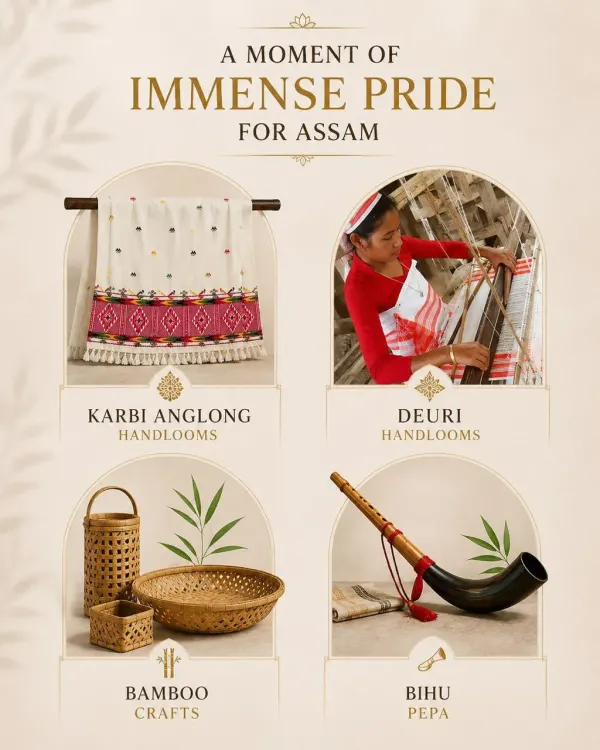
Four new GI tags have been awarded to Assam products: Karbi Anglong Handlooms , Bihu Pepa , Bamboo Crafts , and Deuri Handlooms .
Union Minister Sarbananda Sonowal publicly welcomed the recognition on 15 June 2026 , calling it a moment of immense pride for Assam.
GI protection under the Geographical Indications of Goods Act, 1999 gives artisans legal recourse against counterfeiting and access to premium markets.
Assam has a precedent of GI tags including Muga silk (2007) and Assam Orthodox Tea ; these four add to that heritage portfolio.
The inclusion of Bihu Pepa marks a relatively rare instance of a traditional Indian musical instrument receiving GI status.
The 'Vocal for Local' campaign has been a key policy driver behind accelerated GI filings from northeastern states.
Union Minister of Ports, Shipping and Waterways Sarbananda Sonowal on Monday, 15 June 2026 welcomed the award of Geographical Indication (GI) tags to four products from Assam, calling it 'a moment of immense pride' for the northeastern state. The four newly recognised products are Karbi Anglong Handlooms, Bihu Pepa, Bamboo Crafts, and Deuri Handlooms.
Context
A GI tag is a legal certification granted under the Geographical Indications of Goods (Registration and Protection) Act, 1999, which links a product's identity and quality to its place of origin. For artisans and weavers, the tag is a market credential that deters imitation and can command premium pricing in domestic and export markets. Sonowal, himself a former Chief Minister of Assam, described the recognition as placing the state's 'vibrant cultural heritage on yet another elevated platform.'
The four products span distinct traditions: Karbi Anglong Handlooms originate from the tribal hill district of Karbi Anglong and reflect the weaving heritage of the Karbi community. Bihu Pepa is the iconic wind instrument — a small horn traditionally made from buffalo horn — played during the Bihu festival. Bamboo Crafts represent Assam's extensive tradition of functional and decorative bamboo work, while Deuri Handlooms carry the textile identity of the Deuri indigenous community.
Policy Backdrop
Assam has a well-established history of GI protection for its traditional goods. Muga silk received its GI tag in 2007, followed by Assam Orthodox Tea, both of which set a precedent for safeguarding the state's craft and agricultural heritage. The current batch of four tags continues that trajectory, and notably widens the definition of cultural heritage under GI law by including a musical instrument and bamboo products alongside textiles.
The Union government's 'Vocal for Local' initiative — the hashtag Sonowal used in his post — has been a stated driver behind accelerated GI filings by state governments, weaver cooperatives, and artisan clusters across India. The Northeast in particular has seen a push to formalise traditional knowledge into registrable intellectual property, giving communities legal recourse against counterfeit products.
Stakeholders and Impact
The most direct beneficiaries are the grassroots artisans and weavers of Karbi Anglong and the Deuri community, along with craftspeople working in bamboo and makers of the Bihu Pepa. GI status enables these producers to market their goods under a protected name, access government craft-promotion schemes, and attract buyers in premium retail and export channels. Sonowal extended his 'heartiest congratulations to all involved in their creation.'
Broader stakeholders include state-run handloom corporations, self-help groups, and tourism bodies in Assam, for whom GI-tagged products serve as cultural ambassadors. The recognition of the Bihu Pepa is particularly significant, as it marks one of the relatively rare instances of a traditional musical instrument receiving GI protection in India, signalling an expanding interpretation of what constitutes a region's intellectual and cultural property.
What's Next
Attention will now turn to the establishment of GI enforcement mechanisms in Assam to prevent misuse of the newly granted tags, and to whether other northeastern states will file similar applications for their own craft categories. The inclusion of bamboo crafts and a musical instrument in this round may encourage artisan groups from Nagaland, Manipur, and Meghalaya to pursue GI filings for comparable products. For Assam's weavers and craftspeople, the immediate priority will be leveraging the new tags to access wider markets and government-backed promotion platforms.
Point of View
Particularly in the Northeast where identity politics and economic development intersect sharply. The choice to highlight all four products — spanning textiles, a musical instrument, and bamboo crafts — signals a deliberate effort to frame GI recognition as inclusive of diverse tribal and indigenous communities, not just dominant weaving traditions. As a former Chief Minister of Assam, Sonowal retains strong political equity in the state, and such announcements reinforce his connection to Assamese identity even from a central cabinet role. The widening of GI coverage to instruments and bamboo products also reflects a maturing of India's intellectual property approach to intangible cultural heritage.
NationPress
14 Sept 2026
Frequently Asked Questions
What are the four new GI tags given to Assam products?
The four products are Karbi Anglong Handlooms , Bihu Pepa , Bamboo Crafts , and Deuri Handlooms , all from Assam.
What is a GI tag and why does it matter for artisans?
A GI (Geographical Indication) tag is a legal certification under the Geographical Indications of Goods (Registration and Protection) Act, 1999 that links a product's quality or reputation to its place of origin, protecting artisans from counterfeiting and enabling access to premium markets.
What is the Bihu Pepa and why is its GI tag significant?
The Bihu Pepa is a traditional wind instrument made from buffalo horn, played during Assam's Bihu festival. Its GI tag is notable because it is one of the rare instances of a traditional Indian musical instrument receiving such formal intellectual property protection.
What earlier GI tags does Assam already have?
Assam's earlier GI recognitions include Muga silk , awarded in 2007 , and Assam Orthodox Tea , both of which established a precedent for protecting the state's traditional products.
What did Sarbananda Sonowal say about the new GI tags for Assam?
Sonowal called it 'a moment of immense pride for Assam,' saying the recognition would 'empower grassroots artisans and take indigenous craftsmanship to the global stage,' and extended his 'heartiest congratulations to all involved in their creation.'