Assam CM Office: 900+ Laptops for Rural BC, DigiPay Sakhis
Synopsis
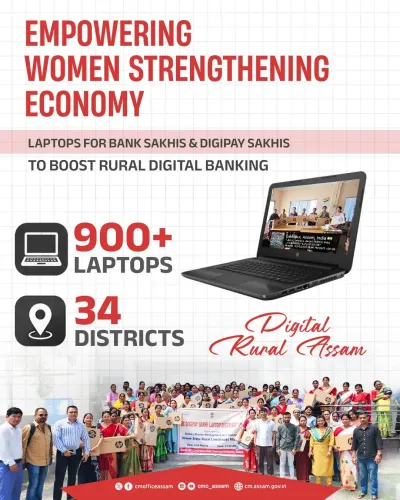
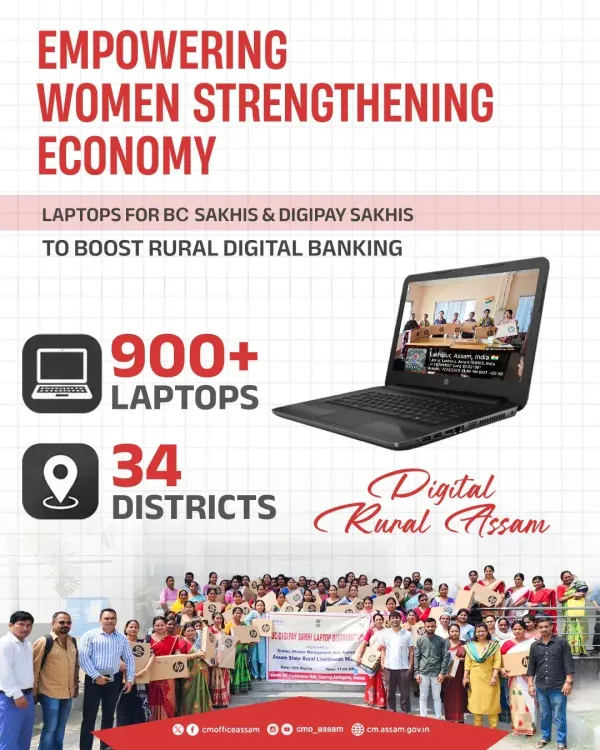
The Assam government has distributed over 900 laptops to BC Sakhis and DigiPay Sakhis across 34 districts, deepening rural digital banking access under CM Dr. Himanta Biswa Sarma. The move builds on India's Business Correspondent model and Digital India framework, empowering women as last-mile financial service providers in the state's villages.
Key Takeaways
Over 900 laptops have been distributed to BC Sakhis and DigiPay Sakhis across 34 of Assam's 35 districts .
The initiative aims to deliver doorstep banking and digital financial services to rural households in Assam.
The programme is framed as an women's empowerment measure, positioning Sakhis as micro-entrepreneurs earning commissions on transactions.
The drive builds on national frameworks including Pradhan Mantri Jan Dhan Yojana (2014) and Digital India (2015) .
Himanta Biswa Sarma , in office since May 2021 , has championed multiple digital and financial inclusion programmes for Assam's large rural population.
Independent assessments of transaction volumes and on-ground impact of the Sakhi network are yet to be published.
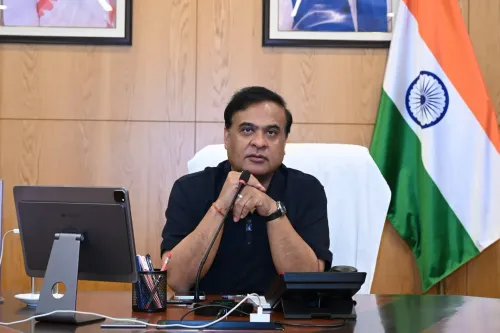
The Chief Minister's Office of Assam announced on Wednesday, June 10, 2026, that the state government has distributed over 900 laptops to BC Sakhis and DigiPay Sakhis across 34 districts to strengthen last-mile digital banking access in rural areas under the leadership of Chief Minister Dr. Himanta Biswa Sarma.
Context
The CMO's post states that 'digital financial inclusion in rural Assam is being strengthened under State Government initiatives through doorstep banking and digital service delivery.' The laptop distribution is positioned as a direct enabler for women serving as banking correspondents in villages, bringing formal financial services to households that lack easy access to brick-and-mortar bank branches.
BC Sakhis and DigiPay Sakhis are women-led banking correspondents deployed to deliver doorstep financial services — from account opening and cash withdrawals to digital payment facilitation — in remote and underserved rural pockets.
Policy Backdrop
The initiative sits within a layered policy architecture that dates to the launch of the Pradhan Mantri Jan Dhan Yojana in 2014, which aimed to provide universal access to banking services across India. That was followed by the Digital India programme in 2015, which sought to expand digital infrastructure and e-governance delivery to the last mile.
Northeastern states, including Assam, have consistently received focused central and state support to close geographic gaps in banking penetration. The Business Correspondent model — placing trained local agents, often women, as proxies for bank branches — has been a central pillar of this strategy. Post-2020, the acceleration of digital service delivery has reinforced the model's relevance across multiple state-level programmes.
Under Dr. Himanta Biswa Sarma, who has served as Chief Minister since May 2021, Assam has pursued several digital and financial inclusion drives targeting its large rural population. The current laptop distribution extends that trajectory by equipping Sakhis with hardware to process transactions and deliver services more efficiently at the village level.
Stakeholders and Impact
The primary beneficiaries are twofold: the BC Sakhis and DigiPay Sakhis themselves, who gain productive assets that expand their capacity as micro-entrepreneurs, and the rural households they serve, who gain more reliable access to banking and digital payment services without travelling to distant branches.
Women entrepreneurs operating as Sakhis occupy a dual role — they are both the delivery agents and the economic beneficiaries of the programme, receiving commissions on transactions. Equipping them with laptops is expected to increase the range and volume of services they can offer, from insurance enrolment to pension disbursement.
Assam has 35 districts in total; the stated coverage of 34 districts suggests near-statewide reach for the current distribution round, though independent assessments of actual transaction volumes generated by these agents remain to be published.
What's Next
Observers will watch whether the state follows this hardware push with training and connectivity support to ensure Sakhis in low-network areas can fully utilise the devices. State budget allocations for scaling the programme further, and any third-party assessments of its on-ground impact, will be key indicators of the initiative's depth.
The broader question is whether the model can sustain itself through commission-based incentives alone or will require continued state subsidy — a tension that has defined the Business Correspondent model nationally since its inception.
Point of View
Device access, and agent attrition. By anchoring the announcement to women's empowerment, the Assam government aligns with a politically resonant national narrative while also addressing a genuine operational bottleneck. The near-statewide coverage of 34 districts signals ambition, but the durability of the model will depend on whether transaction volumes justify the commission economics for Sakhis in low-density villages. This move is consistent with CM Sarma's pattern of high-visibility welfare announcements that double as governance metrics ahead of electoral cycles.
NationPress
21 Sept 2026
Frequently Asked Questions
What are BC Sakhis and DigiPay Sakhis in Assam?
BC Sakhis and DigiPay Sakhis are women trained and deployed as banking correspondents to deliver doorstep financial services — such as account access, cash transactions, and digital payments — in rural villages where bank branches are scarce.
How many laptops has the Assam government given to Sakhis?
The Assam government has provided over 900 laptops to BC Sakhis and DigiPay Sakhis, distributed across 34 districts of the state to support digital banking delivery at the village level.
What is the connection between DigiPay Sakhi and Digital India?
The DigiPay Sakhi initiative operates within the broader Digital India framework launched in 2015, which aims to expand digital infrastructure and e-service delivery across India, with particular focus on rural and underserved areas.
Who is overseeing Assam's rural digital banking programme?
The programme is being implemented under the leadership of Chief Minister Dr. Himanta Biswa Sarma, who has been in office since May 2021 and has prioritised digital and financial inclusion as part of the state government's development agenda.
How does Assam's Sakhi model relate to Jan Dhan Yojana?
The Sakhi model builds on the foundation of Pradhan Mantri Jan Dhan Yojana, launched in 2014 to provide universal banking access in India. Sakhis act as human touchpoints to activate and service Jan Dhan and other accounts in villages that lack physical bank infrastructure.