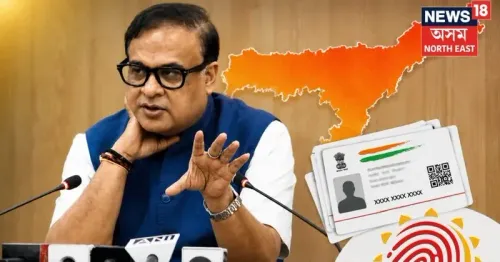
Assam Police becomes Northeast's first UIDAI offline verifier

Synopsis
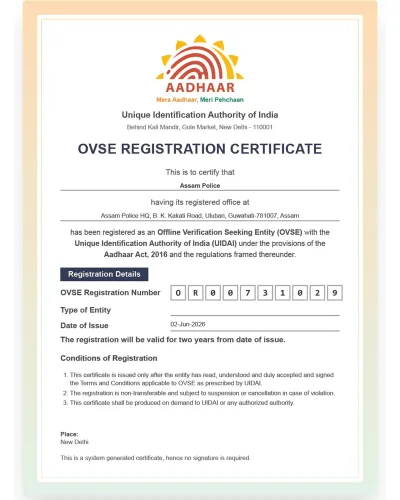
Assam Police has become the first law-enforcement agency in Northeast India to be registered as a UIDAI offline verification entity, enabling paperless, consent-based Aadhaar identity checks without transmitting data to central servers, the Chief Minister's Office of Assam announced on 18 July 2026.
Key Takeaways
Assam Police is now the first agency in Northeast India registered by UIDAI as an offline verification entity.
The registration was announced by the Chief Minister's Office of Assam on 18 July 2026 .
Offline verification under the Aadhaar Act, 2016 allows identity checks without transmitting biometric data to central servers.
The move enables paperless, consent-based identity verification suited to low-connectivity environments in the Northeast.
Other northeastern states may now seek similar UIDAI registrations, with Assam's rollout serving as a regional model.
The Chief Minister's Office of Assam announced on Saturday, 18 July 2026 that Assam Police has become the first law-enforcement agency in Northeast India to be registered as an offline verification entity by the Unique Identification Authority of India (UIDAI), marking a significant step in the region's digital-governance journey.
Context
UIDAI, the statutory authority established under the Aadhaar (Targeted Delivery of Financial and Other Subsidies, Benefits and Services) Act, 2016, has the mandate to authorise agencies as offline verification entities. Unlike online authentication, offline verification allows an agency to confirm a person's identity using Aadhaar-based cryptographic tools without transmitting biometric or demographic data to central servers, preserving privacy while enabling paperless checks.
Assam Police's registration places it in a category that until now had no representative from any of the eight northeastern states, according to the CMO's announcement. The move signals that frontier and sensitive-border states are now being brought into the UIDAI's consent-based verification framework.
Policy Backdrop
The Digital India programme has progressively pushed Aadhaar-linked tools into law-enforcement and citizen-service workflows since the mid-2010s. Indian states have incrementally registered police departments and other agencies as UIDAI offline verification entities to enable identity checks that are faster, paperless, and less susceptible to document forgery.
Offline verification is designed to work even in low-connectivity environments — a critical feature for a region like Northeast India, where terrain and infrastructure gaps have historically limited real-time digital transactions. The Aadhaar Act, 2016 provides the legal basis under which UIDAI issues such authorisations to state agencies.
Stakeholders and Impact
Assam's residents stand to benefit from faster, consent-based identity verification during police interactions, reducing dependence on physical documents. For the state police, the registration opens the door to streamlined processes in areas such as tenant verification, character-certificate issuance, and suspect identification — all without routing sensitive data through external networks.
The development is also significant for Assam Police as an institution, as it formalises the force's role in the national digital-identity ecosystem. Civil-liberties advocates and privacy researchers will likely watch how the offline verification tool is deployed in practice, particularly given Assam's history of complex citizenship-related proceedings under the National Register of Citizens (NRC) process.
What's Next
The key question now is whether neighbouring states — Meghalaya, Manipur, Nagaland, Tripura, Mizoram, Arunachal Pradesh, and Sikkim — will seek similar UIDAI registrations, potentially creating a region-wide offline verification network. How Assam Police integrates this facility into its day-to-day verification workflows will serve as a template for other northeastern forces.
If Assam's rollout proceeds smoothly, it could accelerate UIDAI's push to expand offline verification capacity across India's border states, where identity management has direct national-security implications.
Point of View
Where reliable, consent-based identity verification carries both administrative and political weight. By being the first mover in the Northeast, the Assam government is positioning itself as a digital-governance leader in the region, likely creating pressure on neighbouring states to follow. The broader arc points toward UIDAI progressively tightening the integration of offline Aadhaar tools into state law-enforcement machinery across India's border states.
NationPress
16 Oct 2026
Frequently Asked Questions
What does it mean for Assam Police to be a UIDAI offline verification entity?
It means Assam Police is now authorised by UIDAI to verify a person's Aadhaar-based identity offline — without sending biometric or personal data to central servers — using cryptographic tools that work even in low-connectivity areas.
Is Assam Police the first police force in India to get UIDAI offline verification status?
The Chief Minister's Office of Assam announced it is the first in Northeast India . Whether it is the first police force nationally has not been specified in the announcement.
What is UIDAI and what law governs it?
UIDAI is the Unique Identification Authority of India , a statutory body established under the Aadhaar (Targeted Delivery of Financial and Other Subsidies, Benefits and Services) Act, 2016 , responsible for issuing Aadhaar numbers and regulating verification services.
How will this benefit ordinary residents of Assam?
Residents can expect faster, paperless identity checks during police interactions — such as tenant verification or character-certificate issuance — without needing to carry physical documents or having their data routed through external networks.
Will other Northeast states get similar UIDAI registration?
That remains to be seen. Assam's registration is expected to serve as a template, and it is likely other northeastern states will explore similar UIDAI authorisations for their police forces.