CM Himanta Flags Assam's 94% School Toilet Coverage
Synopsis
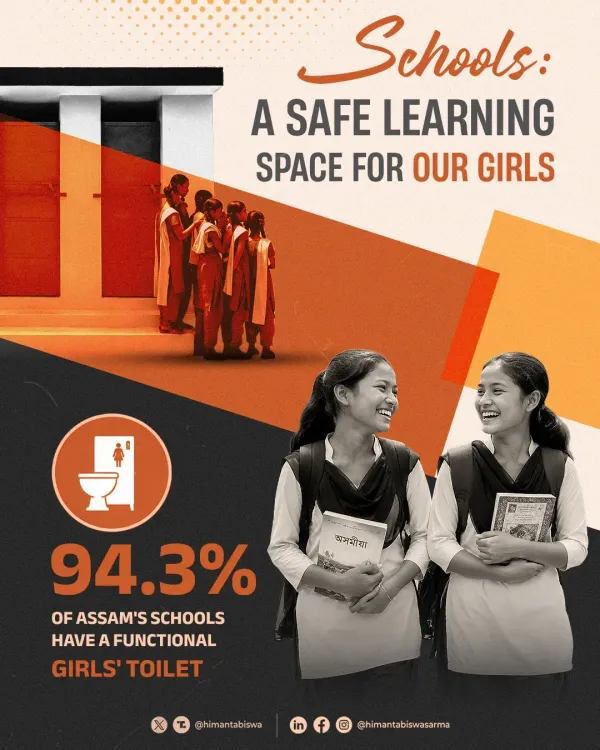
Assam Chief Minister Himanta Biswa Sarma has cited state data showing 94.3% of schools have separate girls' toilets and 93.6% for boys, crediting PM Modi's Independence Day directive from the Red Fort as the policy trigger for the mission-mode push.
Key Takeaways
94.3% of schools in Assam now have separate toilets for girls, according to CM Himanta Biswa Sarma.
93.6% of schools have separate toilet facilities for boys.
The drive was anchored to PM Narendra Modi's Independence Day address from the Red Fort , where he called for separate girls' toilets in schools.
The Swachh Bharat Mission , launched in October 2014 , provided the national framework for school toilet construction.
Coverage data is tracked through the UDISE+ system; independent verification via the next UDISE+ or ASER report is awaited.
Functional maintenance of existing infrastructure remains a key concern flagged in national-level audits of school sanitation.
Assam Chief Minister Himanta Biswa Sarma on Saturday, 6 June 2026, highlighted the state's progress on school sanitation infrastructure, citing that 94.3% of Assam's schools now have separate toilets for girls and 93.6% for boys — figures he attributed to years of mission-mode implementation following a call made by Prime Minister Narendra Modi from the ramparts of the Red Fort.
Context
Sarma's post quoted PM Modi's Independence Day address, in which the Prime Minister had declared, 'There should be separate toilets for girls' — a directive that became a foundational plank of the national school sanitation drive. The Chief Minister framed Assam's current coverage numbers as a direct fulfilment of that call, describing the state's approach as 'mission mode' execution over several years.
The 15 August 2014 Red Fort address is widely regarded as the moment that placed school toilet construction at the centre of national education and sanitation policy, linking girls' access to safe facilities directly to enrolment and retention outcomes.
Policy Backdrop
The Swachh Bharat Mission, launched in October 2014, embedded school toilet targets within a broader national sanitation framework. The scheme explicitly prioritised gender-sensitive infrastructure, recognising that the absence of separate facilities for girls was a leading driver of female dropout rates in rural and semi-urban schools.
States have since reported school-level coverage through the Unified District Information System for Education (UDISE+), which tracks infrastructure alongside enrolment and learning outcomes. Assam's reported figures — 94.3% for girls and 93.6% for boys — place the state among those claiming near-saturation coverage under the mission's monitoring framework.
The broader national pattern has consistently linked improved sanitation infrastructure to measurable gains in female literacy and reduced absenteeism, particularly at the primary and upper-primary levels.
Stakeholders and Impact
The most direct beneficiaries of this infrastructure push are school-going girls and boys across Assam, particularly in rural districts where the absence of toilets historically forced families — especially those with daughters — to withdraw children from school. Improved facilities are associated with greater parental confidence in sending girls to school and with reduced health risks linked to open defecation.
For the BJP government in Assam, the data point serves as a visible metric of governance delivery, connecting state-level execution to a nationally recognised policy directive from the Prime Minister. The North-East Democratic Alliance (NEDA), which Sarma convenes, has frequently highlighted such development indicators as evidence of the BJP-led governance model's effectiveness across the region.
What's Next
The next credibility test for these figures will come with the release of updated UDISE+ or ASER (Annual Status of Education Report) data, which independently assess school facilities and learning outcomes. Analysts and civil society groups are likely to scrutinise not just coverage numbers but the functional status and maintenance of existing toilet infrastructure — a distinction that national audits have previously flagged as a gap between construction and usability.
Any fresh state budget allocations for toilet maintenance and hygiene promotion in Assam's schools will signal whether the government's commitment extends beyond headline coverage figures to long-term operational upkeep.
Point of View
Thereby reinforcing both the Centre-state alignment narrative and the BJP's development record in the Northeast. The choice of a Modi quote as the anchor elevates what could have been a routine administrative update into a statement of political continuity. However, the post's impact will depend on independent data validation; national audits have repeatedly shown a gap between toilet construction figures and the functional, maintained use of those facilities. If upcoming UDISE+ or ASER reports corroborate Assam's numbers, it strengthens the state's claim as a model for mission-mode execution; if they reveal shortfalls in usability, the headline figures risk becoming a liability.
NationPress
26 Sept 2026
Frequently Asked Questions
What percentage of Assam schools have separate toilets for girls?
According to Assam Chief Minister Himanta Biswa Sarma, 94.3% of schools in the state have separate toilet facilities for girls as of his June 2026 statement.
What did PM Modi say about girls' toilets in schools?
PM Narendra Modi called for separate toilets for girls in schools during his Independence Day address from the Red Fort , a directive that became central to the Swachh Bharat Mission's school sanitation targets.
What is the Swachh Bharat Mission's role in school sanitation?
The Swachh Bharat Mission , launched in October 2014 , included explicit targets for building toilets in schools — particularly separate facilities for girls — as a strategy to improve enrolment, retention, and hygiene outcomes.
How is school toilet coverage in India measured?
School infrastructure data, including toilet coverage, is tracked through the Unified District Information System for Education (UDISE+) , an annual government survey, and independently assessed by reports such as the ASER .
Why are separate toilets for girls in schools important?
The absence of separate toilet facilities for girls is a documented driver of female school dropout rates in India. Providing gender-specific facilities improves safety, hygiene, and parental willingness to keep daughters enrolled.